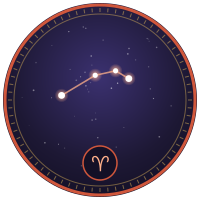
 ♈︎ Aries
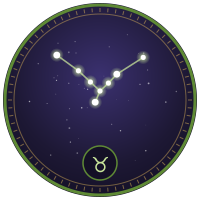 ♉︎ Taurus
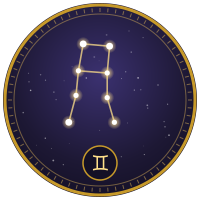 ♊︎ Gemini
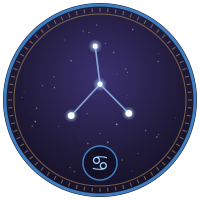 ♋︎ Cancer
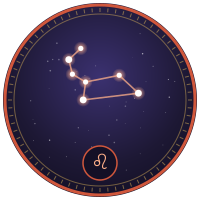 ♌︎ Leo
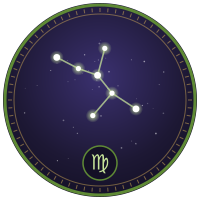 ♍︎ Virgo
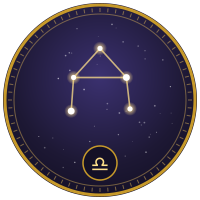 ♎︎ Libra
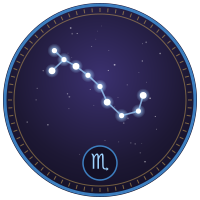 ♏︎ Scorpio
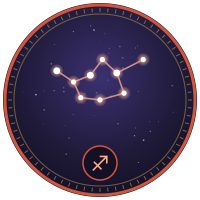 ♐︎ Sagittarius
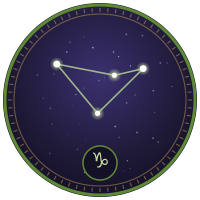 ♑︎ Capricorn
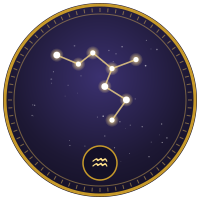 ♒︎ Aquarius
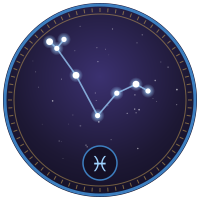 ♓︎ Pisces
Zodiac signs: dates, symbols, elements and rulers
| Glyph | Sign | Symbol | Dates | Element | Modality | Ruler |
|---|---|---|---|---|---|---|
| ♈︎ | Aries | Ram | Mar 21 to Apr 19 | Fire | Cardinal | Mars |
| ♉︎ | Taurus | Bull | Apr 20 to May 20 | Earth | Fixed | Venus |
| ♊︎ | Gemini | Twins | May 21 to Jun 20 | Air | Mutable | Mercury |
| ♋︎ | Cancer | Crab | Jun 21 to Jul 22 | Water | Cardinal | Moon |
| ♌︎ | Leo | Lion | Jul 23 to Aug 22 | Fire | Fixed | Sun |
| ♍︎ | Virgo | Maiden | Aug 23 to Sep 22 | Earth | Mutable | Mercury |
| ♎︎ | Libra | Scales | Sep 23 to Oct 22 | Air | Cardinal | Venus |
| ♏︎ | Scorpio | Scorpion | Oct 23 to Nov 21 | Water | Fixed | Mars (modern: Pluto) |
| ♐︎ | Sagittarius | Archer | Nov 22 to Dec 21 | Fire | Mutable | Jupiter |
| ♑︎ | Capricorn | Sea-Goat | Dec 22 to Jan 19 | Earth | Cardinal | Saturn |
| ♒︎ | Aquarius | Water-Bearer | Jan 20 to Feb 18 | Air | Fixed | Saturn (modern: Uranus) |
| ♓︎ | Pisces | Fish | Feb 19 to Mar 20 | Water | Mutable | Jupiter (modern: Neptune) |
Zodiac signs by month
- What zodiac sign is January?
- January zodiac sign: Capricorn until January 19, Aquarius from January 20. In 2026 the Sun enters Aquarius on January 20 at 01:44 UTC.
- What zodiac sign is February?
- February zodiac sign: Aquarius until February 18, Pisces from February 19. In 2026 the Sun enters Pisces on February 18 at 15:51 UTC.
- What zodiac sign is March?
- March zodiac sign: Pisces until March 20, Aries from March 21. In 2026 the Sun enters Aries on March 20 at 14:45 UTC.
- What zodiac sign is April?
- April zodiac sign: Aries until April 19, Taurus from April 20. In 2026 the Sun enters Taurus on April 20 at 01:39 UTC.
- What zodiac sign is May?
- May zodiac sign: Taurus until May 20, Gemini from May 21. In 2026 the Sun enters Gemini on May 21 at 00:37 UTC.
- What zodiac sign is June?
- June zodiac sign: Gemini until June 20, Cancer from June 21. In 2026 the Sun enters Cancer on June 21 at 08:25 UTC.
- What zodiac sign is July?
- July zodiac sign: Cancer until July 22, Leo from July 23. In 2026 the Sun enters Leo on July 22 at 19:13 UTC.
- What zodiac sign is August?
- August zodiac sign: Leo until August 22, Virgo from August 23. In 2026 the Sun enters Virgo on August 23 at 02:19 UTC.
- What zodiac sign is September?
- September zodiac sign: Virgo until September 22, Libra from September 23. In 2026 the Sun enters Libra on September 23 at 00:05 UTC.
- What zodiac sign is October?
- October zodiac sign: Libra until October 22, Scorpio from October 23. In 2026 the Sun enters Scorpio on October 23 at 09:38 UTC.
- What zodiac sign is November?
- November zodiac sign: Scorpio until November 21, Sagittarius from November 22. In 2026 the Sun enters Sagittarius on November 22 at 07:23 UTC.
- What zodiac sign is December?
- December zodiac sign: Sagittarius until December 21, Capricorn from December 22. In 2026 the Sun enters Capricorn on December 21 at 20:50 UTC.
The four elements at a glance
- The fire signs (zodiac signs 1, 5 and 9): Aries, Leo, Sagittarius
- The earth signs (zodiac signs 2, 6 and 10): Taurus, Virgo, Capricorn
- The air signs (zodiac signs 3, 7 and 11): Gemini, Libra, Aquarius
- The water signs (zodiac signs 4, 8 and 12): Cancer, Scorpio, Pisces
What is a zodiac sign?
Picture the sky as a backdrop and the Sun as a marker that slides across it over a year. That path is called the ecliptic. Astrologers cut it into twelve equal slices of 30 degrees each, and each slice is a zodiac sign. Counting begins at the March equinox, when the Sun moves from south to north of the celestial equator, and that point is defined as 0 degrees Aries. Each further 30 degrees opens a new sign, so Taurus starts at 30, Gemini at 60, continuing all the way around.
This scheme is called the tropical zodiac. Western astrology uses it, and so does every NatalCalc calculator. Because it is pinned to the equinoxes and solstices, the signs stay tied to the seasons: Aries always opens northern spring, Cancer begins at the June solstice, Libra at the September equinox and Capricorn at the December solstice. The twelve astrological signs, in other words, are a calendar of the Sun's year rather than a map of the stars behind it.
The star patterns that lent the signs their names are another matter. They come in very uneven sizes, with official borders set by the International Astronomical Union. NatalCalc worked out when the Sun crossed them in 2026: it stood in front of Virgo from Sep 17 to Oct 31, but in front of Scorpius only from Nov 23 to Nov 30, and from Nov 30 to Dec 18 it passed through Ophiuchus, a constellation that has never been one of the astrology signs. Ophiuchus is real sky, not a thirteenth sign of the tropical zodiac.
Why the mismatch? Earth's spin axis traces a slow circle, a motion called precession, and that motion drags the equinox point backward along the ring of constellations. When the system was laid out in antiquity, signs and star patterns roughly agreed. Since then the constellations have drifted by about a month against the calendar, so during 2026 the Sun sat in front of the stars of Pisces for nearly all of the dates astrologers call Aries. Sidereal astrology, used in the Indian tradition, follows the stars instead and often places a person's Sun one sign earlier.
The zodiac signs in order, and why Aries comes first
Here are the zodiac signs in order, following the Sun through the year: Aries, Taurus, Gemini, Cancer, Leo, Virgo, Libra, Scorpio, Sagittarius, Capricorn, Aquarius and Pisces. The sequence never changes. It runs in the direction the Sun appears to move against the background stars, which is also the direction the Moon and planets usually travel, so a planet leaving Gemini enters Cancer next unless it turns retrograde first.
Aries leads because its first degree is the March equinox, the doorway to northern spring, where the system took shape. Several ancient calendars began their year near that point, when days start to outlast nights. A circle needs a zero somewhere, and the season of new growth was the obvious place to put it. That placement is also why Pisces, at the end of the list, is often described in the tradition as a closing chapter that loops back into a fresh start.
The order hides a tidy pattern. Elements repeat as fire, earth, air, water, three times around the wheel, while modalities repeat as cardinal, fixed, mutable, four times around. As a result, no two neighboring signs share an element or a modality, and each sign owns a combination nobody else has. Aries is the only cardinal fire sign, Taurus the only fixed earth sign, Gemini the only mutable air sign, and the pattern holds all the way to Pisces.
Zodiac dates and why they shift by a day
The zodiac dates printed in magazines, such as March 21 through April 19 for Aries, are conventions. In any real year the Sun enters each sign at one precise minute, and that minute wanders. The calendar year and the Sun's seasonal cycle do not divide evenly, so the entry time creeps later for a few years in a row and then jumps back after a leap day. The result is a change day that can sit on either of two, sometimes three, calendar dates.
NatalCalc checked all 101 years from 1950 through 2050 in UTC. For Aries the split was 2 years on March 19, 77 on March 20 and 22 on March 21. For Cancer it was 14 years on June 20, 80 on June 21 and 7 on June 22. Seven signs only ever swing between two neighboring days: Taurus, Gemini, Leo, Virgo, Libra, Capricorn and Pisces. The other five, like Aries and Cancer, can land on three.
Clocks complicate things further. The Sun changes sign at a single instant for the whole planet, but the local date of that instant depends on where you are. Across the US, clocks sit 4 to 8 hours behind UTC, which means a sign change in the first hours of a UTC day lands on the evening before for anyone in New York, Denver or Los Angeles. Anyone born right on one of these zodiac sign dates needs three details to be sure: year, hour and birthplace. There is no blend between two signs: at any moment the Sun occupies exactly one.
Fire signs, earth signs, air signs and water signs
Every sign is assigned an element, one of four borrowed from the old Greek idea of basic substances. In astrology the elements sketch temperament in broad strokes. Fire and air form the active, outgoing pair, given the old labels masculine and yang, while earth and water form the receptive pair, given feminine and yin. Those labels describe a style of energy, not anyone's gender.
Fire covers Aries, Leo and Sagittarius. The tradition pictures these signs as warm, direct and quick to act: the friend who books the cabin while the rest of the group is still comparing listings. Aries brings the spark, Leo the steady glow, and Sagittarius the itch to see what lies past the next hill. Their usual friction point is patience, since waiting rarely feels like a plan to a fire sign.
Earth covers Taurus, Virgo and Capricorn, linked with patience, the senses and practical results. Think of the person who packs a spare phone charger for the picnic and quietly levels the wobbly table with a folded napkin. Taurus builds comfort, Virgo refines the details, and Capricorn plans for the long haul. Earth signs tend to trust what they can touch, count or test.
Air covers Gemini, Libra and Aquarius, the communicators of the wheel. Air signs are tied to ideas, conversation and social connection, the people who keep the group chat alive and can argue either side of a question just to see where it goes. Gemini gathers information, Libra weighs it, and Aquarius asks how it might work better for everyone.
Water covers Cancer, Scorpio and Pisces, linked with feeling, memory and intuition. Water signs often sense the mood of a room before a word is said, notice who went quiet at dinner, and remember how a moment felt long after the details blur. Cancer protects its people, Scorpio commits fully or keeps its distance, and Pisces lets the edges between itself and others soften.
Cardinal, fixed and mutable: the three modalities
Modality, also called quality or mode, describes how a sign meets change. The cardinal group is made of two opposite pairs, Aries and Libra, Cancer and Capricorn, and each of the four opens a season north of the equator: spring, summer, autumn and winter. They are the initiators, the ones who start the project, send the first text after an argument or call the meeting nobody else wanted to schedule.
The fixed group, Taurus and Scorpio, Leo and Aquarius, falls mid-season, once the weather has settled in. These signs are linked with persistence and loyalty, and with a reluctance to change course after a decision is made. The mutable group, Gemini and Sagittarius, Virgo and Pisces, closes the seasons as one gives way to the next. They adapt, edit and improvise, which makes them flexible and, at times, hard to pin down to a plan.
Element and modality together give each sign its signature. Leo is fixed fire, a flame that keeps burning in one hearth; Sagittarius is mutable fire, a flame that leaps to the next field. Cancer and Scorpio both belong to water, but Cancer tends to start things and Scorpio tends to hold on to them. Reading the two together explains a lot of the differences between signs that share an element.
Ruling planets, traditional and modern
Every sign has a ruling planet, the body said to express that sign's themes most naturally. The traditional scheme uses only the seven bodies visible without a telescope. Leo belongs to the Sun and Cancer to the Moon, while each of the other five takes two signs: Mercury rules Gemini and Virgo, Venus rules Taurus and Libra, Mars rules Aries and Scorpio, Jupiter rules Sagittarius and Pisces, and Saturn rules Capricorn and Aquarius.
After Uranus, Neptune and Pluto were discovered, many astrologers assigned them signs as well. Uranus became the modern co-ruler of Aquarius, Neptune of Pisces and Pluto of Scorpio. Some practitioners use only the traditional rulers, some prefer the modern ones, and plenty mention both. This page names both wherever a sign has two, so you can follow whichever school you like.
Rulership matters most once you look at a whole birth chart. With Gemini rising, for instance, an astrologer checks where Mercury sits in your chart to see how that quick first impression plays out in daily life. Rulers link signs to planets and planets to houses, which is how a chart becomes a connected story instead of a list of placements.
Zodiac symbols and glyphs
Each sign has a symbol, the figure it is named for, and a glyph, the small mark used in charts and calendars. Eleven of the zodiac symbols are people or animals, real or mythical, from the Ram to the centaur Archer and the Sea-Goat. Libra's Scales are the only object. Aquarius carries its own quirk: the Water-Bearer pours from a jar, yet the sign belongs to air.
Where the glyphs came from is partly guesswork, and historians do not agree on every one. The usual readings are pictorial. The Aries mark resembles a pair of curling horns, Taurus a round head topped with horns, Gemini two figures standing side by side, and Leo a mane or a looping tail. Scorpio is often read as a letter-like shape that ends in a stinger, Sagittarius as an arrow, and Pisces as two arcs tied by a line, matching the two fish joined by a cord.
Others are harder to decode. The Cancer mark consists of two curls, said by some to be claws and by others to be the waxing and waning Moon, Cancer's ruler. Virgo and Scorpio share a similar base and differ in the final stroke. The Libra mark is seen by some as scales viewed from the side and by others as a sunset, half a disk resting on a line, a neat fit for the autumn equinox. Capricorn's loop is often traced to the Sea-Goat's fish tail, and Aquarius shows two wavy lines that may stand for water or for currents of air. Many of these shapes changed over the centuries, which is one reason their origins stay debated.
Star signs, Sun signs, Moon signs and rising signs
Star signs and zodiac signs mean the same thing in everyday speech; star sign is simply the more common phrase in British English. Both usually refer to your Sun sign, the sign the Sun was passing through at your birth. That is the sign behind every horoscope column, and it is what someone means at a party when they ask what your sign is.
Your chart holds far more than that. The Moon needs only about 2.5 days to cross a sign, which is why a Moon sign can hinge on the hour of birth. The rising sign, also called the Ascendant, is whichever sign was climbing above the eastern horizon at that minute, and a new one rises roughly every two hours, so it calls for an accurate time and place. Sun, Moon and Ascendant together are often nicknamed the big three.
A handy shorthand: the Sun describes core identity and purpose, the Moon emotional needs and comfort habits, the Ascendant your manner with new people and new rooms. Two friends who share a Sun sign can feel strikingly different once these other placements come into view, which is why astrologers rarely stop at the Sun.
How to find your zodiac sign
For most birthdays, the table on this page settles it: find the date range that contains your birthday and read across. If you were born within a day of a sign change, open the Sun sign calculator and give it your birthday, birth hour and birthplace. It computes the Sun's exact position for that moment and reports which sign the Sun had reached, something no fixed date range can do.
To go further, the birth chart calculator places every planet in its sign and house, and the big three calculator picks out the Sun, Moon and Ascendant in one step. All of them run in your browser, so your birth details stay on your own device. The month-by-month list on this page is a quick way to check a friend's sign when all you know is the month.
Frequently asked questions
What are the 12 zodiac signs in order?
The order begins with Aries, which starts around March 21 at the March equinox, then runs through Taurus, Gemini, Cancer, Leo, Virgo, Libra, Scorpio, Sagittarius, Capricorn and Aquarius, and ends with Pisces, which closes the cycle around March 20. The table on this page gives each sign's usual date range. In any particular year the exact change can move by a day, depending on the year and your time zone.
What are the water signs?
Cancer, Scorpio and Pisces. Cancer is cardinal water, Scorpio fixed water and Pisces mutable water, so the three share an emotional, intuitive temperament but show it in different ways: Cancer by looking after people, Scorpio by committing fully, and Pisces by absorbing the mood around it. Traditionally they are receptive, or yin, signs, and earth is the element usually paired with them as a good match.
What are the fire signs?
Aries, Leo and Sagittarius. All three are linked with enthusiasm, courage and a taste for action, and they count as active, or yang, signs in the tradition. Aries is cardinal and likes to start things, Leo is fixed and likes to keep a flame going, and Sagittarius is mutable and likes to chase the next horizon. Fire is usually paired with air, which in the old metaphor feeds the flame.
What are the air signs?
Gemini, Libra and Aquarius. Air signs are associated with thinking, talking and connecting people and ideas. Gemini is mutable and curious, Libra is cardinal and diplomatic, and Aquarius is fixed and independent-minded. Aquarius surprises many readers because its symbol is the Water-Bearer, but it belongs to air: the jar is part of the picture, not the element. Air is traditionally paired with fire.
Which zodiac sign has the most days?
Cancer. NatalCalc's figures for 2026 give 31.45 days for Cancer, the longest stay of any sign, and 29.44 days for Capricorn, the shortest. The signs are equal in size, 30 degrees each, but Earth's orbit is slightly oval. Earth moves slowest around early July, which stretches the Sun's time in Cancer, and fastest around early January, which shortens its time in Capricorn.
Are star signs and zodiac signs the same?
Yes, in everyday use. Both terms mean the twelve signs of the zodiac, and when someone asks for your star sign they usually mean your Sun sign. The confusion comes from the name: because of precession, the signs no longer line up with the star patterns they were named after. Your sign tells you where the Sun was in the seasonal cycle, not which constellation stood behind it.
 Sun sign calculator
 Horoscopes 2027
 Moon phase today