What the Ace of Cups means
An ace is a seed. It carries the whole nature of its suit in the smallest, purest form, before any story has grown around it. For Cups, the suit of emotion, intuition and connection, the seed is a feeling that has not yet been explained, argued with or turned into a plan.
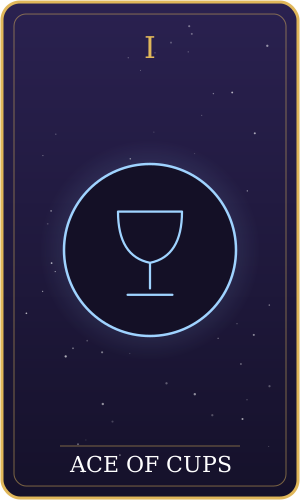
In the traditional Rider-Waite-Smith picture, a single hand emerges from a cloud, palm up, holding a large golden chalice. Five streams of water spill from the cup's rim and fall into a pond below, where water lilies float on the surface. Above the cup, a white dove glides downward with a small round wafer in its beak.
Our site uses its own artwork instead of the classic illustration, but the symbols below are the ones tradition attaches to the card. Think of the whole picture as a gift being offered rather than a prize being won. Nobody in the scene is straining or bargaining.
That is the heart of the card's meaning. Something emotional is available right now: a wave of warmth, a rush of inspiration, a softening toward someone, a first honest feeling after a long numb patch. The card asks whether you are willing to hold the cup out and let it be filled.
Reading the symbols
The hand from the cloud is a convention that runs through all four aces. It suggests that the gift comes from beyond ordinary effort. You cannot schedule a surge of affection or force an idea to arrive, and the hand reminds readers that some experiences are received more than made.
The chalice itself is an old image of the heart as a vessel. A cup can be full, empty, cracked or overflowing, and readers often use it as a plain question: how much room do I have for feeling at the moment, and what is currently filling me up?
The five streams are commonly connected with the five senses, as though emotion reaches us through sight, sound, touch, taste and scent before it becomes a thought. Some readers prefer to see them as five directions of love: toward others, toward the self, toward work, toward place, toward something larger.
The lilies and the dove complete the picture. Lilies grow from mud into open blossoms, which suits a card about feeling that rises from a dark, quiet place. The dove, a long-standing sign of peace, adds a note of blessing without turning the card into a lecture.
Ace of Cups upright
Upright, the Ace of Cups describes an emotional beginning. It might be the first spark of attraction, a friendship that suddenly deepens, or an unexpected wave of gratitude on an ordinary Tuesday. The common thread is that the feeling is real, warm and not yet complicated.
It is also a card of compassion. Many readers connect it with the moment someone stops being defensive and simply listens, or with the generosity of a person who gives without keeping score. The cup overflows because it is not clutching its contents.
Creative energy belongs here too. A songwriter finding a first line, a cook inventing a recipe from leftovers, or a parent making up a bedtime story on the spot are all small versions of this card. The feeling comes first and the form follows.
As a reflection prompt, an upright Ace can be put simply: what feeling is trying to reach me today, and what would it look like to let it in without immediately fixing, judging or explaining it? Often the answer is smaller and kinder than expected.
Ace of Cups reversed
Reversed, the cup tips and the water spills or fails to flow. The usual reading is blocked or withheld feeling. A person may be going through the motions of their day while keeping the real emotional weather out of sight, even from themselves.
Another reading is emotional fatigue. If you have been caring for others, absorbing everyone's moods, or working through a long stretch of stress, the cup may simply be low. The reversed Ace then reads less like a flaw and more like a gauge showing that refilling is overdue.
It can also point to a gift that is hard to accept. Someone offers kindness and you deflect it, or a good idea arrives and you talk yourself out of it before it takes shape. The water is there, but the hand is closed.
None of this is a judgment. A reversed card is a mirror for a moment, not a fixed condition. If emotional numbness or heaviness lasts, a card is not a substitute for support from people you trust or a qualified professional.
Ace of Cups in love and relationships
In love readings, the Ace of Cups is among the most open and tender cards in the deck. It often describes the early glow of a connection, or a new layer of closeness in an existing one. The mood is sincerity: people saying what they mean and meaning it.
For couples, the card can suggest a renewal of affection, such as rediscovering why you liked each other, or a conversation that clears the air and leaves both people lighter. It does not predict any outcome. It simply names an opening and asks how each person wants to meet it.
For single readers, it often reads as readiness more than arrival. The heart has room again. That might look like being curious about someone new, or it might look like a deeper kindness toward yourself after a hard stretch. Self-love, in the plain sense of treating yourself gently, is a fair reading here.
As feelings, the Ace of Cups can describe someone who is moved, warm and perhaps a little overwhelmed by how much they feel. Reversed, it may describe someone guarded, unsure of their own feelings or worn out by caring. A card cannot read a mind, so use it as a prompt to ask.
Ace of Cups in career and work
At work, the Ace of Cups usually points to engagement. It describes the satisfaction of a task that feels meaningful, a team that treats one another kindly, or a flash of inspiration for a project. It fits caring professions, creative fields and any role where empathy is part of the skill.
The card may also describe the first stirrings of a new interest. A person might notice they enjoy mentoring a colleague more than they expected, or that a side project gives them more energy than their main one. Noticing that is useful information about what fills your cup.
In a group, the Ace can stand for a person or a moment that lifts morale: a thank-you note, an honest apology, a meeting where people feel safe to speak up. These small acts shape how pleasant a workplace is to be in, and they cost very little.
Reversed, the card may reflect burnout, emotional distance from a role, or a creative dry spell. It offers themes for thought, not career advice. Decisions about jobs and income deserve real information and trusted people, with the card serving only as a conversation starter.
Is the Ace of Cups a yes or no card?
Most readers treat the Ace of Cups as a yes, since a new, open-hearted beginning leans toward welcome. That is an editorial convention and not an ancient rule, and readers differ. Yes is the reading our yes-or-no tool uses for this card when it appears upright.
Our tool applies one rule to reversed cards: yes becomes maybe, maybe becomes no, and no stays no. So a reversed Ace of Cups reads as a maybe, a sign that the feeling is real but not yet ready to flow, and that patience or a little care may matter more than speed.
The reversed rule only comes into play if you tick "Include reversed cards" in the yes-or-no tool. The box starts unticked, so by default every card you draw is upright and the Ace of Cups answers yes.
Keep the answer in proportion. A yes from this card means the question feels warm and hopeful, not that an outcome is likely or guaranteed. The format is meant for fun and reflection, and questions about health, money, law or safety deserve qualified advice instead.
Ace of Cups and astrology
In the Golden Dawn tradition, which shaped most modern decks, each ace is tied to the element of its suit. Cups belong to Water, so the Ace of Cups is the root of that element. This is a correspondence from tradition, and other systems assign things differently.
Astrology has three water signs: Cancer, Scorpio and Pisces. Cancer is cardinal and ruled by the Moon, Scorpio is fixed and ruled by Mars with Pluto as modern co-ruler, and Pisces is mutable and ruled by Jupiter with Neptune as modern co-ruler. Together they cover feeling that nurtures, feeling that probes and feeling that dissolves boundaries.
To link the card with your own chart, look at where the water signs fall. The houses holding Cancer, Scorpio or Pisces, and any planets placed in them, hint at where emotion tends to run strongest for you. People with several planets in water may find the Ace feels like home territory.
Our free birth chart calculator shows those placements in a few seconds. Treat the connection as a thread of curiosity, not a prediction. Astrology and tarot are both reflective tools here, and neither says what will happen.
Ace of Cups as advice
As advice, the Ace of Cups suggests receiving before doing. If a kind message arrives, read it twice. If a wave of affection or gratitude shows up, say it out loud while it is still warm instead of saving it for a better moment.
It also suggests tending the vessel. That can be as plain as eating a proper meal, calling the friend who is easy to talk to, or giving yourself an hour with no obligations. A cup that is never refilled cannot pour for anyone else.
Try a short practice. Write down one feeling you noticed today without trying to explain it, then one small way to honor it, such as a walk, a text, or ten minutes with a favorite song. Repeat for a week and see which feelings keep returning.
If the card comes up reversed, begin with gentleness. Name what you are holding back, even privately on paper, and choose one safe person or place where a little of it can be said. The Ace never demands a flood. A single drop counts.
Ace of Cups corresponds to the element of water. See your element balance.
Frequently asked questions
Is the Ace of Cups a good card?
Most readers consider the Ace of Cups one of the warmest cards in the deck. It speaks of new feeling, kindness and creative inspiration, and it usually shows up as an invitation to be open. Reversed, it describes blocked or tired emotion rather than anything harmful. Like every card, it is a prompt for reflection, not a forecast.
What does the Ace of Cups mean in love?
In love, the Ace of Cups points to an emotional opening: fresh attraction, deeper closeness or a softening after tension. For single readers it often suggests readiness and self-kindness more than a specific arrival. It does not predict any relationship outcome. Reversed, it may describe guarded feelings or a heart that needs rest.
What does the Ace of Cups reversed mean?
Reversed, the Ace of Cups usually describes feelings that are held back, tired or hard to receive. It can point to emotional numbness, creative dryness or difficulty accepting kindness. The card is a mirror for a moment, not a verdict. Ongoing heaviness deserves support from trusted people or a qualified professional.
How does the yes or no tool treat the Ace of Cups reversed?
Our tool gives the upright Ace of Cups a yes. If you have ticked "Include reversed cards", a reversed draw moves one step along: yes becomes maybe. Maybe becomes no, and no stays no. The box is off by default, so most draws are upright. This is our own convention for fun and reflection, not a traditional law.
Which element goes with the Ace of Cups?
In the Golden Dawn tradition, the Ace of Cups corresponds to Water, the element of the whole suit. Water links with Cancer, Scorpio and Pisces in astrology. It is one traditional assignment among several, so use it as a thread for curiosity. Your own chart shows where water signs sit for you.
What does the Ace of Cups mean as feelings?
As feelings, the Ace of Cups can describe someone who is moved, affectionate and open, even if a bit overwhelmed by how much they feel. Reversed, it may describe guardedness or emotional tiredness. A card cannot read another person's mind, so treat it as a thoughtful guess and a reason to ask them directly.
 King of Wands
 Two of Cups
 The Star
 The Moon