What the Moon means
Of all the cards, the Moon is the one most about not knowing yet. It sits between the Star and the Sun, and it works like a stretch of night between two kinds of daylight. Things look different in that light: shapes are soft, shadows are long, and the mind fills gaps with whatever it carries around.
That is the heart of the card. It points to intuition, imagination and sensitivity, and it also points to the way worry and assumption can color a situation before the facts arrive. Neither side is bad. The Moon asks the reader to notice which impressions are information and which are just echoes.
In the traditional Rider-Waite-Smith picture, a pale moon with a calm face hangs in the sky, its disc half-hidden by a smaller circle. Drops of light fall from it. Below, a winding path runs between two stone towers toward distant hills, and a dog and a wolf stand on either side, each looking up and each seeming to call.
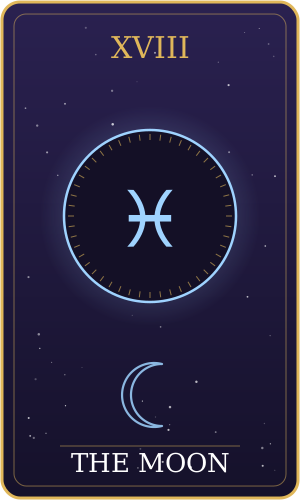
In the foreground, a crayfish drags itself out of a pool and onto the land. Our site shows its own artwork rather than the classic illustration, but these are the symbols tradition associates with the card, and each one has a quieter meaning than its mood suggests.
The symbols, one at a time
The moon itself stands for the changeable, reflective side of experience. It shines with borrowed light, which makes it a fitting emblem for impressions that feel vivid but come from somewhere other than direct evidence.
The dog and the wolf are often read as two sides of one nature: the tame and the wild, the part of us that follows routine and the part that wants to roam. Their shared howl suggests both are asking for attention, and the card does not choose between them.
The two towers frame the path like a gate. Readers often see them as thresholds, a pair of fixed points that mark the way through uncertainty. The road is long and not fully lit, yet it is a road, and it leads somewhere.
The crayfish emerging from the water is the oldest, slowest creature in the scene, rising from the deep mind into daylight. It can stand for an old feeling or memory coming up to be looked at. Slow movement is the point; nothing here requires speed.
The Moon upright
Upright, the Moon describes a period when intuition is loud and certainty is scarce. A reader might feel drawn to a decision for reasons they cannot yet explain, or find that dreams, moods and small hunches are more present than usual. The card validates that sensitivity while asking for patience.
It also warns, gently, about projection. When information is incomplete, the mind tends to supply the missing parts, often with its biggest fears or its biggest hopes. A text that goes unanswered can become a whole story. The card suggests checking the story against what is actually known.
Creativity is a strong theme too. Writers, musicians and anyone who works with images often find the Moon a friendly card, because it speaks the language of atmosphere, symbol and mood. A restless night might produce an idea.
As a reflective prompt, the upright Moon asks two questions. What do I actually know? And what am I filling in? Sorting those into two lists often brings relief, even before any answers arrive.
The Moon reversed
Reversed, the Moon often marks the fog beginning to lift. A confusing situation starts to make sense, a worry loses its hold, or something that was hidden comes into view. The edges of the scene get sharper.
A second reading is about facing what was avoided. The reversed card may point to a feeling that has been pushed down and now wants acknowledgment, or a habit of hiding things, from oneself or from others, that has become tiring to maintain.
A third possibility is that the sensitivity of the upright card turns into overwhelm. Too many impressions at once can make it hard to tell what is real, and the reversed Moon can reflect that. The suggestion is to simplify: fewer inputs, more sleep, and a trusted person to talk with.
None of this is alarming. The reversed Moon is closer to waking up than to sinking deeper. If anxiety or sleeplessness is a regular burden, a qualified professional is a better source of help than any card.
The Moon in love and relationships
In love, the Moon is the card of mixed signals and deep feeling. It can describe the early weeks of getting to know someone, when attraction is strong but the picture is incomplete. It encourages curiosity over conclusions: ask, listen, and let the other person show who they are over time.
In an established relationship, the Moon may point to unspoken moods. One partner might be quieter than usual, or something unsaid might be hanging in the air. The card suggests naming the feeling in plain words instead of guessing, and giving the other person room to answer.
As feelings, the Moon can describe someone who is unsure, sensitive or protective of their inner world. They may care a lot and still struggle to say so. Equally, the card can describe a person who is not fully clear with themselves about what they want.
Reversed in love, it often brings relief, such as a misunderstanding clearing up or a person finally saying what they have been holding back. It can also be a prompt to stop replaying imagined conversations and have a real one.
The Moon in career and work
At work, the Moon suggests a stage where the plan is not fully visible. A new role may still be taking shape, instructions may be vague, or a team may be waiting on a decision. The card advises gathering information before committing to a strong position.
It also honors the quieter skills: reading a room, sensing what a client has not quite said, noticing when a project feels off before the data shows why. Those are real strengths, and the card invites using them alongside facts and not instead of them.
Creative work, caregiving and any job that involves imagination or empathy often resonate with the Moon. A person in these fields might see the card as a reminder to protect rest, since sensitive work can be draining.
Reversed, the card may suggest that a murky situation is clearing, or that a worry about work has been bigger in the mind than on paper. The card offers no financial or career-decision advice. Real choices are better made with documents, dates and people who can confirm the details.
Is the Moon a yes or no card?
In the convention used by this site, the Moon is a maybe. Most readers treat it as undecided because the card itself is about incomplete information; answering a firm yes or no would contradict its spirit. This is an editorial convention, not a rule, and it is the one our yes-or-no tool uses.
Reversed, the tool moves the answer one step toward no, so the Moon reads as a no: the fog has not lifted, which makes waiting wiser than acting on a guess. If the "Include reversed cards" box stays unticked, as it does by default, the Moon always arrives upright. The fog may lift later, but this tool does not claim to know when.
A maybe is a perfectly good result. It suggests that more information, more time or a calmer mood could change how the question looks. It can be a nudge to ask a better question or to find out one more fact before deciding.
As with every draw, this is for fun and reflection. Questions about health, money, law or safety belong with qualified people and real sources.
The Moon and astrology
In the Golden Dawn tradition, the Moon card corresponds to Pisces. This is a traditional assignment, not a universal one, but it is the correspondence this site uses.
Pisces is a water sign, mutable in quality, ruled by Jupiter in the traditional scheme with Neptune as the modern co-ruler. It is linked with imagination, empathy, dreams and the porous boundary between self and surroundings. The fit is easy to see: the card is full of water, reflected light and things that shift shape.
To bring the card into your own chart, check where Pisces falls in your birth chart. The house containing Pisces, and any planets placed there, can suggest where sensitivity and imagination tend to be strongest for you. People with the Sun, Moon or Ascendant in Pisces sometimes find this card unusually familiar.
Our free birth chart calculator shows those placements. Treat the link as a reflection tool: an interesting pairing of symbols that invites you to notice patterns, not a statement about what must happen.
The Moon as advice
As advice, the Moon suggests moving at walking pace. When the view is unclear, small steps and frequent check-ins work better than a big leap. Let a decision sit overnight, if it can.
Pay attention to dreams, moods and hunches, but write them down and look at them again in daylight. Often a note that felt profound at midnight turns out to be a useful clue and sometimes just a tired thought. Both are fine to learn from.
Keep a few anchors steady while things feel hazy: regular meals, a simple routine, a friend who is good at plain talk. Grounding is what lets sensitivity be a strength.
If the card appears reversed, the advice is to act on whatever has become clear and leave the rest for later. A little clarity is enough to take the next step.
The Moon corresponds to Pisces. See whether Pisces is among your big three; read about Pisces rising; read about the Pisces Moon, or read the Pisces horoscope for 2027.
Frequently asked questions
Is the Moon a bad card?
No. The Moon is a card of uncertainty, intuition and imagination, and it only feels unsettling because it describes not having the full picture. Many readers value it for its creativity and sensitivity. It simply asks for patience and some fact-checking before decisions. It is a reflective prompt, never a prediction of trouble.
What does it mean when the Moon comes up reversed in the yes or no tool?
Upright, the Moon is a maybe here. The tool is built so that a reversed card slides the answer one step toward no, which turns this maybe into a no, since the fog has not lifted, which makes waiting wiser than acting on a guess. That is a convention we chose for the tool, not an official tarot rule for the Moon, and you only see it when the "Include reversed cards" box is ticked. Otherwise every card arrives upright.
What does the Moon mean in a relationship?
In a relationship, the Moon often points to mixed signals, unspoken moods or feelings that are strong but not yet put into words. The suggestion is to ask directly, avoid building stories from silence, and give things time. Reversed, it commonly means a misunderstanding is clearing or someone is ready to speak honestly.
What does the Moon reversed mean?
Reversed, the Moon usually means the fog is lifting. A worry may be shrinking, a hidden detail may come to light, or a feeling that was avoided may be ready to be acknowledged. It can also reflect sensory or emotional overload, in which case simplifying and resting helps. Ongoing anxiety deserves professional support.
Which zodiac sign goes with the Moon?
Tradition links the Moon card with Pisces, a mutable water sign associated with imagination, empathy and dreams. This comes from the Golden Dawn system and other systems differ. If you have Pisces placements in your birth chart, the Moon card may feel particularly meaningful as a symbol for your sensitive side.
Does the Moon card mean someone is lying?
Not necessarily. The Moon is about unclear information, not about dishonesty. It may reflect a situation where facts are missing, feelings are mixed, or you are imagining more than you know. The healthy response is to ask questions and wait for evidence before drawing conclusions about another person.
 The Star
 The Sun