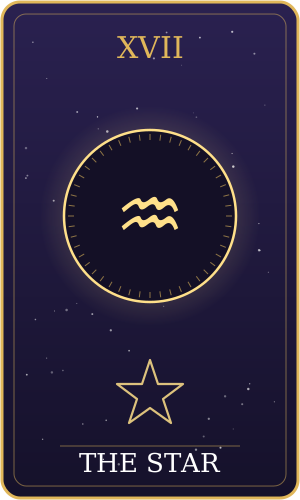
What the Star means
The Star arrives in the deck right after the Tower, and that placement shapes how most readers see it. The Tower is the card of things coming down; the Star is the first calm breath once the dust has settled. Its core message is that something in you is still intact, still curious, and still able to look forward.
In the traditional Rider-Waite-Smith picture, a bare figure kneels at the edge of a small pool beneath a night sky. She holds two pitchers. From one she pours water onto the ground, and from the other she lets water slip back into the pool. Behind her is open country, a few quiet hills, and a bird perched in a leafy tree.
Overhead hangs one large star with eight points, surrounded by seven smaller ones. Readers often take the big star as a guiding ideal and the smaller ones as the many little hopes that orbit it. The numbers are not a code to memorize; they simply give the sky a sense of generous, ordered abundance.
Our site uses its own artwork for the card rather than the classic illustration, but the symbols below are the ones tradition attaches to it. Think of the card as a picture of care: water given to the land, water returned to its source, and nobody in a hurry.
The symbols, one at a time
The two pitchers are usually read as a pair of motions. One stream feeds the soil, which stands for practical life, and the other flows back into the pool, which stands for the inner life. The pairing suggests that real renewal needs both: some attention for the outside world and some for what happens inside.
Her nakedness is not meant to be provocative. In the tarot's visual language it stands for having nothing to defend. She is not wearing armor, a costume or a role, which is part of why the card feels so restful.
The pool and the earth beneath her knee make the scene feel grounded despite the dreamy sky. One foot rests on the water and one on the land, a small picture of being able to move between feeling and doing without strain.
The bird in the tree is often described as an ibis, a creature linked in older traditions with learning and writing. A modern reader might simply see a quiet witness, a sign that life carries on around you while you rest. Nothing in the scene asks for a performance.
The Star upright
Upright, the Star points to hope that does not need to shout. It is not the excitement of a new start, which belongs to the Fool, nor the confidence of success, which belongs to the Sun. It is the steadier feeling of knowing that things can improve, even if the details are still blurry.
Common themes include recovery, trust, inspiration and a return of energy. A person drawing this card may be coming out of a tiring season, a disappointment or a long period of pressure. The card says that rest counts as progress, and that a quiet evening, a long walk or an honest conversation may be doing more work than it looks like.
It also carries a creative flavor. Many readers associate the Star with ideas that arrive without force, such as a project you suddenly want to return to, or a sense of direction that appears after you stop demanding one. The mood is open, generous and unhurried.
Used for reflection, an upright Star can prompt a simple question: what is already helping me feel steadier, and how could I give it a little more room? Often the answer is something small and ordinary.
The Star reversed
Reversed, the Star describes hope that has gone dim. The wish is still there, but it feels far away, and the sky looks empty. This may show up as discouragement, a sense of disconnection or a reluctance to plan anything because plans feel pointless.
Another reading is impatience. The upright card trusts a slow process, while the reversed card may be pushing for proof that things are getting better. When results do not appear quickly, doubt can creep in and make the whole effort seem futile.
A reversed Star is not a verdict or a warning. It is a mirror for a low-energy moment, and the useful response is usually gentle: sleep, food, time outdoors, a call with someone who listens well. Because this is a reflective tool and not a medical one, anyone whose low mood feels heavy or lasting should talk with a qualified professional rather than lean on a card.
Some readers also note that the reversed Star can point to comparing yourself with others. Watching other people's skies can make your own look dull. Turning attention back to the pool in front of you is the card's quiet suggestion.
The Star in love and relationships
In love readings, the Star is warm and unpressured. For someone in a relationship, it often describes a period of reconnection, where old tension softens and both people feel more able to be honest. It can also describe a relationship that has no drama at all, just steady and kind attention.
For single readers, the card tends to be read as openness without desperation. It suggests being receptive to meeting someone, while not treating every date as an audition. Many people read it as a reminder that healing after a breakup is real and does not need to be rushed.
As feelings, the Star can describe a person who feels tender, hopeful and a little shy about it. They may not make big declarations. They may show interest by remembering small details, sending a thoughtful link or simply being easy to be around.
Reversed in love, the card may describe someone who has lost faith in romance for the time being, or a pair who have drifted into routine and stopped noticing each other. The suggestion is modest: bring back one small ritual, such as a shared walk or a weekly dinner without phones.
The Star in career and work
At work, the Star is a card of vision and recovery. It often shows up for people who are coming off a draining project and starting to feel curious again. It may describe a sense of direction that is still forming, with no need yet to lock it into a title or a deadline.
It also favors work that has meaning for the person doing it. A reader might use the card to ask what kind of tasks leave them feeling restored rather than depleted, and then notice how often those tasks appear in a normal week.
In team settings, the Star can stand for a person who steadies the room, someone whose calm optimism makes it easier for others to think clearly. It is a card about encouragement, mentorship and sharing credit.
Reversed, it may reflect burnout, cynicism or a feeling that the effort is not going anywhere. The card does not offer career advice or decisions; it only invites a pause to ask what has been missing. Practical choices about a job or income are best made with real information and trusted people.
Is the Star a yes or no card?
In the convention used by this site, the Star is a yes. Most readers who use tarot for quick yes-or-no questions treat it as favorable, because its themes of hope, healing and renewal lean toward encouragement. This is an editorial convention, not an ancient rule, and different readers assign it differently. It is the one our yes-or-no tool uses.
If the Star lands reversed, our rule turns the yes into a maybe, because the timing or the mood is off, and waiting or resting may help more than pushing ahead. None of this applies to the Star unless you tick "Include reversed cards", since the box starts unticked.
A yes from the Star is best heard as encouragement, not a promise. It says that the question feels hopeful, and that the person asking might proceed with a clear head. Nothing in a tarot draw can confirm that an outcome is likely, and the yes-or-no format is meant for fun and reflection.
For questions about health, money, law or safety, a card is the wrong tool. Those deserve qualified advice and real information.
The Star and astrology
In the Golden Dawn tradition, which shaped most modern tarot decks, the Star is assigned to Aquarius. This is a correspondence from tradition, and other systems have made different assignments, but it is the one this site follows.
Aquarius is an air sign, fixed in quality, ruled by Saturn in the traditional scheme with Uranus as the modern co-ruler. It is linked with ideas, community, independence and thinking about the future. The pairing makes sense when you picture the card: the water-bearer figure of the zodiac pours out a stream, and the Star's kneeling figure does much the same.
To connect the card with your own chart, look at where Aquarius sits in your birth chart. The house holding Aquarius, or any planets placed in it, can hint at where hope, friendship and forward-looking ideas tend to show up in your life. A person with the Sun, Moon or Mercury in Aquarius may find the Star feels especially familiar.
You can find those placements with our free birth chart calculator. Astrology here is a lens for self-reflection, and a card correspondence is a thread to follow out of curiosity, not a prediction about anyone's life.
The Star as advice
As advice, the Star suggests slowing down and tending to what restores you. That might mean a regular bedtime, a walk with no destination, or finally writing down the idea that has been circling for weeks.
It also encourages sharing. The figure pours water outward, so the card invites generosity: a kind message to a friend, a favor offered without keeping score, time given to a group you care about.
Try a simple evening exercise. Write three things that felt even slightly hopeful today, however small, and one thing you would like to give yourself more of tomorrow. Repeat for a week and see what patterns appear.
If the card comes up reversed, the advice is to lower the bar for the day. One modest, kind action toward yourself is plenty. The Star never demands a transformation; it recommends patience and the willingness to keep looking up.
The Star corresponds to Aquarius. See whether Aquarius is among your big three; read about Aquarius rising; read about the Aquarius Moon, or read the Aquarius horoscope for 2027.
Frequently asked questions
Is the Star a good card?
Most readers see the Star as one of the more reassuring cards in the deck. Its themes are hope, renewal and calm, and it commonly appears after a hard or tiring stretch. Reversed, it describes a dip in confidence rather than anything harmful. As with every tarot card, it is a prompt for reflection and not a forecast about what will happen.
What does it mean when the Star comes up reversed in the yes or no tool?
For the Star, the reversed rule is easy to state: the tool moves every reversed card one step toward no, so an upright yes turns into a maybe, because the timing or the mood is off, and waiting or resting may help more than pushing ahead. It is our own convention for fun and reflection, and it applies to the Star only if you have ticked "Include reversed cards", which is off by default.
What does the Star mean in a relationship?
In a relationship, the Star often points to reconnection, honesty and gentle healing after tension. It can also describe quiet, steady affection that does not need big gestures. For single readers, it tends to suggest openness without pressure. Reversed, it may reflect discouragement about love or a couple that has drifted into routine and could use a small shared ritual.
What does the Star reversed mean?
Reversed, the Star usually describes hope that feels dim. It can point to discouragement, doubt, impatience or a sense of being cut off from what once inspired you. The card is not a warning. It suggests lowering the pressure, resting and taking one small caring step. Persistent low mood deserves attention from a qualified professional.
Which zodiac sign goes with the Star?
In the Golden Dawn tradition the Star corresponds to Aquarius, an air sign linked with ideas, community and the future. That is a traditional assignment and not the only one in existence. If Aquarius appears in your birth chart, through the Sun, Moon or another placement, the Star may feel personally familiar.
What does the Star mean as feelings?
As feelings, the Star can describe someone who feels hopeful, tender and open, though perhaps a little quiet about it. They may be recovering from something and starting to trust again. A card cannot read another person's mind, so treat this as a thoughtful guess and a prompt to ask them directly.
 The Tower
 The Moon
 The Sun