What the Tower means
The Tower is dramatic to look at. In the traditional Rider-Waite-Smith image, a tall stone tower stands on a rocky peak against a night sky. Lightning strikes its crown, knocking it off like a lid, and flames burst from the windows. Two figures fall from the building, headfirst and with arms outstretched, into the dark below. Yellow flecks drift in the air, often read as sparks or as the Hebrew letter yod, a symbol of divine energy.
It is easy to read this as disaster, and many people draw the card with a little dread. A calmer reading looks at what the image actually shows. The tower is a structure someone built, and structures can be sound or flawed. The lightning is not random destruction for its own sake. It is the force that exposes what was fragile. Crowns, towers and high places have long stood for ambition, pride and certainty, and the card suggests that certainty built on a weak base can crack.
The falling figures deserve attention too. They are leaving a place that was closing in on them, and the fall carries them out of it. Many readers see this as a picture of sudden release: a moment that is jarring but breaks a pattern which was not going to change gently.
The card should not be read as a prediction that anything bad is coming. Tarot on this site is for reflection and entertainment. The Tower is a symbol for thinking about shake-ups, whether they have happened, are happening, or are simply imagined, and about how people respond when what they relied on shifts.
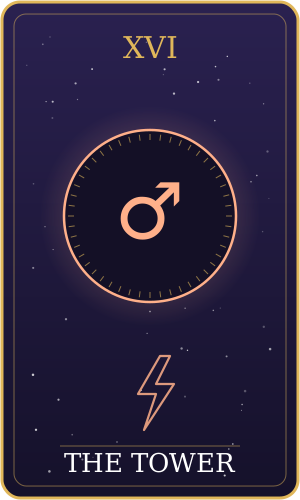
Our site shows its own artwork instead of the classic image, but the point is the same. The Tower is the card of a sudden truth, and the clearing that follows it.
The Tower upright
Upright, the card points to upheaval: a sudden change that arrives with little warning and rearranges the picture. It might be an unexpected piece of news, a plan that falls apart, or a belief that suddenly stops making sense. The tone is abrupt. Things that seemed settled turn out to be less stable than they appeared.
The second theme is revelation. The lightning is also a flash of light. In a single moment, something becomes clear that was hidden, whether it is a truth about a situation, a person or oneself. This can be uncomfortable, and it can also be a relief to finally see plainly.
A third theme is the collapse of false structures. A habit, an assumption, a story about how things work: if it was built on shaky ground, the card suggests it may not hold. Readers often use it to ask what has been propped up for too long, and whether it might be easier to let it go than to keep supporting it.
A fourth theme is rebuilding. The Tower rarely stands alone in the story. After the Tower comes the Star, the quiet card of hope, and the order is no accident. The clearing makes space. In the aftermath, the ground is open and new foundations can be laid, perhaps stronger and more honest than before.
A fifth theme is energy. Shake-ups release a lot of it, and the card is linked to Mars, the planet of drive and action. The charge that comes with sudden change can be put to use.
Common upright keywords include upheaval, sudden change, revelation, breaking down, clarity and shake-up.
The Tower reversed
Reversed, the card can mean a few different things, and the surrounding cards help decide. One reading is a shake-up that is avoided or softened: the lightning misses, or the damage is smaller than it might have been. The relief is real, though the card often adds a gentle question about whether the underlying cracks have been dealt with.
A second reading is resisting change. The structure is wobbling, but the person is holding it together by effort, denial or distraction. This can last a long time, and it can wear a person out. The reversed card may be suggesting a planned, gradual change in place of waiting for a sudden one.
A third reading is a slow collapse. Where the upright card is a single blow, the reversed version can describe change that happens in small, steady steps over weeks or months. It is less dramatic, though it may be just as real.
A fourth reading is the aftermath. The shake-up has already happened, and the reversed card describes the period afterward: sorting through what is left, feeling shaky, working out what comes next. Patience and small routines tend to help in this stage, and there is no need to rush the rebuild.
Finally, the reversed Tower can mark a fear of change, a reluctance to look at something that needs attention. The card does not insist. It simply notes that facing a difficult truth early, and on your own terms, often feels better than avoiding it.
Typical reversed keywords include averted shake-up, resisting change, slow collapse, aftermath and delayed reckoning.
The Tower in love and relationships
In a love reading, the Tower speaks to a sudden change in how a relationship feels or looks. It might be a revelation that shifts the picture, a conversation that clears the air, or an event that makes both people re-evaluate. It does not predict a breakup or any specific event. It points at the experience of a foundation being tested.
For couples, the card can suggest that something long unspoken is ready to come out. Honest conversation is often uncomfortable at first, but it can also be the start of a firmer footing. The question the card raises is what the relationship was resting on and whether it can be rebuilt together, more openly.
For someone who is single, the card may describe a shake-up in what you believed about love: an idea of the perfect partner that falls away, a pattern that becomes obvious, or a sudden change of heart. It can also reflect the aftermath of an ending, and the need to find your footing again.
As feelings, the Tower can describe someone who is going through a sudden internal shift, feeling overwhelmed, or reacting strongly to something unexpected. They may be rethinking things. It is a snapshot of a mood, and it says nothing fixed about what another person thinks of you.
Reversed in love, the card can show a rough patch that has been avoided or smoothed over, with tension still beneath. It can also describe recovering after a hard moment, or slowly changing long-held patterns. If a relationship ever feels unsafe, trusted people and qualified support services are the right place to turn, not a card.
The Tower in career and work
At work, the Tower describes sudden shifts in the working landscape: a plan that is scrapped, a reorganization, a project that fails and has to be rethought, or a realization that a path is no longer right. The card is a lens for understanding how people react to such moments, not a forecast of any in particular.
Its positive side is clarity. A sudden disruption can reveal which parts of a system were fragile and which were solid. Teams often learn more from a disruption than from a smooth year, and the card can serve as a reminder that rebuilding offers a chance to do things more sensibly.
The card also relates to personal beliefs about work, such as the idea that you must stay in one field, that a title defines you, or that a particular route is the only one. When one of these assumptions cracks, the card is an invitation to look at what is left standing: skills, relationships and values that carry over.
Reversed, the card can describe a workplace tension that has not yet boiled over, a change that is being postponed, or the slow recovery after a setback. A useful question is what could be strengthened now, while there is time, so that fewer things depend on luck.
The Tower offers no financial advice and makes no prediction about jobs, pay or markets. It is a prompt for reflection, and important decisions deserve proper information.
Is the Tower a yes or no card?
Tarot has no official yes and no values, and the assignment is a convention. Most readers treat the Tower as a no, because the card describes plans being disrupted or structures giving way. That is the value our yes-or-no tool uses, and it is an editorial choice and not a fact about the card.
The no is often a not like this. A question about whether a fragile plan will hold may get a no from the Tower, which can also be read as a nudge to strengthen the plan. A question about whether a change is coming may get a different reading, since the card is the very picture of change.
A no cannot get any firmer, so when the Tower lands reversed the tool keeps the answer at no, although the shake-up is delayed or softened. The shift for the Tower is a convention of our tool, and it happens only when "Include reversed cards" has been ticked. As always, the tool is for fun and reflection and not for decisions about health, money, law or safety.
The Tower and astrology
In the Golden Dawn tradition, the Tower corresponds to the planet Mars. This is a traditional correspondence, shared by many decks but not all, so treat it as one lens. Mars is the planet of drive, action and assertion, ruling Aries and, in the classical scheme, Scorpio (where Pluto is the modern co-ruler).
The link makes sense when you think about energy. Mars is the spark and the force that cuts through delay. It is the part of the chart that acts, sometimes bluntly, and the Tower shows what happens when that force meets something that is not built to withstand it. Mars is also a courageous planet, and rebuilding after a shake-up asks for exactly that courage.
To connect this to your own chart, look at where Mars sits: its sign shows your style of acting and reacting, and its house shows the area of life where you tend to push, compete or take initiative. Aspects to Mars show how that energy interacts with the rest of you. You can find your Mars sign and house with our natal chart calculator.
Everything here is about tendencies. Mars in a given sign does not predict upheaval, and a chart with a quiet Mars is not exempt from change.
The Tower as advice
As advice, the card suggests checking your foundations before they are tested. Ask which of your plans depends on a single assumption, and whether a second option could be kept in reserve. Small reinforcements are easier than repairs.
If a shake-up has already happened, the card suggests giving yourself time. The first days after a surprise are rarely the best moment for big decisions. Keep routines simple, lean on people you trust, and let the dust settle.
It also suggests looking for what the change has revealed. Something true has come to light, and it may be useful, even if it is not welcome. Writing it down in plain words can help turn confusion into something workable.
Finally, remember what comes next in the sequence. After the Tower is the Star, a card of quiet hope. The card does not promise a particular outcome, but it does remind us that clearing and rebuilding are part of a normal cycle, and that people often come out of a shake-up with a clearer sense of what they value.
The Tower corresponds to Mars. Find Mars in your birth chart.
Frequently asked questions
Is the Tower a bad card?
Not as bad as it looks. The Tower is dramatic, but it mostly describes sudden change and revelation, and what follows is often a clearer view and room to rebuild. It can feel unsettling in the moment. Most modern readers see it as a card of necessary disruption, and it makes no prediction of harm.
What does the Tower mean in a relationship?
Upright, it points to a sudden revelation or shift that tests what the relationship rests on, which can lead to honest conversation and a firmer footing. Reversed, it can suggest tension that has been avoided or the slow recovery after a hard moment. It is a prompt for reflection and not a forecast of a breakup.
What does it mean when the Tower comes up reversed in the yes or no tool?
Upright, the Tower is a no here, and reversing it does not change the one-word answer. The tool slides every reversed card one step toward no, and a no is already there, although the shake-up is delayed or softened. That is a convention we chose for the tool, not an official tarot rule for the Tower, and you only see it when the "Include reversed cards" box is ticked.
What does the Tower reversed mean?
Reversed, it can mean a shake-up that is avoided, resisted or drawn out into a slow change, or the aftermath of a big event while things settle. It may point to cracks that have not been addressed yet. The usual advice is to deal with them calmly and early, and to be patient with recovery.
What is the astrology of the Tower?
In the Golden Dawn tradition, the Tower corresponds to Mars, the planet of drive, action and assertion. That pairing is traditional, and other tarot systems assign the cards differently. To explore it, look at the sign and house of Mars in your own birth chart using our natal chart calculator.
Why is the tower struck by lightning?
The lightning stands for a sudden flash of truth that exposes what was unstable. The tower is a structure built on certainty or pride, and when its crown is knocked off, the falling figures are released from a place that had been closing them in. It is a symbol of necessary change, followed in the deck by the hopeful Star.
 The Devil
 The Star
 The Moon
 The Sun