What the Devil means
The Devil looks alarming, but it is one of the most psychologically interesting cards in the deck. It is not a portrait of evil or a warning about anything supernatural. In modern tarot practice it is a mirror for the ways people become bound to things: routines, comforts, appearances, relationships, ideas about what they must have. The theme is attachment, and the question it asks is who is holding the chain.
In the traditional Rider-Waite-Smith image, a horned, bat-winged figure sits on a black pedestal. In front of the pedestal stand two people, a man and a woman, with small horns of their own and tails that echo those of the figure above. Around each of their necks hangs a chain, tied to the pedestal. Look closely, and the chains are loose. The loops are wide enough to lift off. Nothing is forcing them to stay.
That detail is the key to the whole card. The people are bound, but only lightly, and mostly by their own belief that they cannot leave. The figure above holds a torch pointed downward, which can stand for desire and the pull of the material world. His raised hand carries a gesture that mirrors the one in the Hierophant, a hint that the card is a twisted reflection of that figure's structures of belief.
The scene is set against a dark, empty background, with no landscape to give relief. This suggests a closed-in feeling, as though attention has narrowed until nothing else is visible. The card is about that narrowing, and about how easily a person can mistake a habit or a worry for the whole of reality.
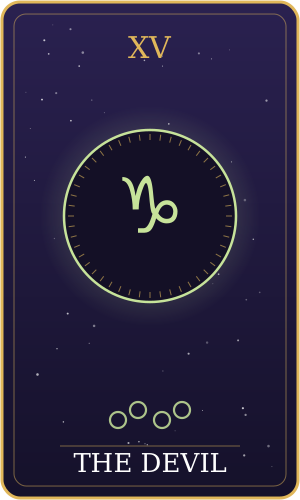
Our site shows its own artwork rather than the classic image. The reading stays calm and practical: the card invites an honest look at what feels binding, which is often the first step toward loosening it. The Devil here is a symbol for reflection, not a verdict on anyone's character.
The Devil upright
Upright, the card points to attachment. It may show up when someone feels pulled by a habit they would like to change, drawn to a situation that is not good for them, or caught in a pattern they keep repeating. The attachment might be to a person, a routine, a source of comfort, a status symbol or a way of thinking. The card does not shame this. It names it.
The second theme is the shadow side. In psychology-inspired readings, the shadow is the part of ourselves we prefer not to look at: impulses, envy, appetites, fears. The Devil invites a calm look at these parts. What we ignore tends to run in the background, whereas what we acknowledge can be understood and managed.
A third theme is material focus. The card is linked to the physical world: money, possessions, appearance, pleasure. There is nothing wrong with enjoying these. The question is whether they have taken over, so that a person works only to afford more, or measures worth by what they own. Readers often use the card to ask about balance in that area.
A fourth theme is feeling stuck. People who draw the card sometimes describe a sense of being trapped in a job, a dynamic or a cycle. The chains in the image are loose, and the card quietly points out that options often exist even when they are not obvious. This is a prompt, not a promise. Some situations are complicated, and the right support, from friends or qualified professionals, can matter a great deal.
A fifth theme is temptation and play. The card has a lighter edge too, associated with humor, sensuality and a willingness to enjoy life's pleasures, so long as they remain a choice.
Common upright keywords include attachment, habits, temptation, shadow side, material focus and feeling stuck.
The Devil reversed
Reversed, the card usually points to release. The chains are slipping off, or the person has noticed they were never locked. Awareness of a pattern grows, and with awareness comes choice. This is often read as one of the most hopeful reversed cards, because it describes the moment when a habit loses its grip.
A related reading is reclaiming power. Where the upright card shows a person giving authority to something outside themselves, the reversed card shows them taking it back. That might look like setting a boundary, saying no to an old routine, or deciding that a belief no longer deserves their loyalty.
Another reading is detachment. Reversed, the card can describe stepping back from something that had too much hold, such as scrolling, a draining friendship or a perfectionist standard. Even a small shift counts. A gradual loosening counts.
The reversed Devil can also describe the process being harder than it looks. Releasing a habit often brings discomfort, such as old urges, doubt or loneliness. The card does not deny this. It suggests being patient with the process and getting support where it is needed.
A less common reading is denial: acting as if the pattern does not exist, which keeps it in place. If that fits, the card may be inviting a more honest look.
Typical reversed keywords include release, breaking free, reclaiming choice, awareness and detachment.
The Devil in love and relationships
In a love reading, the Devil is about attachment and desire. It can describe a strong physical or emotional pull, a relationship with a lot of chemistry, or a connection that feels hard to step away from. The card is not a judgment of the relationship. It asks whether the bond is freely chosen and whether both people have room to breathe.
For couples, the card sometimes points to patterns that have become automatic, like the same argument on repeat, an unspoken script about who does what, or a dynamic where one person's needs routinely take priority. Naming the pattern is usually the first step toward changing it, and a calm conversation can do more than a dramatic gesture.
For someone who is single, the card may reflect a pull toward a familiar type, an on-and-off connection, or a habit of seeking attention in ways that do not satisfy. It can also simply describe a playful, passionate phase. Context matters, and the surrounding cards usually show whether the tone is light or heavy.
As feelings, the Devil can describe strong attraction, a sense of being captivated, or a person who finds it hard to let go. It can also describe someone who feels stuck in a pattern and is unsure how to change it. This is a mood, not a verdict about any person's intentions.
Reversed in love, the card tends to describe loosening: stepping out of an unhealthy dynamic, setting a boundary, or realizing that a bond is lighter than it felt. It can also suggest renewed independence. If a relationship ever feels unsafe, reaching out to trusted people or qualified support services is more useful than any card.
The Devil in career and work
At work, the Devil often relates to ambition, money and status, and to the ways they can take over. It may describe a person who has built a successful career but feels bound to it, perhaps by golden handcuffs of comfort or by a fear of what others will think. The card asks what is truly motivating the effort.
It also relates to workplace patterns: overwork that has become a habit, a culture where people feel they cannot say no, or a role that no longer fits but is hard to leave. The loose chains suggest that there may be more room to adjust than it seems, though only the person involved can judge their circumstances.
A positive reading is ambition with eyes open. Wanting success, comfort and recognition is human, and the card invites enjoying them without being ruled by them. Being honest about what you want from work can be freeing.
Reversed, the card often shows a break from an unhelpful work pattern: a new boundary around hours, a decision to stop chasing a standard that never satisfied, or a shift in what success means. It might also show someone recognizing a habit like procrastination or constant checking of messages and deciding to change it.
The card does not give career or financial advice, and it makes no prediction about jobs or income. It is a prompt for reflection, and major decisions deserve real information.
Is the Devil a yes or no card?
Tarot has no official yes and no values. Readers assign them by convention. Most readers treat the Devil as a no, or as a yes with strings attached, because the card is about attachments and bindings. In our yes-or-no tool it counts as a no, and that is an editorial choice rather than a fact about the card.
The no often reads as a prompt to look twice. If the question is about something that feels like a compulsion or a quick fix, the card may be asking whether it is truly wanted or just hard to resist. In that case the answer is less a rejection than an invitation to pause and check.
Reversed, the Devil is still a no in the tool: the rule only moves a yes to a maybe and a maybe to a no, so a no stays put even though the hold is loosening, which changes the card's tone. If the "Include reversed cards" box stays unticked, as it does by default, the Devil always arrives upright. As always, the tool is for fun and reflection and should not be used for decisions about health, money, law or safety.
The Devil and astrology
In the Golden Dawn tradition, the Devil corresponds to the sign Capricorn. This is a traditional correspondence, used by many decks and not by all, and it is best seen as one lens. Capricorn is a cardinal earth sign ruled by Saturn, associated with structure, ambition, responsibility and the material world.
The fit is easy to see. The card is about the physical world and the structures people build around themselves, and Capricorn is the sign most at home with structure. A structure can support or confine, and Capricorn's theme and the card's theme meet in that double meaning. Saturn's lessons about limits and commitments echo the question of which bonds are chosen and which are inherited.
To connect this to your own chart, look at where Capricorn falls. The house that holds Capricorn, and the sign and house of Saturn, tend to show where you take on responsibility and where discipline matters. Planets in Capricorn often carry some of this seriousness and drive. Our natal chart calculator can show where these placements sit for you.
These are tendencies. A strong Capricorn emphasis does not mean a person is more attached than anyone else, and a chart without it is no more free.
The Devil as advice
As advice, the card suggests noticing what you keep returning to out of habit. A simple exercise is to list three things you do automatically each day and ask of each: do I choose this, or does it just happen? The aim is awareness, not self-criticism.
It also suggests testing the chains. If something feels like a trap, try a small experiment: a day without it, one honest conversation, one small boundary. Seeing that the loop can be lifted is often more convincing than any argument.
Be kind about the shadow. Everyone has appetites and impulses they are not proud of. Treating them with curiosity tends to work better than treating them with disgust, because curiosity keeps the door open to understanding.
Finally, ask for support when you need it. Some patterns are heavy, and friends, family or qualified professionals can help in ways a card cannot. If a habit or substance feels out of your control, a doctor or a support service is the right first step, not a card. The Devil's message is hopeful: the hold is often looser than it feels, and noticing it is where change starts.
The Devil corresponds to Capricorn. See whether Capricorn is among your big three; read about Capricorn rising; read about the Capricorn Moon, or read the Capricorn horoscope for 2027.
Frequently asked questions
Does the Devil tarot card mean evil?
No. In modern tarot, the Devil is not about evil or the supernatural. It is a symbol of attachment, habits, temptation and the shadow side of human nature. The chains in the traditional image are loose, which suggests that what feels binding can often be released. The card is used here as a prompt for honest self-reflection.
Is the Devil a bad card?
Not necessarily. It looks intense, but it mostly asks you to notice what has a hold on your attention, and noticing is a constructive step. It can also express pleasure, humor and desire when enjoyed freely. Reversed, it often signals release. How the card feels depends on the question and the cards around it.
What does the Devil mean in a relationship?
Upright, it can describe strong attraction, a hard-to-break pull, or patterns that have become automatic. It asks whether the bond is freely chosen and whether both people have room. Reversed, it often points to loosening an unhealthy dynamic or setting a boundary. It is a prompt for reflection and not a judgment of any partner.
What does it mean when the Devil comes up reversed in the yes or no tool?
The Devil counts as a no in our yes-or-no tool when it is upright, and it is still a no when reversed. The rule moves a yes to a maybe and a maybe to a no, but a no has nowhere further to go, even though the hold is loosening, which changes the card's tone. The rule is an editorial convention of this site and not a teaching of tarot about the Devil, and reversed cards stay off unless you switch them on.
What does the Devil reversed mean?
Reversed, the card usually points to release: noticing a pattern, reclaiming choice and loosening an unhelpful hold. It can describe setting a boundary or stepping back from a habit. It may also suggest that letting go brings discomfort and takes patience. If a pattern feels heavy, support from trusted people or professionals can help.
Which zodiac sign is the Devil?
In the Golden Dawn tradition, the Devil corresponds to Capricorn, a cardinal earth sign ruled by Saturn and linked to structure and responsibility. This is a traditional pairing and not every tarot system uses it. You can see where Capricorn and Saturn sit in your birth chart with our natal chart calculator.
 Temperance
 The Tower
 The Star
 The Moon