What Temperance means
After the heavy theme of Death, the next card in the Major Arcana is a breath of calm. Temperance shows a winged figure, usually read as an angel, standing with one foot on dry land and one in water. In their hands are two cups, and a stream of liquid arcs from one to the other, never spilling a drop. It is a picture of careful, patient blending.
The details in the traditional Rider-Waite-Smith image all point toward harmony. The figure has one foot on the ground and one in a pool, a sign of moving between the practical world and the world of feeling or imagination. A path leads toward distant mountains, under a glow that suggests something rising on the horizon. Irises grow near the water's edge, flowers named for the rainbow goddess, hinting at a link between earth and sky. On the figure's chest is a square with a triangle inside it, which readers often take as the meeting of the material and the spiritual.
The word temperance carries a particular meaning. It is not about abstaining from things. It comes from an old sense of mixing in the right proportion, as when a blacksmith tempers steel or a cook balances salt and sweetness. The card is about getting the proportion right, finding the amount of each ingredient that makes the whole better than its parts.
The pouring itself matters. Moving water from one cup to the other is slow work. It cannot be rushed, and it cannot be done carelessly. The card gives weight to qualities that rarely get dramatic attention: steadiness, timing, restraint and a sense of measure.
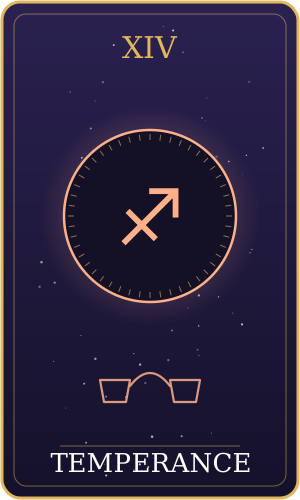
Our site shows its own artwork rather than the classic image, but the message stays the same. Temperance is the card of someone quietly doing the careful thing, and doing it well.
Temperance upright
Upright, Temperance points to balance. It may appear when a person has been swinging between extremes, working nonstop and then collapsing, or saying yes to everything and then shutting down. The card suggests a middle path that is sustainable, one where energy is spent at a pace that can be kept up.
The second theme is moderation. This is not a call to dullness. It is a reminder that many good things work better in measured doses, whether that is time, attention, spending, ambition or enthusiasm. A person who finds their own proportion tends to feel steadier and less drained.
The third theme is patience. Because the stream moves slowly, the card often relates to projects and relationships that need time. It suggests that results built gradually and with care tend to last, and that being in a hurry could spoil the mix.
A fourth theme is combining opposites. Two cups, two realms, two ways of seeing: Temperance asks how things that seem to conflict could be blended. It might be work and rest, logic and feeling, or two people's different habits. The aim is not to erase the differences but to find a workable mixture.
A fifth theme is quiet recovery. Readers sometimes link the card to a gentle pace of healing in a general sense, such as returning to routines after a hard stretch. It is not medical guidance, and it makes no claims about health. It simply honors the value of steady, unforced restoration.
Common upright keywords include balance, moderation, patience, blending, harmony and an even pace.
Temperance reversed
Reversed, the card points to imbalance. Something has tipped out of proportion: too much work, too much screen time, too much giving, too much holding back. The stream is no longer flowing evenly, and the cups may be overflowing or running dry.
A common reading is excess. This could be overcommitting, overspending of energy, or lurching from one extreme to the other. The card is not moralizing. It observes that the current pattern is hard to sustain and asks what would restore a sensible measure.
Another reading is impatience. When someone wants results immediately, they may rush a process that needed time, and the reversed card can mark that. Think of turning up the heat on a slow-cooking dish: the outcome tends to suffer. The card suggests easing off and letting the process run at its own speed.
A third reading is discord. Parts that should work together are pulling in different directions, whether that is two people in a household, two priorities in a schedule, or two sides of oneself. The mixture is not blending, and it may need a calmer look at what each side actually needs.
Reversed Temperance can also point to a lack of long-term vision. Short-term fixes take over, and the bigger picture slips out of view. A pause to set a direction can bring the pouring back into rhythm.
Typical reversed keywords include imbalance, excess, impatience, discord and overdoing it.
Temperance in love and relationships
In love, Temperance is generally a gentle, encouraging card. It often describes a relationship in which two people are learning to blend their differences, or a connection that is growing steadily without drama. The emphasis is on compatibility built through patience, communication and compromise rather than through intensity alone.
For couples, the card suggests that balance is the theme to watch. Who gives more? Who decides more? Is time together and time apart in a comfortable proportion? Small adjustments, made with goodwill, tend to keep the stream flowing evenly. The card also favors calm conversation over high-stakes confrontation.
For someone who is single, the card often points to a measured approach to meeting people: not rushing, not shutting down, and letting connection develop at a natural pace. It can also suggest working on your own balance, because a settled life tends to be a good basis for sharing it.
As feelings, Temperance can describe someone who is thoughtful and even-tempered, interested in building something steady, or someone who is trying to keep a balanced head while their emotions are strong. It typically reads as caring and considered rather than passionate and impulsive. As ever, a single card is a prompt and not a certainty about another person.
Reversed in love, the card can describe an imbalance: one partner doing most of the emotional work, mixed signals, or a cycle of extremes. It can also point to impatience with the pace of a relationship, or friction between two different rhythms. The suggestion is to name what is out of proportion and talk about it kindly.
Temperance in career and work
At work, Temperance describes steady, collaborative effort. It fits situations that call for patience and diplomacy, such as bringing different teams together, combining skills, or keeping a long project moving without burnout. It is a card of sustainable pace, and it respects people who show up consistently rather than in bursts.
The card also relates to work-life balance, a phrase that is easy to say and hard to practice. Temperance suggests treating it as a matter of proportion, asking whether the mix of effort, rest, learning and connection feels right for the long haul. It does not prescribe a formula, because the right balance is personal.
Another theme is mediation. A person who can hear two viewpoints and help them blend into a workable plan embodies this card. Teachers, coordinators, editors and anyone who bridges different groups may recognize themselves in it. Again, this is a theme for reflection.
Reversed, the card can describe overwork, uneven workloads, rushed deadlines, or clashes between colleagues with different styles. It may also suggest that a short-term push has gone on too long. A useful prompt is to ask what could be adjusted slightly to make the pace more even.
The card offers no financial advice and no prediction of promotions, pay or job security. It is simply a lens for thinking about how you work.
Is Temperance a yes or no card?
Tarot has no official yes and no values, and readers assign them by convention. Most readers treat Temperance as a yes, usually a gentle and gradual one, since the card is about harmony, patience and things coming into proportion. This is the value our yes-or-no tool uses, and it is an editorial choice rather than a rule.
The yes tends to come with conditions. It often means yes, if it is done steadily and in moderation. A question about rushing into something may receive a more cautious reading, because the card is not a friend of hurry. Reversed, the tool moves the answer one step toward no, so Temperance reads as a maybe: the mixture needs adjusting before things can move forward. The shift for Temperance is a convention of our tool, and it happens only when "Include reversed cards" has been ticked.
As with every use of the tool, the answer is for fun and reflection. It should not be used for decisions about health, money, law or safety.
Temperance and astrology
In the Golden Dawn tradition, Temperance corresponds to the sign Sagittarius. This is a traditional pairing, shared by many modern decks but not all, and it is best read as one possible lens. Sagittarius is a mutable fire sign ruled by Jupiter, associated with exploration, optimism, broad views and a search for meaning.
The link can seem surprising, since Sagittarius is often pictured as restless, while Temperance is patient. One way to reconcile them is through the archer's aim. An archer must breathe, steady the bow and judge the distance before releasing an arrow. The card's careful pouring and the sign's long-range vision can be seen as two sides of one skill: steady effort aimed at something meaningful.
To connect this to your own chart, look at where Sagittarius falls. The house with Sagittarius on its cusp, and the placement of Jupiter, show where optimism, learning and expansion tend to appear in your life. Planets in Sagittarius may carry some of this blend of enthusiasm and aim. You can find these placements with our natal chart calculator.
These are themes, not forecasts. A chart with little Sagittarius is not missing the quality of Temperance, and a chart with a lot is not guaranteed to have it.
Temperance as advice
As advice, the card suggests looking for the middle path. If your days have been all effort or all rest, try a small adjustment toward the center and see how it feels. A balanced week is often built from modest changes, not a total overhaul.
It also suggests slowing the pace of a project you have been rushing. Pick one task to do carefully instead of three to do fast. Notice whether the quality changes.
The card encourages you to blend rather than choose between. If two options both have merit, ask whether a version exists that takes something from each. Compromise is easier when it is seen as a recipe and not a defeat.
Finally, it invites regular, small acts of care: a consistent sleep schedule, a daily walk, a weekly check-in with a friend. These are ordinary things, and Temperance honors the ordinary. Steady habits, kept up gently, are the quiet engine behind many good changes.
Temperance corresponds to Sagittarius. See whether Sagittarius is among your big three; read about Sagittarius rising; read about the Sagittarius Moon, or read the Sagittarius horoscope for 2027.
Frequently asked questions
What does the Temperance tarot card mean?
Temperance stands for balance, moderation and patience. The traditional image shows a figure pouring water between two cups in a steady stream, mixing opposites into harmony. Readers take it as a call to find the middle path, blend differences, and let steady effort do its work. Reversed, it points to imbalance, excess or impatience.
Is Temperance a good card?
Most readers see it as a calm, supportive card. It speaks to harmony, patience and sustainable effort, and it rarely signals anything dramatic. It does not promise quick results, though. Its message is that careful, even-handed work tends to pay off over time, and that balance is worth cultivating. Reversed, it simply points to something that is out of proportion.
What does Temperance mean in a relationship?
Upright, it describes a relationship built on patience, compromise and good communication, where two people learn to blend their differences. It favors steady growth over intensity. Reversed, it can point to an imbalance, such as one partner giving more, mixed signals, or friction between different paces. The advice is to talk through what feels out of proportion.
What does it mean when Temperance comes up reversed in the yes or no tool?
Upright, Temperance is a yes here. The tool is built so that a reversed card slides the answer one step toward no, which turns this yes into a maybe, since the mixture needs adjusting before things can move forward. That is a convention we chose for the tool, not an official tarot rule for Temperance, and you only see it when the "Include reversed cards" box is ticked. Otherwise every card arrives upright.
What does Temperance reversed mean?
It usually points to imbalance: too much of one thing, rushing a process, or parts of life pulling in different directions. It can also suggest a lack of long-term perspective or friction between people. The invitation is to ease off, find a more even pace, and ask what small adjustment would restore the right proportion.
Which zodiac sign is Temperance?
In the Golden Dawn tradition, Temperance corresponds to Sagittarius, a mutable fire sign ruled by Jupiter. The sign is associated with exploration, optimism and a search for meaning, which readers pair with the card's patient aim. This is a traditional correspondence and not every tarot system uses it. You can see where Sagittarius and Jupiter sit in your own birth chart using our natal chart calculator.
 Death
 The Devil
 The Star
 The Moon