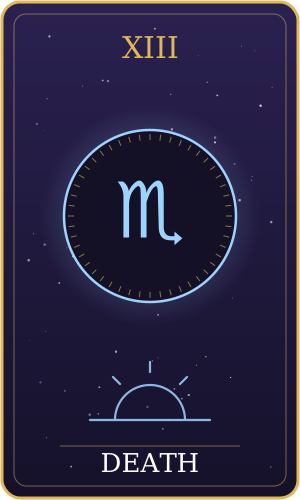
What the Death card means
The Death card has a fearsome reputation, and it is worth settling the main point at the start: on this site, and in nearly all modern tarot practice, the card does not mean physical death. It is a symbol of transformation. The title is a dramatic way of naming something that happens to everyone many times in life, which is that a phase finishes and cannot be continued in the same form.
In the traditional Rider-Waite-Smith picture, a skeleton in black armor rides a white horse across a field. The armor suggests that change is unstoppable and does not negotiate. The horse is white, the color of purity, and carries a black flag decorated with a white five-petaled rose, a symbol of beauty and renewal. Around the horse, people react in different ways: a king lies fallen, a bishop pleads, a young woman looks away, and a child offers flowers.
Those figures are the heart of the image. The fallen king shows that rank and power do not hold off change. The bishop shows that argument does not stop it either. The woman turning away shows how hard it is to look at an ending directly. The child, who simply offers flowers, shows an easier relationship with change, one that meets it without panic. In the distance, between two towers, the sun rises or sets over a river, which many readers take as the promise of a new day waiting on the other side.
So the card is less a threat than a portrait of how we respond to endings. Some of us plead, some of us look away, and some of us accept. Our site shows its own artwork rather than the classic image, but the lesson carries over: change arrives whether or not we are ready, and how we meet it is the part we can work on.
If you are grieving a real loss, please know that this card is a symbol and not a comment on what happened. A card is not a substitute for support from the people around you or from a grief counselor, and it is perfectly fine to set the card aside if it feels too close.
Because the card sits at number 13, in the middle of the Major Arcana, it also marks a hinge in the story. Everything before it has been about building a self, and what follows asks that self to be refined, blended and tested.
Death upright
Upright, the card says that something is ending and that the ending is part of a larger cycle. It could be a job, a living situation, a belief, a friendship, a stage of life or a long-standing pattern. The card does not judge whether the ending is happy or sad. It simply says it is real and that it clears space.
The main theme is transformation. A seed has to stop being a seed before it becomes a plant, and the Death card speaks to that kind of change, where the old form cannot continue if the new one is to grow. Readers often connect the card with periods of renewal that begin by taking something away.
A second theme is release. The card asks what has already finished but is still being carried around: a role that no longer fits, a resentment, a plan that stopped making sense a while ago. Many people find that naming it out loud is a relief, because the energy spent holding it up can be used somewhere else.
A third theme is acceptance. The skeleton does not hurry and does not stop. There is a calm in the way the card portrays the process, and it can be a reminder that resisting an ending usually costs more than going through it.
Finally, the card points to what remains. After the clearing, the essentials are still there. That is why many readers describe Death as a card of both loss and relief: the leaves fall, and the structure underneath becomes visible.
Common upright keywords include endings, transformation, transition, release, clearing out and renewal.
Death reversed
Reversed, the card usually describes resistance to change. An ending has arrived or is overdue, but it is being postponed, denied or fought. This might look like staying in a situation long past its natural close, keeping an object or habit out of fear of what happens next, or telling the same story about yourself after it has stopped being true.
A related reading is stagnation. When nothing is allowed to end, nothing new has room to start, and life can begin to feel flat or repetitive. The reversed card may be hinting that a bit of deliberate clearing, such as finishing a project, deleting what is unused or having an honest conversation, would get things moving again.
Another reading is a slow transition. Not every change arrives as a single dramatic event. Sometimes it is gradual, half-finished and a little uncomfortable, and the reversed card can describe being caught in that middle, where the old thing has loosened but the new one has not yet formed. Patience with a messy middle is often the advice.
The reversed card can also show fear of endings in general: a sense of dread about change that stops a person from trying anything new. The card does not scold. It notes the fear and invites a smaller step, something that makes the change feel manageable.
Keep in mind that reversed Death still does not mean physical death. It means that the cycle of ending and renewal has stalled somewhere.
Typical reversed keywords include resisting change, holding on, stagnation, slow transition and fear of endings.
Death in love and relationships
In a love reading, Death is about a change in the shape of a relationship, not a prediction about it. It may point to a stage that has run its course, such as the early excitement giving way to something steadier, or two people growing out of the roles they once played for each other. The card can describe the end of a pattern as much as the end of a relationship.
For couples, it can suggest that a relationship is ready for a new form. That could be a deeper commitment, a different way of dividing responsibilities, or a fresh start after a rough period. A pattern that has been repeating, such as the same argument or the same silence, may be due to finish.
For someone who is single, the card often points to closing a chapter. It might be letting go of an old attachment, ending a cycle of dating people who are not a good fit, or releasing an idea of what love should look like. After that clearing, there is room for something different, though the card makes no promise about what or when.
As feelings, the card can describe a person who is going through a significant internal shift and may seem different from before. They could be reassessing what they want, or processing the end of something. It is not a reliable sign of how they feel about you, and it should not be used as a verdict.
Reversed in love, the card can describe holding on to a connection out of habit or fear, or being unable to move on from a past relationship. The suggestion is to look honestly at what is being protected. Sometimes the answer is a person worth keeping, and sometimes it is only the comfort of the familiar. Either answer is useful to know.
Death in career and work
At work, Death speaks to endings and transitions in how you earn your living or spend your days. It may reflect the close of a project, the end of a role, a restructuring, or a quieter inner sense that a path has run its course. The card is neutral about whether the change is chosen, and it focuses on what clearing space makes possible.
Many people draw it when they are thinking about a change of direction. In that setting it can be read as a prompt for reflection: which parts of the current path still feel alive, and which are being kept going from habit? It does not advise quitting or staying. Decisions about employment deserve real information, not just a card.
The card also fits the idea of retiring old methods. A team that updates a workflow, a person who stops saying yes to everything, or a business owner who retires a product that no longer serves anyone might all be living out this card. The theme is pruning to allow healthier growth.
Reversed, it can describe clinging to a role or way of working because the alternative feels unknown. It might also describe a transition that is happening more slowly than hoped. A useful question is what small piece of the old way could be set down this week.
As with every card on this site, this is a theme for reflection. It contains no predictions about layoffs, hiring, income or any other outcome.
Is Death a yes or no card?
Tarot does not come with official yes and no values, so this is a convention. Most readers treat Death as a no, or at least a not in its present form, since the card is about endings. This is the value our yes-or-no tool uses, and it is an editorial choice rather than a fact about the card.
The no is often softer than it sounds. If you ask whether a situation will carry on as it is, Death suggests it will not stay the same. If you ask whether a change will come, the card may lean toward yes. Readers who use the card for yes-or-no questions often look at how the question was phrased, because the same card can read as a no to continuing and a yes to transformation.
Reversed, Death is still a no in the tool: the rule only moves a yes to a maybe and a maybe to a no, so a no stays put even though the change is possible but resisted. A reversed Death is only dealt when you tick "Include reversed cards", which is off by default. As always, the tool is for fun and reflection, and not for decisions about health, money, law or safety.
Death and astrology
In the Golden Dawn tradition, Death corresponds to the sign Scorpio. This is a traditional correspondence, offered as tradition rather than as fact, and other tarot systems differ. The link is easy to understand. Scorpio is a fixed water sign, ruled by Mars in the classical scheme with Pluto as its modern co-ruler, and it is associated with depth, intensity, endings and rebirth.
Pluto in particular has long been tied to themes of transformation: the stripping away of what is not essential. Scorpio is the part of the zodiac that does not look away from difficult feelings, and the Death card is the part of the tarot that does the same.
To connect this to your own chart, look at where Scorpio sits for you. The house that holds Scorpio, and the house where Pluto lands, point to areas of life where change tends to happen in deep, sometimes slow waves. Planets in Scorpio may carry something of the card's intensity and capacity for renewal. You can find your Scorpio placements, and the position of Pluto, with our natal chart calculator.
This is about themes and tendencies and not about outcomes. A Scorpio emphasis does not predict endings, and a chart without one is not shielded from change.
Death as advice
As advice, the card suggests identifying what has already ended and allowing it to be over. That might be a small, concrete act: closing an account, giving away clothes that belong to an earlier version of you, or writing down the lesson of a finished chapter and then putting the page away.
It also suggests marking transitions. Rituals, however simple, help the mind register that something has changed, whether it is a walk, a letter you do not send, or a meal with people who knew the old chapter.
If you are afraid of the change in front of you, the card suggests making it smaller. What is one step that would not need all the answers? Often a gentler pace makes a significant transition far more bearable.
Finally, keep faith with what remains. Endings tend to reveal what matters, such as the people who stay, the skills that carry over, and the values that were there all along. The card asks for honesty about the past and some trust in the space it opens up.
Death corresponds to Scorpio. See whether Scorpio is among your big three; read about Scorpio rising; read about the Scorpio Moon, or read the Scorpio horoscope for 2027.
Frequently asked questions
Does the Death card mean death?
No. The Death card is a symbol of transformation, endings and renewal, and it is not a prediction of physical death. Tarot is used here for reflection and entertainment, and on this site the card is always read as a chapter closing so another can begin. The skeleton in the traditional image represents change that cannot be bargained with, not a literal event. If you are grieving someone, remember that a card cannot stand in for the people around you or for a grief counselor.
Is Death a bad card in tarot?
Not really. It looks dramatic, but most readers consider it one of the more constructive cards because it clears space for something new. Endings can be uncomfortable, and the card does not hide that. Still, its core message is renewal: letting go of what has finished so that energy is free for what comes next.
What does the Death card mean in love?
It usually points to a transition in a relationship or in your approach to love, such as a phase ending, a pattern changing, or a fresh start after letting go of the past. It does not forecast a breakup. Reversed, it can describe clinging to something familiar out of fear, or difficulty moving on from a former relationship.
What does it mean when Death comes up reversed in the yes or no tool?
Death counts as a no in our yes-or-no tool when it is upright, and it is still a no when reversed. The rule moves a yes to a maybe and a maybe to a no, but a no has nowhere further to go, even though the change is possible but resisted. The rule is an editorial convention of this site and not a teaching of tarot about Death, and reversed cards stay off unless you switch them on.
What does Death reversed mean?
Reversed, the card typically describes resistance to an ending or a transition that is stuck. Someone may be holding on to a situation, habit or identity that has already run its course, or moving through change slowly and with discomfort. It may be inviting a small, manageable step toward letting go, and it still carries no literal meaning of death.
Which zodiac sign is the Death card?
In the Golden Dawn tradition, Death corresponds to Scorpio, the fixed water sign associated with depth, intensity and rebirth. This is a traditional pairing and not every system uses it. You can see where Scorpio and its modern co-ruler Pluto sit in your own birth chart with a natal chart calculator.
 The Hanged Man
 Temperance
 The Star
 The Moon