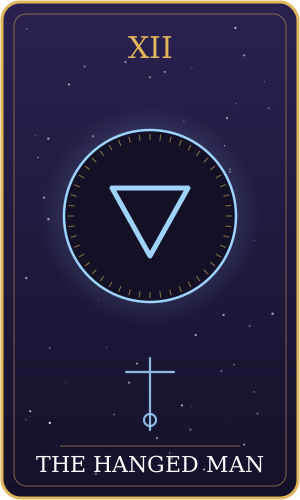
What the Hanged Man means
Most tarot cards show people doing something: marching, judging, climbing, celebrating. The Hanged Man shows a person who has stopped. In the traditional Rider-Waite-Smith picture, a man is suspended by one foot from a wooden frame shaped like a letter T. His other leg is bent behind the straight one, so his legs form a number four, and his hands are tucked behind his back. The scene is quiet, and the surprise is his face: it is relaxed, even content.
A soft glow surrounds his head, much like a halo. This is the detail that changes how the card is read. Whatever has happened to this figure, he is not suffering in the way the position suggests. The glow hints at insight, as if hanging in this odd position has shown him something that standing upright never could. The frame he hangs from is described in many decks as living wood, with leaves, which suggests that this pause is part of growth rather than punishment.
The name sounds grim, and that is one reason the card is so often misread. The image itself is old: in early Italian tarot decks the figure hangs upside down by one foot, and historians connect that pose with the way traitors were once pictured in public shaming paintings. The Rider-Waite-Smith deck changed the mood by giving the man a calm face and a glow around his head, and modern tarot reads the posture as suspension, not as an execution or a punishment. The card is about a period in which movement has been put on hold, either by choice or by circumstance, and in which the most useful thing to do is look at the situation differently.
The symbols can be read one at a time. The upside-down body stands for a reversed viewpoint, seeing the usual order of things flipped. The bound hands stand for giving up the urge to grab and fix. The calm face stands for acceptance. The T-shaped frame and living wood stand for a structure that holds you while you wait. Together they describe voluntary surrender: letting go of effort that is not working so that something else can show itself.
Our site shows its own artwork for the card rather than the classic image, but the idea is the same. Wherever you meet this card, ask what it would look like to stop pushing for a while and simply watch.
The Hanged Man upright
Upright, the card says that a pause is not a failure. It often shows up when progress has slowed, when a decision cannot be made yet, or when a person keeps forcing something that refuses to move. The message is not to give up. It is to stop treating stillness as an enemy and to use it.
The first theme is perspective. Hanging upside down changes what is visible, and the card invites the same move in a problem: argue the other side, look at it from the point of view of the person you disagree with, or ask what the situation would look like in a year. Many readers find that the answer they were hunting for was waiting on the far side of an assumption they had never questioned.
The second theme is surrender, in the gentle sense. This does not mean losing. It means releasing the grip on a particular outcome, a timeline or a story about how things must go. A person who can say, for now, I do not control this, often has more energy left for the parts they do control.
The third theme is patience with a purpose. The Hanged Man is not idle. He is attentive. Think of a gardener who has planted seeds and now waits: nothing visible is happening, yet the waiting is part of the work. Upright, the card often points to a stage like that, where the best contribution is to hold steady and pay attention.
A fourth theme is willing sacrifice. Sometimes the pause costs something, such as a fast result, a bit of pride, or a plan that needs to be set aside. The upright card suggests that the trade is chosen with open eyes and is worth it. The question to ask is what you are giving up and what you hope to gain, and whether you can name both clearly.
Keywords commonly attached to the upright card include pause, surrender, new perspective, letting go, suspension and patience.
The Hanged Man reversed
Reversed, the figure appears right side up, and the meaning shifts from a useful pause to a stuck one. The card can point to stalling: staying in limbo because a decision feels uncomfortable, or telling yourself you are waiting for a sign when really you are avoiding a choice. Waiting that has no end date and no purpose tends to drain energy rather than restore it.
A second reading is resistance. The upright card asks for surrender, so the reversed card can show a struggle against a pause that is actually needed. Someone may be pushing to get through a slow season, forcing a conversation before the other person is ready, or refusing to rest when rest is overdue. The card does not scold; it simply notes that the effort is going against the grain.
A third reading is needless sacrifice. The upright figure gives something up for insight. Reversed, the sacrifice may have stopped paying off. A person might be giving time, attention or goodwill to a situation that returns nothing, and calling it patience. If that rings true, the card is a prompt to ask whether the cost is still worth it, and whether it is fine to take something back.
A fourth reading is impatience. Some people draw the reversed card when they are desperate to skip the quiet middle of a process and get to the result. The card suggests that skipping it may not be possible, and that hurrying could undo what the pause was building.
Finally, reversed can also describe someone who has finally begun to come down from a long wait. In that case, the card marks the end of the suspension and the return to action, with the new perspective in hand. Context decides which reading fits, and the cards around it usually make that clear.
Common reversed keywords include stalling, resistance, indecision, needless sacrifice and impatience.
The Hanged Man in love and relationships
In a love reading, the card often describes a relationship, or a stage of one, that is on hold. Two people might be waiting on a move, a conversation or a change in circumstances. The upright card suggests that this stillness can be used well: by listening more, by dropping the urge to control how things unfold, and by seeing the other person's side before reacting.
For someone who is single, the card can describe a deliberate break from dating, a time of not chasing, or a shift in what they are looking for. It often fits people who have been trying hard and are now willing to loosen their grip and see what comes. The advice is gentle: a quiet stretch is not wasted time, and it may be when preferences become clearer.
In a couple, the Hanged Man can suggest that a standoff is better solved by changing viewpoint than by winning the argument. Swapping sides, even in imagination, tends to soften things. It can also point to a willingness to make a small sacrifice for the relationship, such as giving up the last word, as long as the giving feels free and is mutual.
Reversed in love, the card can describe stalling that has gone on too long: staying in an undefined situation because naming it feels risky, or waiting for a partner to change while giving up your own needs. It can also show one person making all the sacrifices. The question it raises is whether the pause is shared and purposeful or simply a way of avoiding an honest talk.
As feelings, the card can describe someone who is unsure and holding back, not out of indifference but because they are weighing something carefully. They may feel suspended between two choices. It can also describe a person who feels they have put their own wishes aside for the sake of the connection. Because this is one card among many, it is best read as a mood, not a verdict about what another person thinks.
The Hanged Man in career and work
At work, the card often turns up when a project is stuck, a promotion decision is delayed, or a plan is waiting on someone else. The upright reading suggests that this is a time for reflection rather than force. It can be a chance to rethink the approach, gather information, or view the problem from a customer's, a colleague's or a manager's side.
The card also fits periods of transition. A person between roles, on leave, or in a slow season may draw it. It can say that a gap in activity is a legitimate stage and that something useful may be formed in it, such as a new skill, a clearer sense of direction, or fresh energy. This is a theme, not a forecast of how any specific job situation will turn out.
Another work meaning is the willing trade-off. The figure gives up comfort for insight, and in a career context this might mean taking a lateral move to learn something, working on an unglamorous task that builds experience, or letting a colleague take the credit for a smaller piece in order to protect a bigger goal. The card asks whether the trade is chosen and understood.
Reversed, the card can describe being stuck in a role out of inertia, or feeling that an endless wait for a decision is wearing you down. It may also show overwork that is passing itself off as sacrifice. A useful question is what concrete step is available, even a small one, that would turn the waiting into movement.
The card does not give financial or career-decision advice, and a reading is a prompt for reflection, not a reason to quit or stay. If a decision truly matters, it deserves proper information and, where relevant, qualified professional input.
Is the Hanged Man a yes or no?
Tarot has no official table of yes and no values. Readers assign them as a convention, and conventions differ. Most readers treat the Hanged Man as a maybe, because the card is about suspension: the matter is undecided, on hold, or not ready. This is also the value our yes-or-no tool uses, and it is a choice we made, not a fact about the card.
In practice, a maybe from this card often reads as not yet. It can mean that more information is needed, that timing is off, or that the question should be looked at from a new angle before a choice is made. Drawn reversed, the Hanged Man reads as a no in our tool, since every reversed card slides one step toward no; the stall suggests that the pause has not resolved anything. A reversed the Hanged Man is only dealt when you tick "Include reversed cards", which is off by default.
It helps to phrase the question so it can be explored. Instead of asking whether something will happen, try asking what you might need to see differently about it. Used that way, the card is a good fit for the tool, which is meant for fun and reflection rather than for decisions about health, money, law or safety.
The Hanged Man and astrology
In the Golden Dawn tradition, which many modern decks follow, the Hanged Man is linked to the element of Water. This is a traditional correspondence, not something every reader accepts, and other systems assign it differently. Still, the pairing is easy to feel. Water yields, takes the shape of its container, and finds its level without force. It flows around obstacles instead of pushing through them.
Water is also the element of feeling, intuition and the inner life, and the Hanged Man is a card of inner work: a pause in outer activity that makes room for something deeper to surface. Water signs are Cancer, Scorpio and Pisces, and many people find the card especially meaningful when their emotional world is asking for attention.
To connect the idea to your own chart, look at where your planets fall by element. A chart with several planets in Water signs may find the card a familiar description of how it works: gathering impressions quietly before acting. A chart low in Water may find the card a useful reminder to slow down and check how it feels before moving on. You can see your element balance, and which planets sit in Cancer, Scorpio and Pisces, by running your birth data through our natal chart calculator.
None of this predicts anything. Elements describe styles, and the correspondence is one lens among several for thinking about the card.
The Hanged Man as advice
As advice, the card suggests that you stop pushing for a moment and look at the situation from a second position. A few practical ways to do that: write down the problem, then write it again from the viewpoint of someone affected by it. Take a day without making the decision. Ask a friend who sees things differently to describe what they notice.
It also suggests naming what you are holding on to. Is it a deadline, a story about what ought to happen, or a hope that someone else will act first? Noticing the grip is often the first step in loosening it.
Give the pause a shape. Waiting is easier when it has an edge: a week to think, a date to revisit, a question to answer in that time. That keeps the card's patience from sliding into the stalling of the reversed version.
Lastly, treat the pause with some kindness. Stillness feels unproductive in a culture that rewards motion, and the card asks for a different measure. If you can rest in the pause without judging it, you may find that the insight arrives on its own schedule, and that it was worth the wait.
The Hanged Man corresponds to the element of water. See your element balance.
Frequently asked questions
Does the Hanged Man mean death?
No. The name sounds grim, but modern tarot does not read the card as death or as punishment. Early Italian decks showed a figure hanging upside down by one foot, a pose linked with shaming pictures of traitors, but the Rider-Waite-Smith image gave him a calm face and a glow. Today the theme is a pause, a change of perspective and willing surrender. In readings it is a card about stillness, patience and seeing a situation from another side.
What does the Hanged Man mean in a relationship?
Usually a pause or a standoff that benefits from a new viewpoint. It can describe a relationship waiting on a decision, or someone who is holding back to think. The advice is to listen, drop the need to control the pace, and consider the other person's side. Reversed, it can point to stalling or one-sided sacrifice that deserves an honest conversation.
What does it mean when the Hanged Man comes up reversed in the yes or no tool?
Upright, the Hanged Man is a maybe here. The tool is built so that a reversed card slides the answer one step toward no, which turns this maybe into a no, since the stall suggests that the pause has not resolved anything. That is a convention we chose for the tool, not an official tarot rule for the Hanged Man, and you only see it when the "Include reversed cards" box is ticked. Otherwise every card arrives upright.
What does the Hanged Man reversed mean?
Reversed, the card usually points to a pause that has turned into stalling. It can describe resisting a rest you need, avoiding a decision, making a sacrifice that no longer pays off, or being impatient with a slow stage. It can also mark the end of a long wait and a return to action, depending on the cards around it.
What is the Hanged Man's astrological sign?
In the Golden Dawn tradition, the Hanged Man corresponds to the element of Water, not to a single sign. Water includes Cancer, Scorpio and Pisces. Not every tarot system agrees on this, so it is best treated as tradition. You can look at where your own planets sit in Water signs with a natal chart calculator.
Why is the Hanged Man upside down?
The inverted position stands for a reversed point of view. Seeing the world upside down means the usual order is flipped, and old assumptions can be questioned. The figure's calm face and the glow around his head suggest that the position brings insight rather than pain. It is a picture of choosing to look at things differently.
 Justice
 Death
 The Star
 The Moon