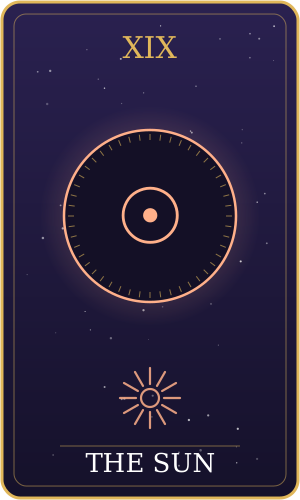
What the Sun means
After the half-light of the Moon, the Sun is the moment the curtains open. It stands for clarity, vitality and the plain pleasure of things being what they appear to be. Readers often describe it as the card of a good day, whatever shape a good day takes for them.
Unlike cards that dramatize struggle, the Sun is mostly uncomplicated. It does not demand effort or sacrifice, and it does not carry a hidden lesson. Its message is closer to permission: it is fine to enjoy this, to be seen, to take up space in the warmth.
In the traditional Rider-Waite-Smith picture, a large sun with a calm face and long alternating rays fills the upper sky. Below it, a small, cheerful child sits on a pale horse, arms spread, holding a bright red banner. Behind them is a low stone wall, and above the wall rise tall sunflowers, all turned toward the light.
Our site uses its own artwork instead of the classic illustration, but these are the symbols tradition connects to the card. The overall effect is meant to be openness: nothing hidden, nothing guarded, and nobody in danger.
The symbols, one at a time
The child is the heart of the picture. Children in tarot imagery usually stand for a state of trust before self-consciousness arrives, a way of being that responds to the moment instead of managing it. The figure is also unarmored and unafraid, which suits the card's mood of ease.
The white horse is often read as strength that has been made friendly. The animal is calm, and the child needs neither reins nor saddle, which suggests that power and gentleness can coexist.
The red banner is a bright, simple flag of life force. Some readers read it as a sign of enthusiasm worn openly. It sits against the blue sky as a deliberate contrast, warm against cool.
The wall and the sunflowers tell a gentle story. The wall marks a boundary the scene has outgrown or can safely look over, and the flowers, which track the sun across the day, show how natural it is to turn toward what nourishes you. Even the rays of the sun alternate straight and wavy, as if light were both a line and a motion.
The Sun upright
Upright, the Sun describes warmth, success of the everyday kind and a feeling of things falling into place. It may show up when a worry resolves, when a project finally feels clear, or when someone simply has more energy than they have had in a while.
It is also a card of authenticity. Where other cards deal in masks and roles, the Sun suggests being straightforwardly yourself. Many readers connect it with confidence that does not need an audience and a sense of humor that includes the person telling the joke.
Joy is a legitimate theme here, and the card encourages noticing it. People often hurry past good moments because they are looking for the next task. The Sun invites a pause: a meal with friends, a sunny walk, news worth celebrating.
For reflection, an upright Sun raises a friendly question: what is working right now, and am I letting myself enjoy it? The answer can be as small as a good coffee or as large as a milestone.
The Sun reversed
Reversed, the Sun is rarely dark. It is better read as light behind a thin cloud. The brightness exists, but something is muting it: tiredness, a delay, a mood that will not lift, or a plan that is slower than hoped.
One reading focuses on overdoing it. Too much sun can be tiring, and the reversed card may point to pushing for cheerfulness when real feelings need attention, or to confidence that has tipped into carelessness. The suggestion is to check in with what is actually true.
Another reading is about joy that is hard to access. A person might have good things in their life and still not feel them. The card does not judge that. It suggests small, low-pressure ways back toward warmth, such as sunlight, movement and company.
Because the Sun is such a cheerful card, drawing it reversed can feel disappointing. A more useful view is that clouds pass. If low mood lingers, talking with a qualified professional is far better than relying on tarot.
The Sun in love and relationships
In love readings, the Sun is among the friendliest cards. For couples, it points to warmth, honesty and fun: the kind of closeness where jokes land and silences are comfortable. It can also describe a relationship that feels natural and easy to be public about.
For single readers, the Sun often suggests being open and visible. It favors an approach of enjoying people's company without rehearsing outcomes. Meeting new people in daylight settings, with friends or through shared interests, fits its spirit.
As feelings, the Sun can describe someone who feels happy, affectionate and fairly direct about it. They are likely to say what they mean and be open about their enthusiasm. That is a tendency, not a certainty, and a card cannot read a specific person.
Reversed in love, it may point to a bit of strain, such as a couple that has lost playfulness or a person holding back affection out of caution. Planning something simple and light together is the card's easy remedy.
The Sun in career and work
At work, the Sun is the card of recognition and momentum. It can describe a project going well, a talent being noticed or a team feeling aligned. It often favors visibility, such as presenting your work, sharing credit and making the effort easy for others to see.
It also suggests that energy and enjoyment are useful signals. Many readers use the Sun as a prompt to ask which tasks make them feel alive, and to notice how much of a week those tasks occupy.
In leadership, the Sun stands for the kind of warmth that makes others comfortable asking questions. It is optimistic without being naive, and its main skill is clarity: saying plainly what is going on.
Reversed, the card may reflect burnout, delayed results or a loss of enthusiasm. It may also warn against overconfidence, such as assuming something is settled before it is. No card gives career or financial advice, so real decisions deserve real information.
Is the Sun a yes or no card?
In the convention used by this site, the Sun is a clear yes. Most readers who use tarot for yes-or-no questions treat it as one of the most positive cards, because its themes are clarity, joy and success. This is an editorial convention rather than a tradition fixed in stone, and it is the one our yes-or-no tool uses.
Drawn reversed, the Sun reads as a maybe in our tool, since every reversed card slides one step toward no; a passing cloud suggests patience or a second look at the details, even though the brightness is there. Remember that "Include reversed cards" starts unticked, so you will see the Sun reversed only after you turn it on.
A yes from the Sun is a friendly encouragement, not a guarantee. It can be a good moment to ask what would make the question easier to say yes to in real life, and to move ahead thoughtfully.
Yes-or-no tarot is for fun and reflection. It is not a tool for deciding matters of health, money, law or safety, where qualified advice matters.
The Sun and astrology
Unlike most cards, the Sun is tied to the body of the same name. In the Golden Dawn system, the Sun card corresponds directly to the Sun, which makes it one of the simplest correspondences in the deck. This is tradition, not proof of anything, but it gives the card a clean link to the birth chart.
In astrology, the Sun is linked with identity, vitality and the core of how a person shines. It spends about 30 days in each sign, which is how the familiar Sun-sign categories are formed. It never goes retrograde.
To tie the card to your own chart, look at the sign and house of your Sun. The sign describes the flavor of your self-expression, and the house suggests where that expression tends to feel most natural and visible. If the Sun card appears often for you, it may be worth comparing it with what you know about your Sun placement.
You can find your Sun sign and house with our free birth chart calculator. As always, astrology here is a lens for self-reflection and entertainment, and a card correspondence is a point of curiosity.
The Sun as advice
As advice, the Sun encourages simplicity and openness. Say the plain thing, share the good news, and let your enthusiasm show a little more than usual. Straightforwardness is often the quickest route to feeling at ease.
It also encourages gratitude of a practical sort. Try noting three things from the day that went well, however minor, and tell one person about them. Joy tends to deepen when shared.
Go outside if you can. The card is, after all, about daylight. A short walk, a break by a window or time spent with plants brings the symbol into your actual day.
If the Sun appears reversed, the advice is to be kind about the cloud. Reduce your list, rest, and do one small thing that you used to enjoy. The light generally returns without being forced.
The Sun corresponds to the element of the sun. See your element balance.
Frequently asked questions
Is the Sun a good card?
Yes, most readers consider the Sun one of the most positive cards in the deck. Its themes are joy, clarity, vitality and openness. Reversed, it points to a passing cloud such as tiredness or delay and not to anything harmful. Like all tarot, it is a prompt for reflection rather than a prediction of what will happen.
What does it mean when the Sun comes up reversed in the yes or no tool?
The Sun counts as a yes in our yes-or-no tool when it is upright. If you tick "Include reversed cards" and it lands reversed, the rule moves the answer one step toward no, so it becomes a maybe, because a passing cloud suggests patience or a second look at the details, even though the brightness is there. The rule is an editorial convention of this site and not a teaching of tarot about the Sun, and reversed cards stay off unless you switch them on.
What does the Sun mean in a relationship?
In a relationship, the Sun tends to describe warmth, honesty, playfulness and ease. It may show a couple enjoying each other's company or a connection that feels natural. For single readers, it suggests approaching others openly. Reversed, it can mean the fun has faded a little and could use a light, simple revival.
What does the Sun reversed mean?
Reversed, the Sun usually means joy that is muted, delayed or pushed too hard. The light is still present, but something is clouding it, such as fatigue or impatience. It can also hint at overconfidence. The suggestion is to slow down and rest. Lingering low mood deserves attention from a qualified professional.
Is the Sun tarot card the same as the Sun sign?
They are connected but not the same. In the Golden Dawn tradition the Sun card corresponds to the Sun as a planet, which in astrology governs identity and vitality. Your Sun sign is the zodiac sign the Sun occupied at your birth. The card is a symbol, while the sign is a position in your birth chart.
What does the Sun mean as feelings?
As feelings, the Sun can describe someone who feels happy, warm and straightforward, perhaps eager to spend time together. A card cannot confirm what a particular person feels, so treat it as a gentle suggestion. A direct, friendly conversation is always the more reliable way to find out.
 The Moon
 Judgement
 The Star