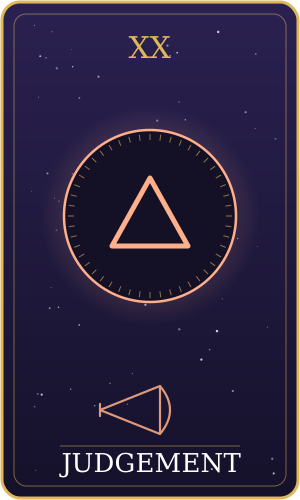
What Judgement means
The name sounds stern, but the card is more about a wake-up call than a courtroom. Judgement describes the point at which a person looks over their own story, sees what has happened and what they have learned, and feels pulled toward something new. The verdict is not delivered by an outside authority. It is a moment of recognition.
Many readers think of it as the card of a second chance. It often accompanies themes of forgiveness, both of others and of oneself, because it is hard to start a new chapter while carrying every old argument at full weight.
In the traditional Rider-Waite-Smith picture, a large angel appears in the clouds, blowing a long trumpet from which a banner hangs. Below, on a stormy sea shore, people rise from open boxes. They are pale, naked and unhurried. A man, a woman and a child lift their arms toward the sound. Snowy mountains stand in the distance.
Our site shows its own artwork rather than the classic illustration. The symbols described here are the traditional ones, and read in order they tell a simple story: a call comes, people respond, and the past is allowed to fall away.
The symbols, one at a time
The trumpet is the most important sign. A trumpet carries over distance and cannot be ignored, which makes it a fitting image for a call that shows up in a person's life with unusual clarity: a sudden conviction, an overdue conversation, a decision that has quietly made itself.
The figures rising from their coffins are often read as old versions of the self. Nobody is frightened. They look up with open faces, as if they had been waiting. This is why the card is not about death but about getting up.
The family grouping, a man, a woman and a child, is commonly taken to mean that the awakening involves all parts of a person: the active side, the receptive side and the youthful, hopeful side. It can also simply suggest that a new start is shared.
The water and the mountains frame the action. The sea can suggest the deep past, now settled, and the peaks suggest a large horizon ahead. The cross on the angel's banner is an old, balanced symbol that readers in any tradition can treat as a mark of harmony.
Judgement upright
Upright, Judgement signals a moment of honest review. A reader might be looking back over a year, a job or a relationship and seeing it more clearly than before. They might realize what mattered, what did not and what they would like to do differently.
The card is as much about forgiveness as it is about evaluation. Seeing a past choice without defensiveness can be freeing, and the card suggests that understanding comes first and change follows.
A calling is another central theme. Judgement can describe the sense that it is time to step into a role, begin a project or speak a truth. The feeling is usually not dramatic. It is more like noticing that the old way of doing things no longer fits.
As a reflective prompt, the upright card asks: what is being called for in me right now, and what old story am I ready to put down? Journaling for ten quiet minutes is often enough to bring a first answer.
Judgement reversed
Reversed, Judgement tends to describe a call that is not being answered. The person may hear it but dismiss it, or may talk themselves out of a change that they sense is due. The card does not scold; it notes that avoidance takes energy too.
It can also point to self-criticism. A reflective moment becomes a trial, and the past is replayed with a harsh commentary. The reversed card gently suggests the same review conducted with a kinder tone, more like a friend than a prosecutor.
Another reading involves unfinished business: an apology not yet made, a decision postponed, a lesson not yet drawn. The card says there is no deadline stamped on it, but there is relief available in dealing with it.
If self-judgment feels crushing or constant, it is worth speaking with a qualified professional. A tarot card is a conversation starter and cannot replace support.
Judgement in love and relationships
In love, Judgement often points to a turning point. A couple may be reviewing what has and has not worked, and deciding together how to move forward. The card values honest conversation: naming what has happened, owning a share of it and listening to the other person's version.
It also resonates with reconciliation and fresh starts. Someone might reconnect with a person from the past, or a relationship might enter a new phase after a frank talk. Forgiveness is a recurring word, though the card does not suggest that every hurt must be dismissed.
For single readers, it can mean being ready to date from a new place, having learned from earlier experiences. A person may feel less interested in repeating old patterns and more curious about what they want.
As feelings, Judgement can describe someone who is reflecting seriously on the connection, perhaps weighing what it means to them. Reversed, the card may show hesitation, regret or an old argument that keeps being revisited.
Judgement in career and work
At work, the card often marks a point of review: a performance conversation, the end of a project, or a personal sense that it is time to reassess where one is headed. It values taking stock before acting.
It can also describe a vocational pull, the feeling that a certain kind of work is calling. A reader might notice an interest that keeps returning, such as teaching, building or caring for others, and wonder how to give it more space.
In team settings, Judgement stands for fair, honest feedback. It favors clear retrospectives, thanks where thanks are due and learning without blame.
Reversed, it can show hesitation about a change, or an inner critic that makes a person underrate their own record. The card does not give career or financial advice, and any real decision about work should rest on facts, timelines and trusted counsel.
Is Judgement a yes or no card?
In the convention used by this site, Judgement is a maybe. Most readers see it as a card about reflection and decision rather than a clear affirmation, so the answer tends to be that it depends on what the question's asker is ready to do. This is an editorial convention and it is the one our yes-or-no tool uses.
If Judgement lands reversed, our rule turns the maybe into a no, because something needs more thought, or a conversation, before moving ahead. If the "Include reversed cards" box stays unticked, as it does by default, Judgement always arrives upright. The card suggests that the question needs a little more thought, or a conversation, before moving ahead.
A maybe from Judgement can be useful. It invites the asker to examine their own motives, to ask what they really want, and to consider whether they are answering a genuine call or just reacting.
Yes-or-no tarot is entertainment and a prompt for reflection. It makes no claim about what will happen and should never be used for matters of health, money, law or safety.
Judgement and astrology
In the Golden Dawn tradition, Judgement corresponds to the element of Fire. That is a traditional assignment from one particular system, and other systems link it to other things, but it is the one used on this site.
Fire is the element of the three fire signs, Aries, Leo and Sagittarius. It is associated with energy, inspiration, courage and the spark that sets things in motion. Judgement's trumpet call, which stirs people to rise, fits the idea of fire as a force that wakes and transforms.
To connect the card to your own chart, look at where your fire placements sit. Count the planets in Aries, Leo and Sagittarius and notice the houses they occupy. Those houses can hint at areas where inspiration and action tend to come easily.
Our free birth chart calculator shows these placements. Treat the pairing as a prompt for reflection, since astrology here is for self-understanding and entertainment, not for predictions.
Judgement as advice
As advice, Judgement suggests taking an honest, kind look at the recent past. Choose a period, perhaps the last year, and write down what went well, what was hard and what you would like to carry forward. Keep the tone fair.
Then listen for the call. Ask what you keep returning to, or what you keep postponing even though it nags at you. A good test is whether the idea feels like relief or like pressure.
Forgiveness, where it feels right, is a practical step as well as an emotional one. Releasing an old grudge, or acknowledging your own part in something, can free up energy for what is coming.
If the card appears reversed, start smaller. Say the sentence you have been rehearsing, or complete one unfinished task. Waking up usually happens in stages, and one gentle step counts.
Judgement corresponds to the element of fire. See your element balance.
Frequently asked questions
Does the Judgement card mean I am being judged?
No. Despite the name, the card is about self-reflection and renewal, not punishment. It shows people rising up and responding to a call. The judging in question is the honest review each person can make of their own past. A reading is always a prompt for reflection and never a verdict on a person.
What does it mean when Judgement comes up reversed in the yes or no tool?
Upright, Judgement is a maybe here. The tool is built so that a reversed card slides the answer one step toward no, which turns this maybe into a no, since something needs more thought, or a conversation, before moving ahead. That is a convention we chose for the tool, not an official tarot rule for Judgement, and you only see it when the "Include reversed cards" box is ticked. Otherwise every card arrives upright.
What does Judgement mean in a relationship?
In a relationship, Judgement often marks a turning point, with honest conversation, review and sometimes reconciliation or a fresh start. It encourages owning your share of what happened and listening to the other person. Reversed, it may show hesitation or an old issue that keeps resurfacing and needs to be addressed calmly.
What does Judgement reversed mean?
Reversed, Judgement commonly describes ignoring a call, doubting yourself or being too harsh about the past. It can also point to unfinished business that is easier to face than to avoid. The suggestion is to review things with kindness and take one small step. Persistent self-criticism is worth discussing with a professional.
Which element goes with Judgement?
In the Golden Dawn tradition, Judgement corresponds to Fire. Fire relates to the signs Aries, Leo and Sagittarius and to inspiration, courage and renewal. This is one traditional system among several, and it is simply a symbolic link you can explore alongside your own birth chart if you enjoy astrology.
Is Judgement a good or bad card?
It is neither. Judgement is a card of honest reflection and fresh starts, which can feel uncomfortable before it feels freeing. Most readers see it as constructive, since it points toward learning and renewal. How it lands depends on how kindly the person looks at their own story.
 The Sun
 The World
 The Star
 The Moon