What the Ace of Pentacles means
Think of an Ace as a doorway rather than a destination. Each of the four suits opens with one, and each offers the raw material of its element before anyone has decided what to do with it. For Pentacles, the element is Earth, so the gift is practical: something you can touch, plant, build, schedule or save.
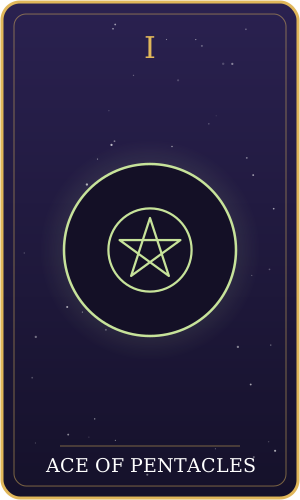
In the traditional Rider-Waite-Smith picture, a hand emerges from a bank of cloud and holds a large golden coin, steady as a platter. A five-pointed star is engraved on its face. Below, a tidy garden stretches out, bordered by a hedge with an arched opening, and a path leads through it toward distant mountains.
Our site uses its own artwork for the card rather than the classic illustration, but the symbols described here are the ones tradition attaches to it. The overall mood is calm and generous. Nothing is rushed, nothing is hidden, and the offer is simply there for whoever notices it.
The core message is that a real possibility has appeared, and that it is the sort that grows through patient handling. It is not a lottery ticket. It is closer to a packet of seeds with the soil already prepared.
The symbols, one at a time
The hand from the cloud is a feature shared by all four Aces. Readers usually take it to mean that the opportunity comes from beyond your own planning: a conversation, a vacancy, an idea that turns up at a good moment. The hand offers but does not push, which leaves the choice about accepting it with you.
The coin itself, called a pentacle in this deck, carries a star with five points. Tradition links the five points with the four elements plus spirit, a way of saying that material things and meaning belong together. A modern reader might simply see a reminder that money and possessions mean most when they serve something you care about.
The garden below is orderly and in bloom. Lilies and other flowers suggest growth that has already been tended. The hedge frames the scene as a protected, cultivated place, a picture of foundations that are safe enough to build on.
The archway in the hedge and the path to the mountains work as a pair. The arch marks the point where a person steps from preparation into action, and the far peaks suggest that the route is long. Tarot imagery often uses mountains for ambition, and here they sit in the distance, patient and unhurried.
The Ace of Pentacles upright
Upright, this Ace points to a promising start with a practical shape. It may show up when a person is weighing a new role, a course, a creative project, a home improvement or a plan to build a steadier daily rhythm. The common thread is that the opening is concrete enough to act on.
Typical keywords include opportunity, foundation, stability and tangible results. The card is less about excitement than about reliability. A reader who draws it might ask what small first step would turn the idea from a wish into something with edges, such as a calendar entry, a budget of time or a rough list of materials.
The Ace also speaks of being well supported. Because Earth is the element of the body and the physical world, readers often tie the card to a sense of being settled, rested and at home in your circumstances. That settled quality is what lets a new beginning last past the first week of enthusiasm.
Used for reflection, the upright Ace is a good prompt for one question: what am I being offered that I have not quite looked at yet? The answer is often something modest that has been sitting in plain view.
The Ace of Pentacles reversed
Reversed, the coin may be offered but not taken. The reading often concerns a missed or half-seen opportunity, or a plan whose foundation is thinner than it looks. A person may be hesitating, waiting for perfect conditions that never quite arrive.
Another common reading is poor timing or poor preparation. The idea might be sound while the groundwork is missing, such as unclear priorities, an overpacked schedule or no realistic sense of the effort involved. The card then asks for a pause to firm up the basics before committing.
A third reading is about scarcity thinking. When a person is tired or worried, even a good opening can look like a burden, and the mind lists every way it could fail. The reversed Ace may simply reflect that mood, which usually eases once a bit of rest and information are in hand.
None of this is a warning about outcomes. A reversed card is a mirror for the present moment, and a practical response is often small: write down what the opening would require, ask someone with experience, or sleep on it. For serious worries about money or work, real information and qualified advice matter far more than any card.
The Ace of Pentacles in love and relationships
In love readings, the Ace of Pentacles is grounded and sincere. For someone in a relationship, it can describe a new stage built on practical trust, such as sharing a calendar, planning a trip, deciding how to divide household tasks or simply creating a more comfortable routine. The affection here is shown through reliability.
For single readers, the card often points to a slower, steadier approach to dating. It may suggest meeting someone through ordinary life, such as a class, a neighbor or a friend's gathering, and letting a connection grow through repeated, easy contact. It is not a promise that anyone will appear, only a hint about what a healthy opening might feel like.
As feelings, the Ace can describe a person who is warm in a practical way. They may show care by fixing things, cooking, remembering your schedule or turning up on time. They might not be the type for sweeping speeches, and may be quietly serious about seeing where things could go.
Reversed in love, the card may describe a relationship where the practical side is neglected, or a person who holds back out of caution. It can also reflect a connection that feels full of potential but has no shared plan behind it. A simple, honest talk about expectations is often the useful move.
The Ace of Pentacles in career and work
Work is the natural home of this card, and its themes are concrete: a new role, a training opportunity, a side project, a fresh responsibility or a better system for managing tasks. It tends to describe the first visible piece of something that will take time to build.
Readers often connect the Ace with craftsmanship and with taking pride in doing a thing properly. A person drawing it might consider where they would like to invest steady effort over the coming months, and which of their skills deserves more room. The card favors sustained, honest work over shortcuts.
In a team, the Ace can stand for a pilot project or a proposal that has practical backing. It reminds a group to test an idea on a small scale before expanding. A tidy plan, clear roles and realistic timelines belong to its spirit.
Reversed, it may reflect a project that stalls for lack of resources or planning, or a worry about whether an opportunity is worth the cost. This site treats the money side of the card as a theme only. It offers no financial or career advice, and decisions about income or employment deserve real information and professional guidance.
Is the Ace of Pentacles a yes or no card?
In the convention used by this site, the Ace of Pentacles is a yes. Most readers who use tarot for quick questions treat Aces as openings, and this one is the most practical of the four, so it leans toward a go-ahead. That reading is editorial, not ancient law, and other readers shade it another way. Our yes-or-no tool uses this version.
If the Ace lands reversed, our rule softens the yes into a maybe, since the opportunity may be real but the groundwork or timing needs attention first. Reversed cards only appear in the tool when you tick "Include reversed cards", and that box starts unticked, so by default this card gives a yes.
A yes from the Ace is best heard as encouragement to look closely at an opening, not a guarantee that it will work out. The format is meant for fun and reflection, and a single card cannot tell anyone how a situation will turn out.
Questions about health, money, law or safety are not suited to a card draw. Those are better handled with qualified advice and trustworthy information.
The Ace of Pentacles and astrology
In the Golden Dawn tradition, which shaped most modern tarot decks, the four Aces are assigned to the four elements, and the Ace of Pentacles belongs to Earth. This is a correspondence from tradition, and other systems have made different assignments, but it is the one this site follows.
The three earth signs are Taurus, Virgo and Capricorn. Taurus is fixed and ruled by Venus, Virgo is mutable and ruled by Mercury, and Capricorn is cardinal and ruled by Saturn. Together they describe the practical side of a chart: the body, daily habits, the senses, skills, structure and the slow building of results.
Because the Ace is the root of the element rather than one of its signs, it is a good card to compare with your whole chart's balance. Count how many planets sit in Taurus, Virgo and Capricorn. A chart rich in earth placements may find the Ace feels familiar, since the card describes a way of working that such charts often prefer.
You can look at those placements with our free birth chart calculator. Astrology here is a lens for self-reflection, and a card correspondence is a thread to follow out of curiosity, not a prediction about anyone's life.
The Ace of Pentacles as advice
As advice, the Ace suggests starting small and starting real. Choose one concrete step you can finish this week, such as an email, a phone call, a sketch of the plan or an hour of focused practice. Momentum in the earth suit comes from repeated action, not from a grand announcement.
It also encourages preparing the ground. Before taking on something new, look at what it will need from your time, your energy and your space. A realistic plan is not a lack of confidence; it is the part of confidence that holds up under ordinary weather.
Try a short exercise. Write down the opening in a single sentence, then list three things that would make it easier to say yes and three that would make it harder. Seeing both lists on paper often shows whether the timing suits you.
If the card comes up reversed, the advice is to slow down and tidy the basics: sleep, schedule, a clear question and a trusted person to talk it over with. The coin is still held out, and the Ace asks for patience, not perfection.
Ace of Pentacles corresponds to the element of earth. See your element balance.
Frequently asked questions
Is the Ace of Pentacles a good card?
Most readers see the Ace of Pentacles as an encouraging card. It stands for a practical new beginning, a real opening that can be built on with steady effort. Reversed, it points to hesitation or shaky groundwork instead of anything harmful. As with every card, it is a prompt for reflection and not a forecast of results.
What does the Ace of Pentacles mean in a relationship?
In a relationship, the Ace often points to a grounded fresh start: shared plans, dependable habits and affection shown through practical care. For single readers it suggests a slow, steady approach to meeting people. Reversed, it may describe a connection with plenty of potential but little shared planning, where an honest conversation about expectations could help.
What does the Ace of Pentacles reversed mean?
Reversed, the Ace of Pentacles usually describes a missed or hesitant opening, or a plan that lacks solid preparation. It can also reflect scarcity thinking, where every opportunity looks risky. It is not meant as a warning. It suggests slowing down, firming up the basics and gathering real information before committing.
What does the Ace of Pentacles mean as feelings?
As feelings, the Ace can describe someone who is sincere, steady and practical in how they show care. They may prefer actions to speeches, such as helping out or making plans that include you. A card cannot read another person's mind, so treat this as a thoughtful guess and a prompt to ask them directly.
Is the Ace of Pentacles a yes or no card?
On this site the Ace of Pentacles is a yes, because Aces are read as openings and this one is the most practical. Reversed, the tool shows a maybe instead, but only if "Include reversed cards" is ticked. The mapping is our own editorial choice, offered for fun and reflection. It claims no accuracy.
Which element goes with the Ace of Pentacles?
In the Golden Dawn tradition the Ace of Pentacles corresponds to Earth, the element of the physical world, the body and practical results. The earth signs are Taurus, Virgo and Capricorn. The pairing comes from tradition, and other systems assign things differently. Several earth placements in your birth chart may make the card feel familiar.
 King of Swords
 Two of Pentacles
 The Star
 The Moon