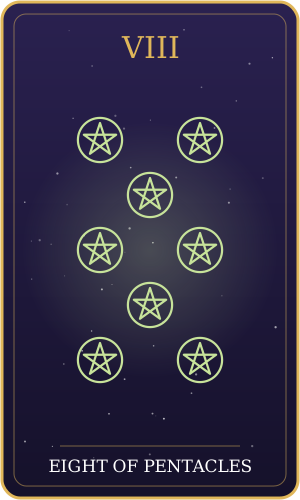
What the Eight of Pentacles means
Every deck has a card for the moment when talent stops being enough and practice takes over. This is that card. The Eight of Pentacles sits in the middle of the Pentacles suit, after the first spark of an idea and before the harvest, in the long stretch where the real learning happens.
In the traditional Rider-Waite-Smith picture, a worker in a leather apron sits on a stool at a plain wooden bench. He holds a small chisel and hammer and is tapping a design into a round coin. Several finished coins are fixed to a post beside him, and a few more are stacked at his feet.
Behind him, a small town sits on a distant hill, but his back is turned to it. The path leading there is empty. Nothing in the scene suggests an audience, a deadline or applause. The card is about the work itself, and about the strange calm that arrives when attention narrows to a single task.
Our site uses its own artwork instead of the classic illustration, but the traditional details are worth knowing. Think of the card as a portrait of apprenticeship: one person, one tool, one repeated motion, and a growing row of results.
Reading the image closely
The row of coins on the post is the quiet heart of the picture. Each one is slightly more refined than the last, which readers take as a reminder that skill is cumulative. Nobody becomes good at something in a single sitting, and the card shows the proof in small, ordinary steps.
The unfinished coin in his hand matters just as much. The card does not show a master admiring a masterpiece. It shows someone in the middle, still working, still learning, and apparently content to be there.
The number eight adds its own flavor. In many tarot traditions, eight carries the idea of rhythm and repetition, a figure that loops back on itself. The worker's hammer taps in a pattern, and the pattern is the point.
Finally, notice the turned back and the distant town. Tradition reads it as devotion rather than isolation. He has not run away from the world; he has chosen, for now, to give a craft the kind of attention it needs.
The Eight of Pentacles upright
Upright, this card praises diligence. It describes the stage of a project, a skill or a habit where results depend on showing up again and again, not on a flash of inspiration. A reader might draw it while learning a language, rebuilding a portfolio, training for something or simply getting better at a daily task.
It also carries the idea of mastery in progress. The card is not impressed by shortcuts, but it is not harsh either. It sees effort as something dignified, and it suggests that doing a small thing carefully can be quietly satisfying in its own right.
Another common theme is focus. Many people who draw the Eight of Pentacles are juggling too much, and the card nudges toward choosing one thing and giving it a full hour. Depth, in this picture, beats a wide spread of half-finished attempts.
For reflection, an upright Eight can prompt a plain question: what am I practicing right now, and am I giving it enough regular time to improve? The answer is often more encouraging than people expect.
The Eight of Pentacles reversed
Reversed, the worker's rhythm breaks. One common reading is perfectionism: polishing the same coin for so long that nothing ever gets finished or shown to anyone. The effort is real, but it has curled inward, and the standard has become impossible to meet.
The opposite reading is just as familiar. The reversed card can describe cutting corners, rushing through tasks or losing interest because the repetition has stopped feeling meaningful. Boredom is a signal worth listening to, even if it is uncomfortable.
A third reading is misdirected effort. Someone may be working very hard on something that no longer matches what they want. The card does not scold; it asks whether the energy is going where they actually intend it to go.
A reversed Eight is a prompt for adjustment, not a verdict. Changing a method, taking a rest day, asking for feedback or setting a firm finish line are the usual suggestions. If exhaustion or stress feels heavy and persistent, a card is no substitute for talking with someone you trust or a professional.
The Eight of Pentacles in love and relationships
In love, the Eight of Pentacles is not a card of fireworks. It tends to describe a relationship that grows through attention: remembering what your partner mentioned on Tuesday, learning how they like to be comforted, and getting better at conflict through practice rather than luck.
For someone in a partnership, the card can suggest that the relationship benefits from small, repeated acts of care. A weekly check-in, a shared chore done well, or the habit of putting the phone down at dinner may matter more than a grand gesture.
For single readers, the card often points to working on yourself or on your habits around dating, such as being clearer about what you want or becoming a better listener. It is less about finding someone and more about becoming practiced at connection.
As feelings, it can describe a person whose affection shows up as consistency. They may not write long messages, but they turn up, follow through and quietly improve things. Reversed, it may suggest someone distracted by work or a pair that has fallen into autopilot.
The Eight of Pentacles in career and work
Work is the natural home of this card. It is a classic image of a trade, a craft or a skill being built, and it often appears for people in training, early in a new role or deepening a specialty. The theme is competence earned slowly.
It can also speak to the value of routine. A reader might use the card to notice which parts of a working week build their abilities and which merely fill time. Seeing that difference can make the next choice about learning feel clearer.
In a team, the Eight describes the colleague who quietly improves the process, checks the details and teaches others by example. It values reliability and craftsmanship over visibility, though it does not forbid showing your work.
Reversed, it can reflect burnout, monotony or a gap between effort and meaning. This card speaks in themes only. It does not offer career or money advice, and decisions about jobs, training costs or income are best made with solid information and trusted people.
Is the Eight of Pentacles a yes or no card?
In the convention used by this site, the Eight of Pentacles is a yes. Most readers who use tarot for quick yes-or-no questions treat it as favorable, because steady effort and skill-building lean toward things working out through persistence. This is an editorial convention, not an ancient rule, and it is the one our yes-or-no tool uses.
If the card lands reversed, our rule turns the yes into a maybe. The reasoning is simple: the card's energy is present, but something about the method, pace or motivation is off. That shift only applies when you tick "Include reversed cards" in the yes-or-no tool, which starts unticked.
Hear a yes from this card as encouragement to keep practicing, not a promise of any result. A tarot draw cannot confirm that an outcome will happen, and the yes-or-no format exists for fun and reflection.
Questions about health, money, law or safety deserve qualified advice and real information, not a card.
The Eight of Pentacles and astrology
Golden Dawn tradition, which shaped many modern decks, assigns the Eight of Pentacles to the Sun in Virgo. Each zodiac sign covers 30 degrees, and tradition splits it into three ten-degree slices called decans. Each numbered minor card from two to ten takes one decan, linked to a planet. This is a correspondence from tradition, not a law of nature.
Virgo is an earth sign, mutable in quality and ruled by Mercury. It is associated with refinement, service, analysis and the pleasure of getting details right, which fits the worker at his bench. The Sun adds a note of identity and vitality: this is effort that someone is proud of.
To connect the card with your own chart, look at where Virgo sits in your birth chart. The house containing Virgo, and any planets placed there, can hint at where you tend to improve through careful practice. If your Sun, Moon or Mercury is in Virgo, this card may feel familiar.
You can find those placements with our free birth chart calculator. Astrology here is a lens for self-reflection and entertainment, and a card correspondence is a thread to follow out of curiosity, never a prediction.
The Eight of Pentacles as advice
As advice, the card suggests choosing one skill or project and protecting a regular slot for it. Thirty focused minutes a day often beats a heroic weekend that never repeats. Put it in the calendar and treat it like an appointment.
It also suggests making your work visible in small ways. The coins on the post are displayed, not hidden. Showing a draft to a friend, asking a mentor for one comment or posting a rough version can turn practice into progress.
Try a simple exercise. Write down what you have improved at over the past year, however modest. Then note one thing you would like to be better at twelve months from now, and the smallest repeatable step toward it.
If the card comes up reversed, the advice is to loosen your grip. Decide what "finished" looks like, stop there, and rest. The Eight of Pentacles never asks for perfection; it asks for patience and honest attention.
Eight of Pentacles belongs to the decan of Sun in Virgo: in the Golden Dawn tradition each minor card from two to ten rules ten degrees of the zodiac. Find Sun in your chart or read about Virgo rising.
Frequently asked questions
What does the Eight of Pentacles mean?
The Eight of Pentacles stands for craft, practice and steady effort. It pictures a worker repeating a task until skill grows, with no audience and no shortcuts. Common themes include diligence, focus, learning and quiet pride in good work. Like every tarot card, it is a prompt for reflection and not a forecast of what will happen.
Is the Eight of Pentacles a yes or no?
On this site it is a yes. Many readers treat steady-effort cards as encouraging, though this is an editorial convention and not an ancient rule. Reversed, our yes-or-no tool turns it into a maybe, but only if you tick "Include reversed cards", which is off by default. It is for fun and reflection, not decisions.
What does the Eight of Pentacles mean in love?
In love, it tends to describe a bond built through small, repeated acts of care rather than grand gestures. It can mean getting better at listening, conflict and everyday kindness. For single readers, it often points to working on your own habits around connection. Reversed, it may suggest autopilot or distraction by work.
What does the Eight of Pentacles reversed mean?
Reversed, the card often points to perfectionism, boredom, rushed work or effort aimed at the wrong target. It is a nudge to adjust your method, set a finish line or rest, not a warning. If stress or exhaustion feels heavy and lasting, talk with someone you trust or a qualified professional.
Which zodiac sign goes with the Eight of Pentacles?
In the Golden Dawn tradition, the Eight of Pentacles belongs to the Sun in Virgo, a decan of the zodiac. Virgo is an earth sign ruled by Mercury and tied to refinement and careful work. That is a traditional assignment, and other systems differ. If Virgo is prominent in your chart, the card may feel personal.
What does the Eight of Pentacles mean as feelings?
As feelings, the card can describe someone whose care shows up as consistency rather than speeches. They may be working at the relationship, or at themselves, with quiet focus. A card cannot read anyone's mind, so treat this as a thoughtful guess and a gentle reason to ask them directly how they feel.
 Seven of Pentacles
 Nine of Pentacles
 The Star
 The Moon