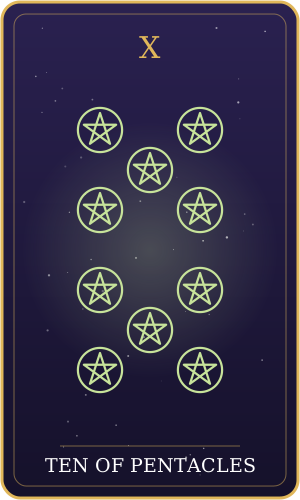
What the Ten of Pentacles means
Ten is the number of completion in the minor arcana, and in the suit of earthly matters that completion has a particular warmth. The Ten of Pentacles is less about a personal achievement than about something that outlasts the person who built it: a home, a tradition, a community, a family culture.
Where earlier Pentacles cards focus on one person at a bench or in a garden, this one widens the lens. It asks what happens when stability is shared, passed along and lived in by more than one generation.
In the traditional Rider-Waite-Smith picture, an elderly man in a patterned robe sits beneath a stone archway with two large dogs at his side. Beyond him, a younger couple talks quietly, and a small child reaches toward one of the dogs. A walled town rises in the background.
Our site uses its own artwork instead of the classic illustration, but the traditional symbols are still worth knowing. Together they make a picture of a household where everyone has a place.
Details in the picture
The ten coins are arranged in a pattern that readers have long compared to a diagram of branching paths. Whether or not that was the designer's intention, the pattern gives the card a sense of structure, as if the pieces of the life below it have been fitted carefully together.
The old man occupies the foreground but is turned away from the other figures. He seems content to watch. Many readers see this as the grace of an elder who has finished building and now trusts others to carry on.
The couple and the child stand for continuity. They are the ones who will inherit habits, stories and rooms, and the scene suggests that these things are passed on in ordinary conversation as much as in formal ways.
The dogs often get overlooked. In tarot imagery they usually signal loyalty and companionship, and here they add a note of ease. The arch, finally, frames everyone as being inside something: a threshold between the busy town and the quiet shelter of home.
The Ten of Pentacles upright
Upright, the card describes stability that has depth. It suits moments when a person feels rooted, perhaps through a long friendship, a family gathering, a house that feels like home or a community in which they are known. The feeling is not excitement; it is the relief of not having to start from scratch.
Tradition and ritual are major themes. Many people draw this card when they are thinking about family customs, holidays, cultural roots or the habits they want to hand on. It can invite a look at which traditions feel nourishing and which are carried out of habit.
It also speaks about legacy in a broad sense. A legacy need not be a possession. It might be a recipe, a way of treating people, or the example of showing up reliably. The card values what remains after the work is done.
For reflection, an upright Ten can prompt a gentle question: who or what makes me feel that I belong, and how can I tend it? The best answers are rarely grand.
The Ten of Pentacles reversed
Reversed, the archway can start to feel narrow. A common reading is friction within a family or close group: old roles, unspoken expectations, or disagreements about how things ought to be done. The household still stands, but not everyone feels at ease in it.
Another reading is the opposite problem, a lack of roots. A person may feel unmoored, as if they have no group or place that holds them. The reversed card can point to moving often, living at a distance from loved ones, or feeling out of step with the people around them.
It can also warn against short-term thinking in the gentle sense of that word: reaching for a quick fix when a slower, sturdier approach would hold up better. The card does not say what to do, only that foundations deserve attention.
A reversed Ten is not a prediction of family trouble or loss. It is a prompt to notice where belonging feels thin. When family tension or isolation weighs on you, a card is no substitute for talking with people you trust or a professional.
The Ten of Pentacles in love and relationships
In love, this card is about building a life as a pair. It often appears when a relationship has moved past the early rush into a shared everyday: combined routines, mingled friend groups, stories about each other's families, and the feeling that the bond has some weight.
It does not predict marriage, children or any particular milestone. It simply notices what long-term closeness tends to be made of: ordinary mornings, shared jokes, a sense of being on the same team.
For single readers, the Ten often points to values. It may suggest thinking about what kind of home life you want and what traditions you hope to keep, so that you can recognize a good fit when it appears. It can also reflect that friends and family already provide real belonging.
As feelings, the card can describe someone who thinks in terms of continuity and who takes commitments seriously. Reversed, it may reflect a couple pulled between their own wishes and family expectations, or someone unsure where they belong.
The Ten of Pentacles in career and work
At work, the Ten speaks of institutions, teams and long-standing ways of doing things. It might show up for people who have been part of an organization for years, who are joining a close-knit team, or who are thinking about how their field will be shaped by those who follow.
A reader could use the card to look at mentorship. Who taught you what you know, and what will you pass on? The picture of an elder, a couple and a child makes a handy template for thinking about generations in a workplace.
The card also relates to family businesses and communal projects, as well as the quieter satisfaction of belonging to a workplace culture that you respect. Stability, in this reading, is as much about people as about tasks.
Reversed, it may suggest tension between tradition and change, or a role that feels too confining. The Ten speaks only in themes. It gives no financial or career advice, and decisions about money, contracts or inheritance belong with qualified professionals.
Is the Ten of Pentacles a yes or no card?
In the convention used by this site, the Ten of Pentacles is a yes. Most readers who use tarot for quick yes-or-no questions treat it as favorable, because stability, belonging and lasting foundations suggest that things hold together. That is an editorial convention, not an ancient rule, and it is the one our yes-or-no tool uses.
If the card lands reversed, our rule turns the yes into a maybe, since the foundation may be there but something about the group, the timing or the expectations needs attention. The reversed shift applies only when you tick "Include reversed cards" in the yes-or-no tool, because the box starts unticked.
Hear a yes from the Ten as friendly encouragement, not a promise. A draw cannot confirm that anything will happen, and the yes-or-no format is for fun and reflection.
Questions about health, money, law or safety need qualified advice and solid information.
The Ten of Pentacles and astrology
The Golden Dawn tradition links the Ten of Pentacles with Mercury in Virgo. In that scheme, each zodiac sign is divided into three ten-degree decans, and every numbered minor card from two to ten receives one decan and a planet. This is a tradition handed down through tarot history, not an astronomical rule.
Virgo is an earth sign, mutable in quality and ruled by Mercury, and Mercury is in the sign of its own rulership. The pairing points toward careful communication, organization and the practical handling of details. That suits a card about systems that keep a household running and stories that get passed on.
To connect the card with your chart, look at where Mercury sits by sign and house, and where Virgo lies in your chart. These can hint at how you think, talk and arrange your daily life. If Mercury is in Virgo for you, the Ten may feel familiar.
You can find those placements with our free birth chart calculator. Astrology here is a lens for self-reflection and entertainment, and a card correspondence is a thread to follow out of curiosity.
The Ten of Pentacles as advice
As advice, the card suggests investing attention in the people and places that hold you. A phone call to a relative, a standing dinner with friends or a small ritual in your own home all strengthen what the Ten admires.
It also suggests asking what you want to keep. Write down a few customs, habits or values from your background that you wish to continue, and a few you would happily retire. The card honors tradition without requiring blind loyalty.
Try documenting something. Record a family recipe, label old photographs or write out how a process works in your team. Handing on knowledge is a concrete way to act on this card.
If it comes up reversed, the advice is to find one place where you feel at ease and start there. Belonging can be built in small units, and one solid friendship is a fine foundation.
Ten of Pentacles belongs to the decan of Mercury in Virgo: in the Golden Dawn tradition each minor card from two to ten rules ten degrees of the zodiac. Find Mercury in your chart or read about Virgo rising.
Frequently asked questions
What does the Ten of Pentacles mean?
The Ten of Pentacles stands for lasting foundations: family, shared traditions, belonging and a legacy that grows over generations. It shows an elder, a couple and a child gathered under an archway. Typical themes are stability, continuity and community. Like all tarot cards, it is a prompt for reflection and not a prediction.
Is the Ten of Pentacles a yes or no card?
On this site it is a yes. Many readers treat cards of stability and belonging as favorable, though that is an editorial convention and not an ancient rule. Reversed, our yes-or-no tool turns it into a maybe, but only if you tick "Include reversed cards", which is off by default. It is for fun and reflection.
What does the Ten of Pentacles mean in love?
In love, it points to building an everyday life together, with shared routines, friends and a sense of being on the same team. It does not predict any milestone. For single readers it often prompts thinking about the home life and values you want. Reversed, it may reflect tension between your wishes and family expectations.
What does the Ten of Pentacles reversed mean?
Reversed, the card can point to friction in a family or group, a feeling of having no roots, or tradition that feels confining. It asks where belonging feels thin and invites small steps toward more of it. It is not a prediction of trouble. If isolation or tension weighs on you, talk with someone you trust or a professional.
Which zodiac sign goes with the Ten of Pentacles?
Golden Dawn tradition assigns the Ten of Pentacles to Mercury in Virgo, a decan of the zodiac. Virgo is an earth sign ruled by Mercury, linked with organization and practical detail. This is a traditional assignment, and other systems differ. Looking at Mercury and Virgo in your own chart is a good way to explore it.
What does the Ten of Pentacles mean as feelings?
As feelings, it can describe someone who thinks long term, values loyalty and wants closeness that lasts. They may take commitments seriously and care about family or community. A card cannot read another person's mind, so treat this as a thoughtful guess and a good reason to ask them directly.
 Nine of Pentacles
 Page of Pentacles
 The Star
 The Moon