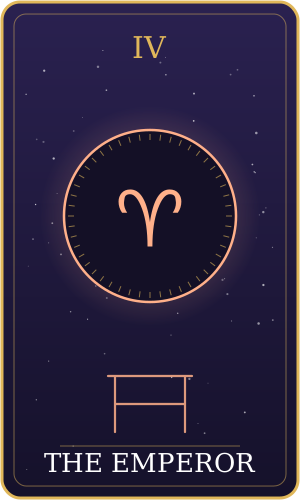
What the Emperor card means
If the Empress is the garden, the Emperor is the wall and the plan around it. He is the fourth card of the Major Arcana, and the number four has long been linked with foundations, four corners and four walls. Where the card before him gives, he organizes. His question is not what feels nice but what will still stand next year.
In the traditional Rider-Waite-Smith painting, an older man with a white beard sits on a massive stone throne, its arms carved into ram heads. He wears red robes beneath armor, and in his right hand he holds an ankh-topped scepter while his left hand cradles an orb. Behind him rise dry, rust-colored mountains. A narrow stream is visible at their base, and the sky is a flat, blazing orange.
Those details tell a consistent story. The ram heads link him to Aries and to bold, initiating force. The armor suggests readiness to defend. The orb stands for the world he is responsible for, and the scepter for authority that is meant to protect life. The bare mountains suggest that structure is often built in unforgiving conditions, by people who stay steady while things around them shift.
The Emperor is often read as a father figure, but the card is bigger than gender or family roles. It describes anyone who creates order: the person who sets a budget, writes the schedule, makes the call when others hesitate, or holds a boundary firmly and calmly. His power is meant to be used for stability, and the card gets interesting when it is not.
Emperor upright meaning
Upright, the Emperor stands for structure and the confidence that comes from having a plan. When he appears, many readers take him as a sign that it is time to organize: set priorities, create routines, define the rules of a project or a home, and take responsibility for what is yours. He values discipline that serves a goal, not discipline for show.
Leadership is central to his meaning. This might be formal, such as running a team or a household, or informal, such as being the steady person that others look to in a crisis. A good Emperor listens, decides and takes accountability. The card often indicates that you may be asked to step into that role, or that you already have and could do so with more clarity.
He also represents protection and reliability. Think of a sturdy structure that keeps weather out: a clear agreement, a savings habit, a consistent bedtime, a friend who shows up when they say they will. These plain constants give people room to take risks elsewhere.
Common upright keywords are authority, stability, order, fatherhood, discipline, boundaries and rational thought. Practical applications include writing a plan, making a decision you have been postponing, or stating a boundary calmly and keeping it.
Emperor reversed meaning
Reversed, the Emperor tends to point to authority out of balance, and it can swing in two directions. On one side is rigidity: rules that no longer serve anybody, a need to control details, an inability to adapt, or a boss or relative whose way is the only way. The structure that once protected has turned into a cage.
On the other side is a lack of structure. Without the Emperor's steadiness, plans stay vague, routines slip, and responsibilities pile up unattended. Reversed, the card can describe someone who avoids accountability, or a situation in which nobody has actually taken charge. Both extremes are about the same question: how to hold authority in a healthy way.
The reversed card can also relate to your relationship with authority figures. You may be bristling at someone's control, or realizing that you have been copying a controlling pattern learned early in life. Noticing this is not about blame. It gives you a choice about the kind of leader, partner or parent you want to be.
Reversed keywords include domination, inflexibility, immaturity, stubbornness and chaos. A balanced response is to review which rules in your life are still useful and which you follow out of habit, and to add a bit of structure wherever things feel loose.
The Emperor in love and relationships
In love, the upright Emperor tends to describe stability and commitment. He suggests a relationship with clear expectations, loyalty and someone who is willing to take responsibility. It can fit a partner who is protective and dependable, or a stage in a relationship when two people begin making practical plans, such as sharing a home, a calendar or financial decisions.
For people who are dating, the card can mean that you want substance over spark, and that consistency matters more than grand gestures. It may also be a prompt to be clear about what you are looking for and to say so openly, rather than hoping the other person guesses.
As feelings, the Emperor can describe someone who is serious, reliable and may find it difficult to express tenderness. They tend to show care through actions, like fixing, planning or providing, more than through words. This can be reassuring, though it may leave a partner longing for more emotional openness. The card is a description of style, not a guarantee of depth.
Reversed in love, it can point to a controlling dynamic, emotional coldness, or a partner who avoids commitment. It can also reflect a power imbalance. If that rings true, the suggestion is gentle: talk about decisions and expectations in specific terms, and notice whether both people truly have a voice.
The Emperor in career and work
The workplace is the Emperor's natural home. Upright, he supports leadership, management, planning, organization, entrepreneurship and any role where responsibility matters. The card often appears when structure would help: a clearer process, a defined role, a schedule that protects focus. It rewards patient building over quick wins.
He can also indicate a significant figure at work, such as a boss, mentor or client with authority, whose approach is practical and expects reliability. In that case, the card suggests meeting expectations with clarity and preparation.
Reversed, he may describe micromanagement, rigid hierarchies, power struggles, or the opposite, a team without direction. It may also be an invitation to look at your own leadership style. Consider this reflective, not a recommendation about a specific job, deal or financial plan. Those choices call for qualified advisers who know your situation.
Is the Emperor a yes or no card?
Most readers treat the Emperor as a yes when the question is about building, planning or committing, since he is a card of solid footing and decisive action. With reversed cards ticked on, the Emperor drops from yes to maybe whenever it lands reversed. In the card's own terms, a plan that lacks structure, or leans on control others have not agreed to, deserves a hedged answer. None of this applies to the Emperor unless you tick "Include reversed cards", since the box starts unticked.
As with every yes-or-no draw, this is an editorial convention and not a built-in function of tarot. Most readers treat the Emperor as a yes; this is the one our yes-or-no tool uses. Think of the answer as a prompt for reflection, and take decisions about health, money, law or safety to people qualified to advise you.
The Emperor and astrology
In the Golden Dawn tradition, the Emperor is assigned to Aries, the first sign of the zodiac. The system is symbolic, yet the fit is easy to see: the ram heads on his throne announce it. Aries is a fire sign, cardinal in quality and ruled by Mars, and it stands for initiative, courage and the drive to begin things and lead them.
It may seem odd that a card about order belongs to a sign known for impulsiveness. One way to read it is that the Emperor shows what Aries looks like when it has grown up, with that raw initiating force given a framework, a purpose and a sense of responsibility. Fire without structure burns out; fire in a hearth warms a house.
In your own chart, look at where Aries falls. A Sun, Moon, Ascendant or other planet in Aries, or a house with Aries on its cusp, can show where you are quick to take the lead. Mars, as Aries's ruler, adds another layer: its sign and house show how you assert yourself and pursue what you want.
The NatalCalc birth chart calculator lists all of those placements for you. As a reflection exercise, notice where you take charge naturally, and ask whether you could give that energy a clearer structure.
The Emperor as advice
As advice, the Emperor says to build a framework. Pick the area where you feel scattered and write down three rules or routines that would help. Keep them simple enough that you can follow them on an ordinary Tuesday.
He also encourages decisiveness. If you have collected enough information, make the call and own it. Accepting responsibility for a choice, including its imperfections, is an act of strength.
Boundaries are part of his territory. You can be calm and clear about what is and is not acceptable to you, without hostility. A boundary stated early and kindly is usually easier on everyone than one enforced after resentment has built.
If he came up reversed, check your own grip. Where could you loosen control and trust other people's competence? Or where have you left things open for so long that someone needs to say, this is how we will do it? The Emperor's best form is firm and fair.
The Emperor corresponds to Aries. See whether Aries is among your big three; read about Aries rising; read about the Aries Moon, or read the Aries horoscope for 2027.
Frequently asked questions
What does the Emperor card mean in tarot?
The Emperor stands for structure, authority, stability and leadership, a figure who creates order so that others can feel safe. He sits on a stone throne with ram heads, holding an orb and a scepter. Upright, he points to planning, discipline and taking responsibility. Reversed, he may describe rigid control, domination, or a lack of structure and accountability.
Is the Emperor a good card?
Generally yes, since he represents reliability and clarity. People who prefer flexibility may find him strict, and that is part of the lesson, as he shows both the benefits and costs of rules. Reversed, he asks whether control has become too tight or too loose. Think of him as a question about balance between firmness and flexibility.
What does the Emperor mean in love?
In love, the Emperor suggests commitment, protection and steadiness. As feelings, he can describe a serious and dependable person who shows care through action. He may find it hard to put tenderness into words. Reversed, he may point to control, coldness or fear of commitment, and he encourages open conversation about expectations and about who gets a say in decisions.
What does it mean when the Emperor comes up reversed in the yes or no tool?
Upright, the Emperor is a yes here. The tool is built so that a reversed card slides the answer one step toward no, which turns this yes into a maybe, since a plan that lacks structure, or leans on control others have not agreed to, deserves a hedged answer. That is a convention we chose for the tool, not an official tarot rule for the Emperor, and you only see it when the "Include reversed cards" box is ticked. Otherwise every card arrives upright.
What sign is the Emperor linked to?
In the Golden Dawn system, the Emperor corresponds to Aries, the fire sign ruled by Mars. The ram heads on his throne echo this. The link is traditional and symbolic. In your chart, you can look at where Aries and Mars fall to reflect on how you lead, assert yourself and start things.
What does the reversed Emperor mean?
The reversed Emperor can mean too much control, such as stubbornness and domination, or too little structure, such as avoided responsibility and disorder. It can also reflect a difficult relationship with authority. A useful step is to look at which rules in your life help you and which are simply habit, then adjust one.
 The Empress
 The Hierophant
 The Star
 The Moon