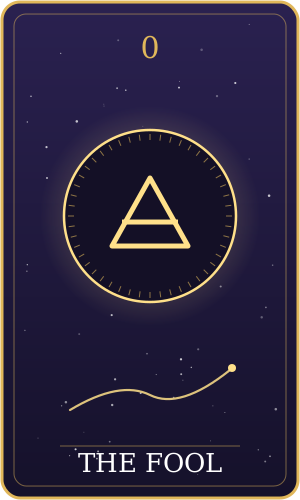
What the Fool card means
The Fool is the only card in the Major Arcana without a fixed place in the sequence. Its number is zero, which is why some decks put it first and others tuck it at the end, as though the story could begin again whenever you reach the last card. That small oddity tells you most of what you need to know: this card is about the moment before anything has been decided.
In the traditional Rider-Waite-Smith picture, a young traveler in a bright tunic walks along the top of a mountain ridge, face tilted toward the sky rather than toward the ground. A small white dog bounds at his heels, either warning him or celebrating with him. Over his shoulder rests a stick with a bundle tied to it, so he is traveling light. In his free hand he holds a single white flower. A pale sun rises behind him, and the peaks in the distance are snowy and far away.
Each of those details carries a reading. The cliff is the unknown, and the fact that he has not looked down is the whole point of the card, for better and for worse. The bundle suggests that he has what he needs and not much more. The flower is a quiet symbol of innocence and good intentions. The dog is often read as instinct, the part of you that senses a threat or an opportunity before your thoughts catch up. The sun stands for optimism that has not yet been tested.
Plenty of decks, including the illustrated artwork on this site, redraw the scene with different clothes, animals and landscapes, but the core stays the same: a person at the start of something, carrying very little and trusting a great deal. The card does not say whether the trust is wise. It says that a first step is available, and that taking it will teach more than another month of planning would.
Fool upright meaning
Upright, the Fool points to a fresh start that feels a little unreasonable and a lot alive. It may show up when you have been circling an idea for a long time, such as a new city, a class, a creative project or a different way of spending your weekends, and the only thing left is to begin. The card values curiosity over certainty and beginner's energy over polished expertise.
Spontaneity is a big part of the picture. The upright Fool is the friend who says yes to the unplanned road trip, the person who signs up for the beginner pottery class knowing they will be bad at it for a while. There is humor in the card, and permission to laugh at your own first attempts. Perfectionism does not live in this image.
It also speaks about trust: in yourself, in other people, and in the idea that things can work out without a complete map. That trust is not blind in the healthiest reading. It is closer to a willingness to stay open while you gather information, rather than demanding all of it before you move.
Keywords usually listed for the upright card include new beginnings, innocence, free spirit, adventure, openness and a leap of faith. If a question about starting something lands on the Fool, many readers take it as encouragement to treat the first step as an experiment instead of a final verdict. You can always adjust the route once you are walking.
Fool reversed meaning
Reversed, the card can lean in two opposite directions, and context decides which. The first is recklessness: the figure walks off the edge because he truly was not looking. This reading shows up around impulsive choices, skipped research, ignored advice or a pattern of starting things with enthusiasm and no follow-through. The energy is still there, but it has lost its judgment.
The second reading is the reverse of that: hesitation. The traveler stands frozen at the edge, certain that every possible mistake is waiting below. Fear of looking foolish can keep a person from the very experiences that would have made them feel capable. If you pulled the reversed Fool while holding back from something you actually want, the card may be asking what exactly you are protecting yourself from.
A third thread is naivety. Reversed, the Fool can describe seeing only the best in a situation, or in a person, and overlooking signs that deserve a second look. This is not a verdict about your character. It is a prompt to ask a practical question you have been avoiding.
Reversed keywords include recklessness, poor planning, hesitation, naivety, being taken advantage of and fear of the unknown. A useful exercise is to write down what you already know about the situation and what you are only hoping. The gap between the two lists is usually where the card is pointing.
The Fool in love and relationships
In a love reading, the upright Fool often stands for the lightness of a new connection: a first date with no script, a message that makes you grin at your phone, a person who feels refreshingly unlike anyone you have dated before. The card encourages curiosity about someone instead of immediate evaluation. It also fits a person who is ready to be open again after a period of caution.
For people already in a relationship, the Fool may suggest bringing play back. A spontaneous plan, a place neither of you has been, or a new shared hobby can break a routine that has gone quiet. The card is also sometimes read as a reminder that long relationships still benefit from beginner's curiosity about the other person.
As feelings, the card is read as someone who is excited, a bit nervous and not yet sure what to call this. They may be drawn to you for your ease or your unpredictability. They may also be taking things lightly because they are cautious about commitment, so the card alone does not tell you how deep the feeling is. It speaks of energy and openness more than of promises.
Reversed in love, the Fool can describe rushing, such as declaring big plans after two weeks, or the opposite, backing away from a good thing because it feels unfamiliar. It can also point to idealizing someone. A calm response is to slow the pace enough to see the real person, and to say out loud what you want instead of hoping it will be guessed.
The Fool in career and work
At work, the upright Fool is the card of the new role, the career pivot idea, the side project, the first day of a course. It favors experimentation and a willingness to be a beginner again. Teams sometimes need exactly this energy: someone who asks the naive question that exposes an assumption everyone else stopped noticing.
The Fool can also describe a workplace where the path is not yet defined. A start-up, a freelance stretch, or a position without a detailed job description can all fit. In that setting the card suggests staying flexible and learning in public, instead of waiting until you feel fully qualified.
Reversed, it may show up as a hasty decision made without reading the details, a pitch that was never rehearsed, or a stall at the application stage because the result might be rejection. The practical middle is to prepare enough to be safe and then send the thing. This is a theme for reflection, not a recommendation about any particular job or financial choice, which belong with you and the right professionals.
Is the Fool a yes or no card?
Most readers treat the Fool as a yes. It is a card of go-ahead energy, and when a question asks whether to begin, try or say yes to an invitation, the card leans toward the affirmative. If the Fool lands reversed, our rule turns the yes into a maybe, because the energy is there but the preparation or the nerve may be missing. The shift for the Fool is a convention of our tool, and it happens only when "Include reversed cards" has been ticked.
To be clear, yes-or-no tarot is an editorial convention, not a rule built into the cards. Different readers assign different answers, and the same card can mean different things depending on the question. Most readers treat the Fool as a yes; this is the one our yes-or-no tool uses. Treat it as a prompt for thought, and keep real decisions about health, money, law or safety with the people and professionals who can actually advise you.
The Fool and astrology
In the Golden Dawn tradition, which shaped how most modern decks link tarot to astrology, the Fool is assigned to the element of Air. That is a tradition and one of several systems, not a scientific claim, but the logic is easy to see. Air is the element of breath, ideas and open space, and the Fool walks in open space with his head up.
In astrology, the three air signs are Gemini, Libra and Aquarius. They are associated with communication, curiosity, social ease and fresh perspectives. The Fool's questions, his movement and his willingness to talk to anyone along the road all echo that cluster. A chart with a lot of air placements is often described as quick, sociable and mentally restless, though no single element defines a person.
If you want to connect the card to your own chart, look at where your air signs fall. Your Sun, Moon, Mercury or Ascendant in Gemini, Libra or Aquarius may show where you already behave a bit like the Fool, starting conversations and trying ideas before you have formed final opinions. A house that holds an air sign can hint at which life area gets that same curious treatment.
You can look up all of your placements with the NatalCalc birth chart calculator, which works from your date, time and place of birth entirely in your browser. Reading the Fool alongside your chart is a reflection exercise: notice where you leap easily, and where you tend to hold back, then ask what you would try if failing were allowed.
The Fool as advice
As advice, the Fool suggests taking the first small step toward something you have been postponing. It does not need to be dramatic. Sending the email, booking the trial lesson or visiting the place once is plenty. The card cares more about movement than about size.
It also advises traveling light. Many people stall because they want to resolve every contingency before beginning. The Fool carries one small bundle. Ask what you can leave at home, including expectations about how it should look or how quickly you should be good at it.
Finally, the card invites a gentle sense of humor. If you stumble, you can laugh at it. A beginner who treats mistakes as information tends to improve faster than one who treats them as evidence of unfitness.
If the reversed Fool came up, the advice flips to checking the ground: find out one fact you have been avoiding, talk to someone who has done it, or decide the next step to take within a week. Then go. The card honors both sides of the leap, the looking and the jumping.
The Fool corresponds to the element of air. See your element balance.
Frequently asked questions
What does the Fool card mean in tarot?
The Fool represents the start of a path: curiosity, trust, spontaneity and a willingness to begin before everything is certain. It is numbered zero, the point before the story starts. Upright, it encourages a light-hearted first step. Reversed, it can warn about acting without thought or about being so afraid of looking foolish that you never begin at all.
Is the Fool a good or bad card?
Neither, really. Tarot cards describe energies, not outcomes. The upright Fool is usually welcomed because it signals openness and fresh possibilities. The reversed Fool is less comfortable, since it points to hurry or hesitation, but even then it is a useful nudge. Think of it as a question about how ready you feel and how much you are willing to risk.
What does the Fool mean in a love reading?
In love, the Fool often points to a new, playful connection or to a chance to bring spontaneity back into an existing relationship. As someone's feelings, it may describe excitement mixed with uncertainty. It says little about commitment on its own. Reversed, it can describe rushing, idealizing a person or avoiding closeness because it feels unfamiliar.
What does it mean when the Fool comes up reversed in the yes or no tool?
The Fool counts as a yes in our yes-or-no tool when it is upright. If you tick "Include reversed cards" and it lands reversed, the rule moves the answer one step toward no, so it becomes a maybe, because the energy is there but the preparation or the nerve may be missing. The rule is an editorial convention of this site and not a teaching of tarot about the Fool, and reversed cards stay off unless you switch them on.
What element and sign is the Fool linked to?
In the Golden Dawn system, the Fool corresponds to the element Air, which connects it with the air signs Gemini, Libra and Aquarius in a loose way. Other traditions assign it differently, and some link it to Uranus. These links are symbolic, and many readers enjoy comparing them with where air signs fall in a birth chart.
What does the reversed Fool mean?
The reversed Fool usually points to one of two things: acting impulsively without enough thought, or hesitating so long that the opportunity feels out of reach. It can also describe naivety about a person or plan. A helpful response is to identify the one fact you have been avoiding, then decide on a small, concrete next step.
 The Magician
 The Star
 The Moon