What the Hermit means
In the Rider-Waite-Smith tradition, a tall, hooded figure in a gray cloak stands alone at the top of a snow-covered mountain. In one hand is a lantern, and inside the lantern glows a six-pointed star. In the other hand is a long staff. The sky behind is plain and gray, and there is no one else in sight.
The lantern is the heart of the picture. It lights only a small circle, enough to take the next step but not to reveal the whole path. Readers often take that as a statement about wisdom: you do not need the entire map, only enough light to move honestly. The staff suggests support, perhaps the steadiness of experience.
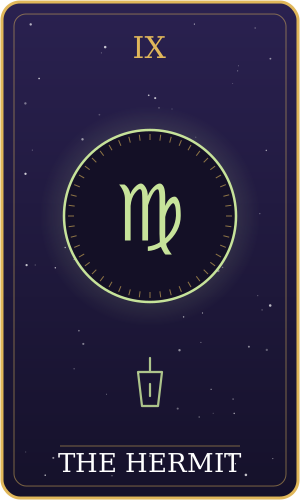
The mountain top suggests that this solitude was earned. The Hermit has climbed, and the view from the top is quiet. Our site uses its own artwork instead of the traditional illustration, but the mood stays the same: calm, wintry, thoughtful and self-contained.
The number nine is often tied to completion of a cycle and the wisdom that follows. The Hermit is the figure who steps away after a long stretch of activity, not to hide but to understand what it all meant.
The Hermit upright meaning
Upright, the Hermit invites a deliberate pause. It points to time spent alone with your thoughts, inner searching and a preference for depth over noise. The quiet it describes is chosen, and it tends to feel clarifying rather than lonely.
The card also stands for guidance that comes from within. When so many opinions are available, the Hermit suggests that the most useful answer may be the one you reach by sitting with the question. It can also point to a teacher or mentor, someone who has walked the path and now offers a small light.
Common keywords include solitude, introspection, wisdom, patience, discernment and spiritual or personal searching. A related theme is selectivity: protecting your attention so that what matters can be heard.
In a reading, the card sometimes follows busy or social cards as a sign that rest and review are due. It may appear before a major decision, which suggests that gathering your thoughts is more helpful now than gathering more input.
The Hermit reversed meaning
Reversed, the lantern flickers. The card tends to describe solitude that has turned into isolation, or withdrawal that has become a way of avoiding something. A quiet evening is restorative, but weeks of cutting off everyone can leave a person feeling stuck and unseen.
Another reading is the opposite problem: being unable to be alone. If you fill every minute with noise, scrolling or people, the reversed card may ask what you are avoiding hearing. Silence is uncomfortable at first, and the card suggests that this is worth tolerating briefly.
It can also show resistance to advice, a stubborn insistence on doing everything alone even when help would make it easier. The Hermit in the upright position values independence. Reversed, independence can harden into a wall.
Reflection prompts: Am I resting, or hiding? Who could I reach out to this week? What question have I been refusing to sit with? The card is not asking you to change your personality, only to check whether your balance of solitude and connection still serves you.
The Hermit in love and relationships
In a love reading, the Hermit upright often points to a time of introspection about what you want from a relationship. It may suggest that stepping back, not rushing into anything, is healthy right now. For couples, it can describe a need for personal space that is not a rejection of the partner.
For singles, the card often signals a season of getting to know yourself. That can mean time spent on your own interests, values and boundaries, which later makes dating clearer. There is no deadline in the card, and it frames being single as a stage with its own value.
As feelings: someone represented by the Hermit may feel reserved, thoughtful and in need of time to process. They might be cautious about opening up, preferring depth to speed, and their quiet should not automatically be read as disinterest.
Reversed in love, the card may point to distance, loneliness or a partner who withdraws when things feel heavy. As feelings, it can read as shyness or fear of being known. Patience and gentle invitations tend to work better than pressure, and honest conversation can bridge the gap.
The Hermit in career and work
At work, the Hermit suggests focus, expertise and independent effort. It can describe a project that benefits from deep, uninterrupted attention, or a stage in your career where you are reassessing what you want. Quiet specialists, researchers and thoughtful problem-solvers are well represented by this card.
It may also indicate a mentor relationship, either as someone who guides you or as the person you are becoming for others. Experience tends to be the lantern in this setting, and the card values quality over visibility.
Reversed, it may reflect feeling overlooked, working in isolation to the point of disconnection, or avoiding feedback. The suggestion is often to share your progress with a trusted colleague rather than polishing it alone.
The card provides themes only. It does not give career, financial or legal advice, so for decisions about jobs, money or contracts, speak with qualified professionals and use the card as a prompt for your own reflection.
Is the Hermit a yes or no card?
Most readers treat the Hermit as a maybe. It is neither a push forward nor a stop sign. It is a pause, and a question that is asked of it, such as "should I act now?", tends to get an answer along the lines of "look inward first." This is an editorial convention, and some readers lean toward a soft no.
Our yes-or-no tool uses it as a maybe when upright, which means the answer is not settled and more reflection would help. With reversed cards ticked on, the Hermit drops from maybe to no whenever it lands reversed. In the card's own terms, withdrawal alone leaves the question open, which makes reconnecting with others and gathering more information the first step. If the "Include reversed cards" box stays unticked, as it does by default, the Hermit always arrives upright.
Treat the result as a prompt to think, not a ruling. The tool is for entertainment and reflection, and it should never be used to decide matters of health, money, law or safety.
The Hermit and astrology
In the Golden Dawn tradition, the Hermit corresponds to Virgo. Virgo is an earth sign, mutable in quality and ruled by Mercury. The match highlights attention to detail, discernment and a service-minded wish to understand how things work.
Virgo's associations with careful analysis suit the lantern. A small circle of light, used well, reveals precise information, and the Hermit's refusal to rush echoes Virgo's preference for getting things right. The sign's mutable nature adds adaptability, as the figure keeps moving up the mountain by adjusting each step.
Remember that this is a tradition and not a measurement, and systems vary. If you want to explore the link, look at where Virgo and Mercury fall in your birth chart using the NatalCalc chart calculator. The house holding Virgo may point to an area where you naturally refine, organize or retreat to think.
Use that as reflection, not as a forecast. Your chart offers vocabulary for your habits of attention, not a script.
The Hermit as advice
As advice, the Hermit suggests scheduling quiet on purpose. A walk without headphones, an evening with no screens or a weekend morning with a notebook can give you room to hear your own view. Keep it small and kind to yourself, since the goal is clarity, not deprivation.
It also advises asking fewer people for opinions. Gather what you need, then check what you think. A good test is to write down the decision and notice which option feels lighter in your body when you read it back.
Finally, the card says to share your light when you are ready. The figure holds the lantern high enough that others can see it. After you have reflected, bring the insight back to people who matter, whether as a conversation, a plan or a simple thank-you.
The Hermit corresponds to Virgo. See whether Virgo is among your big three; read about Virgo rising; read about the Virgo Moon, or read the Virgo horoscope for 2027.
Frequently asked questions
What does the Hermit mean in tarot?
The Hermit represents solitude, reflection and inner guidance. The lantern held on a mountaintop suggests that wisdom comes from stepping back and listening to your own experience, one step at a time. Reversed, it may point to isolation or avoiding something that needs attention. Let it open a question in you instead of closing one.
What does the Hermit mean in love?
In love, the Hermit often points to a season of reflection: getting to know yourself as a single person, or needing healthy space within a partnership. It suggests depth over speed. Reversed, it can describe distance or withdrawal, where gentle communication and patience tend to help more than pressure. Think of it as a conversation starter with yourself.
What does it mean when the Hermit comes up reversed in the yes or no tool?
For the Hermit, the reversed rule is easy to state: the tool moves every reversed card one step toward no, so an upright maybe turns into a no, because withdrawal alone leaves the question open, which makes reconnecting with others and gathering more information the first step. It is our own convention for fun and reflection, and it applies to the Hermit only if you have ticked "Include reversed cards", which is off by default.
Is the Hermit a negative card?
No. Many people expect it to be sad because of the lone figure, but most readers see it as a card of wisdom and healthy retreat. It becomes a caution only when reversed, where solitude may have turned into isolation or avoidance. Even then, it is a gentle prompt rather than a warning.
Why is the Hermit linked to Virgo?
The Golden Dawn tradition pairs the Hermit with Virgo, the mutable earth sign ruled by Mercury. Both are associated with careful attention, discernment and thoughtful service. This is symbolic, and other systems differ, but you can explore the idea by looking at where Virgo falls in your own birth chart. It offers a theme to consider, and nothing more binding than that.
What does the Hermit reversed mean?
Reversed, the Hermit may describe loneliness, withdrawal from people or a refusal to accept help. It can also mean the opposite, an inability to be alone with your thoughts. The card invites you to check your balance between solitude and connection and adjust it in whichever direction you need. Weigh it lightly and keep the final say for yourself.
 Strength
 Wheel of Fortune
 The Star
 The Moon