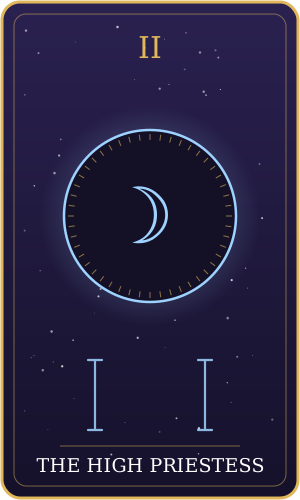
What the High Priestess card means
After the Fool sets out and the Magician gets to work, the High Priestess appears and the pace drops. She is card number two, and she asks you to stop acting for a moment and notice what you already sense. Her territory is the quiet kind of knowing: the hunch you cannot quite explain, the thing you realize while washing dishes, the answer that arrives once you stop chasing it.
In the traditional Rider-Waite-Smith painting, a woman sits on a plain stone seat in front of a hanging cloth woven with pomegranates and palm leaves. She wears a blue robe that pools around her feet like water, a crown shaped like the three phases of the moon, and a cross on her chest. In her lap rests a partly covered scroll with the letters TORA on it, meant to suggest sacred law that is only half revealed.
Two pillars flank her, one dark and one light, marked with the letters B and J. They are commonly read as opposites that need each other: light and shadow, reason and instinct, yes and no. She sits exactly between them, favoring neither. A crescent moon lies at her feet, and behind the veil, if you look closely, a hint of water appears, the unseen world just beyond the curtain.
The point of the picture is restraint. She does not lecture or explain. She keeps the scroll partly covered because some understanding cannot be handed over; it has to be grown into. Many readers see her as a reminder that being quiet is not the same as being passive, and that there is real work in listening.
High Priestess upright meaning
Upright, the High Priestess points to intuition and to information that lives below the surface. You may be picking up on a mood in a room, a gap between what someone says and what they seem to feel, or an inner preference that contradicts the sensible plan. The card gives that quiet signal credit instead of asking you to defend it with evidence.
She also stands for patience and for waiting until a situation reveals itself. Not every question needs an immediate answer, and some situations clarify only when you stop pressing them. If you have been asking a friend, a search engine and a notebook the same question for weeks, the card may suggest that the answer is not a matter of more input.
Privacy is another strand. The upright card can speak well of keeping something to yourself for now, whether a new idea that needs time to take shape or a feeling you want to understand before you share it. Secrecy in this reading is closer to incubation than to hiding.
Common upright keywords are intuition, mystery, inner wisdom, stillness, the subconscious and hidden knowledge. Dreams, journaling, meditation and long walks without headphones are frequent suggestions. These are ways of giving the quieter parts of your mind room to speak.
High Priestess reversed meaning
Reversed, the High Priestess often points to a disconnect from your own instincts. You might be so busy gathering opinions that you have stopped consulting your own. Or you might be overriding a clear sense of unease because you cannot justify it logically. The card asks whether you have been drowning out an inner voice with noise, distraction or other people's certainty.
The reversed card can also relate to secrets, and here it shifts in tone. A hidden agenda, an unspoken issue between people, or information being held back can all fit. Sometimes the secret belongs to someone else. Sometimes it is something you keep from yourself, such as a feeling you have not allowed to become a thought.
Another reading is surface thinking: skipping the deeper question, taking things at face value, or relying only on what can be measured. Alternatively, the reverse can occur, a tendency to read hidden meaning into everything and to treat anxiety as intuition. A fair test is to ask whether the sense you have is calm and repeating, or loud and spiraling.
Reversed keywords include repressed feelings, lack of clarity, withholding, confusion, and distrust of your inner voice. A gentle step is to give yourself fifteen unscheduled minutes, write down what you notice without editing, and see what repeats.
The High Priestess in love and relationships
In love, the upright High Priestess often describes a connection with depth and a bit of mystery. It could be a relationship where much is understood without being said, or someone new whom you cannot read all at once. The card values slow reveals over fast declarations, and trust that builds in the quiet between conversations.
For people in a long relationship, she may suggest paying attention to what is under the daily logistics. What does your partner seem to need that they are not asking for? What are you not asking for? The card favors listening more than speaking, and noticing tone and silence as well as words.
As feelings, the High Priestess can mean someone who is reserved, thoughtful and not ready to say everything. They may feel more than they show. They might also be processing privately before they share, so a lack of immediate response is not necessarily lack of interest. The card shows a person who needs time, and it does not tell you what they have decided.
Reversed, the card may describe emotional distance, unspoken questions or a sense that something is being held back by one or both of you. It can also fit a person who keeps others at arm's length. A calm approach is to name your own feelings first, simply and without an accusation, and to leave room for the other person to answer in their own time.
The High Priestess in career and work
In work settings, the upright High Priestess is the person who sees what is happening beneath the meeting agenda. She suits research, analysis, writing, counseling-style roles, creative incubation and any situation where observation matters more than speed. If you have been asked for a quick decision, the card may be a reminder that you are allowed to say you will think about it.
She can also indicate hidden information that will matter: terms not yet disclosed, a dynamic among colleagues that is not on any chart, or a skill of yours that deserves a quieter kind of recognition. Discretion is a professional strength in her reading.
Reversed, the card can suggest overlooking warning signs, working without a full picture, or feeling disconnected from why you do what you do. It can also describe office politics and information being guarded. Treat this as a theme for reflection about how you gather information, and not as guidance for any particular career move or financial decision.
Is the High Priestess a yes or no card?
Most readers treat the High Priestess as a maybe. She is the card of the unanswered question, and her image, balanced between two pillars with a veil in front of the unseen, tells you the answer is not ready to be given. Upright she suggests waiting and listening. If the High Priestess lands reversed, our rule turns the maybe into a no, because the inner voice is being ignored or the facts are incomplete. Remember that "Include reversed cards" starts unticked, so you will see the High Priestess reversed only after you turn it on.
This is an editorial convention. Different readers assign different answers, and the cards do not actually deliver verdicts. Most readers treat the High Priestess as a maybe; this is the one our yes-or-no tool uses. Take it as a nudge to reflect, and keep decisions about health, money, law or safety with qualified professionals.
The High Priestess and astrology
In the Golden Dawn tradition, the High Priestess is assigned to the Moon. This is a tradition and a symbolic system, but the connection feels natural: the Moon governs reflection, rhythm and the changing tides, and the crescent at her feet and the lunar crown on her head say the same thing in pictures.
In a birth chart, the Moon describes your emotional nature, your instinctive reactions and what makes you feel safe. Its sign shows how your feelings tend to move, whether quickly and expressively, slowly and privately, or somewhere in between. The Moon is also the fastest-moving point in the chart, spending about two and a half days in each sign, which is why birth time matters when you want to be sure of it.
Reading the card against your chart can be a gentle exercise. Check where your Moon sits and what sign it is in. A water Moon in Cancer, Scorpio or Pisces is traditionally linked with strong intuition, though intuition appears in every chart. The house holding your Moon points toward the area of life where you feel and sense most keenly.
The NatalCalc birth chart calculator will show your Moon sign and house from your date, time and place of birth, all computed in your browser. As a reflection prompt, ask how you know when something feels right, and which part of your chart seems to carry that sense.
The High Priestess as advice
As advice, the High Priestess suggests waiting before you decide. Give a question one more night, and notice how you feel on waking. Often the body answers before the mind catches up, and the answer is calm even if it is inconvenient.
She also recommends making room for silence. Switch off the audio on your commute, keep one evening a week free of screens, or sit on a bench without a phone. Insight tends to need empty space around it.
Keep a small record. Jot down a dream, a hunch or a feeling, and check back a few weeks later to see which ones held. Over time, you learn the difference between your intuition and your anxiety, which is a very practical skill.
If she came up reversed, the advice is to ask the question you have been dodging. Speak with someone you trust, or write the answer you are afraid of, and see how it sits. The veil is thinner than it looks once you decide to look behind it.
The High Priestess corresponds to Moon. Find Moon in your birth chart.
Frequently asked questions
What does the High Priestess card mean in tarot?
The High Priestess stands for intuition, inner knowing and patience. She sits between two pillars before a veil, suggesting that some understanding cannot be rushed or explained. Upright, she encourages you to listen inward and wait. Reversed, she may point to ignored instincts, secrets or a disconnect from your own feelings.
Is the High Priestess a good card?
Generally yes, though it asks for something many people find hard: stillness. She is a card of depth and reflection, not action. If you want quick answers, her slower pace can feel frustrating. Reversed, she is less comfortable, since she may highlight confusion or withheld information, but even then she points toward something useful to examine.
What does the High Priestess mean in love?
In love she describes depth, reserve and a bond where much is felt before it is said. As someone's feelings, she suggests a thoughtful person who needs time and may not show everything at once. Reversed, she can mean distance, unspoken issues or hidden feelings. She asks for patient, honest listening on both sides.
What does it mean when the High Priestess comes up reversed in the yes or no tool?
Upright, the High Priestess is a maybe here. The tool is built so that a reversed card slides the answer one step toward no, which turns this maybe into a no, since the inner voice is being ignored or the facts are incomplete. That is a convention we chose for the tool, not an official tarot rule for the High Priestess, and you only see it when the "Include reversed cards" box is ticked. Otherwise every card arrives upright.
What does the High Priestess represent in astrology?
In the Golden Dawn tradition, she corresponds to the Moon, linked with emotion, instinct and the subconscious. In a birth chart, the Moon shows how you feel and what makes you feel secure. Checking your Moon sign and house is a common way to explore her themes. The link is symbolic and traditional, not scientific.
What does the reversed High Priestess mean?
Reversed, she often suggests that you are ignoring your intuition, being kept in the dark, or relying only on surface facts. It can also describe secrets between people. A practical response is to set aside quiet time, note what you truly feel about the situation, and ask the direct question you have been avoiding.
 The Magician
 The Empress
 The Star
 The Moon