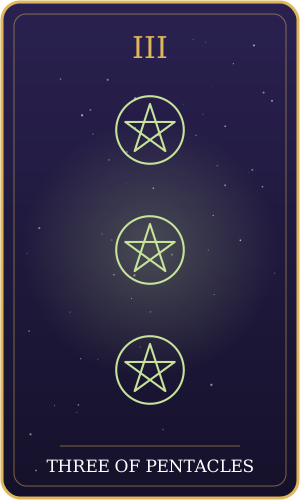
What the Three of Pentacles means
A team that works well is rarely a team of identical people. Someone has the technical hands, someone has the overview, and someone holds the purse or the vision. The Three of Pentacles is the tarot's picture of that arrangement running smoothly, with each person respected for what they bring.
In the traditional Rider-Waite-Smith picture, a stonemason stands on a low bench inside a church, carving detail into an arch. Two figures stand before him at floor level: a robed monk holding rolled plans and a well-dressed person who seems to be reviewing them. Three coins are set into the stonework above, each in its own carved niche.
The artwork on our site is our own, not the classic illustration, though the symbolism described is traditional. The scene is quiet and purposeful. There is no rush and no drama, only people checking a plan against the work.
The central message is that quality comes from combining skills and being open to feedback. It is a card of apprenticeship, shared standards and the pleasure of seeing a plan take its first real shape.
The symbols, one at a time
The stonemason is the maker. He is placed slightly above the others, which many readers take to mean that the skilled worker is at the center of the project. His tools are not shown in dramatic fashion; the point is competence applied steadily.
The two visitors form the second half of the picture. One carries plans, a sign of design and intention. The other appears to be weighing what is being built, a sign of the person who commissions or approves. Between them, the plan and the craft are meeting in the middle.
The setting matters too. A church is a long-term building, designed to outlast the people who start it. By placing the scene there, the card hints that the work is meant to last and that the people involved are taking the long view.
The three coins above the group sit in carved arches, as though they were part of the building itself. This is a neat bit of symbolism: the rewards of the work are not separate from it. They are built into the structure, and they become visible as the result takes form.
The Three of Pentacles upright
Upright, the card celebrates collaboration with a purpose. It often shows up when a person joins a group, begins a joint project, asks for feedback or finds that their skill is respected by others. The mood is steady and constructive.
Common keywords include teamwork, learning, mastery and recognition. The card suggests that there is something to learn from the people around you, and something they can learn from you. It rewards humility about what you do not know and pride in what you do.
There is also an emphasis on planning. The plans in the picture are on paper before the stone is cut, and the review is part of the process. Readers often take that to mean that checking the details with others, before the work is final, saves time later.
As a reflective prompt, the upright Three asks: who is on my side of this project, and what do they see that I do not? Sometimes the answer is a colleague, a mentor or a friend with a different set of skills.
The Three of Pentacles reversed
Reversed, the plan and the craft stop meeting in the middle. The card may describe a project where people are working at cross-purposes, where roles are unclear, or where one person is carrying most of the effort. The symptoms are familiar: duplicated work, missed messages and a growing sense of frustration.
Another reading is about standards. A reversed Three can point to work done in a hurry or without care, or to feedback that is missing or ignored. It may be a gentle nudge to check quality before moving on.
A third reading is solitary effort. Some people try to do everything on their own, either because they do not trust others or because they find asking for help uncomfortable. The card can invite a person to consider whether a project would go better with another pair of hands.
A reversed card is not a verdict on a team or a person. It is a mirror for a moment, and the practical response is usually communication: agree who does what, set a time to review progress and speak up early when something feels off.
The Three of Pentacles in love and relationships
In love readings, the Three is a card of partnership as shared building. For a couple, it can describe working on something together, such as a home, a routine, a plan for the year or simply the ongoing project of understanding each other. It values effort, patience and contributions from both sides.
For single readers, the card often suggests that connection may grow through shared activity. Joining a class, a volunteer group or a hobby club puts people side by side with a common task, which tends to make conversation easier than a formal date might.
As feelings, the Three can describe someone who shows care by working alongside you. They may offer practical help, take part in your plans or want to learn about what matters to you. Their regard may come with respect for your skills and a wish to build something together.
Reversed in love, the card may describe an uneven partnership, where one person does most of the emotional or household work, or where the two have different pictures of what they are building. A calm conversation about shared goals and fair division of effort tends to be the helpful step.
The Three of Pentacles in career and work
This is one of the strongest work cards in the deck. It speaks of skilled collaboration, mentoring, training and projects where each contributor has a clear part. It often turns up around group assignments, onboarding, apprenticeships and any setting where quality depends on cooperation.
The card also honors craft. A reader might use it to ask where they would most like to deepen their skill, and who could teach them. It favors steady improvement over flashy shortcuts, and it respects the person who is willing to do careful work.
In a team, the Three can stand for good communication: reviews that are specific, feedback that is kind and clear, and credit shared fairly. Regular check-ins, written plans and a shared definition of done all fit its spirit.
Reversed, it may point to friction in a group, unclear responsibilities or work that is not meeting the standard. This site treats career and money as themes only and offers no career or financial advice. Real decisions about employment deserve real information and trusted guidance.
Is the Three of Pentacles a yes or no card?
In the convention used by this site, the Three of Pentacles is a yes. Most readers treat it as a card of constructive effort and good company, so it leans toward an affirmative. It is a convention that editors and readers settled on over time, and some assign the card differently. The yes-or-no tool on this site follows it.
If the Three lands reversed, our rule softens the yes into a maybe, because the idea may be sound while the teamwork or the standards still need attention. Nothing appears reversed unless you tick "Include reversed cards", which is unticked by default.
A yes from the Three is best heard as encouragement to involve other people and to do the work properly. It is not a promise about how things will go. The format is meant for fun and reflection, and no single card can predict an outcome.
Questions about health, money, law or safety are not suited to a card. Those matters belong with a qualified professional and dependable sources.
The Three of Pentacles and astrology
Under Golden Dawn tradition, every card from two to ten is tied to a planet within a sign, a decan. The Three of Pentacles carries Mars in Capricorn. Systems vary, and this site goes with the traditional Golden Dawn choice.
Capricorn is an earth sign, cardinal in quality and ruled by Saturn, tied to structure, ambition and patient climbing. Mars is the planet of drive, effort and action. In the traditional scheme Mars is said to be exalted in Capricorn, a way of describing energy that works well when it is organized and aimed at a clear goal.
That pairing suits the card. The mason is applying real physical effort, but within a disciplined plan, and the result is built with intent. The mix of drive and structure is exactly what many people look for in a good working team.
To bring this into your own chart, look at where Mars sits by sign and house, and where Capricorn falls among your houses. They can suggest how you tend to work and where you apply effort. Our free birth chart calculator shows both, as a lens for reflection and not a forecast.
The Three of Pentacles as advice
As advice, the Three suggests bringing someone in. If a project has stalled, consider who has the skill you lack, and ask them a specific question. People often enjoy being asked for a particular kind of help.
It also encourages preparing a clear plan before the work begins. A short written outline of goals, roles and a review date can save weeks of confusion. The mason does not guess; he checks his work against the drawing.
Try a small exercise. Write down one skill you could teach someone and one skill you would like to learn. Then name a person for each. Mutual learning is the quiet engine of the card.
If it comes up reversed, the advice is to check in. Ask whether everyone is working toward the same picture, and say thank you where it is due. A well-timed conversation can do more for a project than extra hours of effort.
Three of Pentacles belongs to the decan of Mars in Capricorn: in the Golden Dawn tradition each minor card from two to ten rules ten degrees of the zodiac. Find Mars in your chart or read about Capricorn rising.
Frequently asked questions
Is the Three of Pentacles a good card?
Most readers see the Three of Pentacles as a positive card. It stands for skilled teamwork, learning and recognition of good work. Reversed, it points to friction or uneven effort instead of anything harmful. As with every tarot card, it is a prompt for reflection about how you work with others and not a forecast of results.
What does the Three of Pentacles mean in a relationship?
In a relationship, the Three often describes partners building something together, with patience, shared effort and respect for each other's skills. For single readers it suggests connection growing through shared activities. Reversed, it may show uneven effort or different pictures of the future, where an honest talk about shared goals can help.
What does the Three of Pentacles reversed mean?
Reversed, the Three of Pentacles usually points to poor coordination, unclear roles, rushed work or a tendency to go it alone. Read it as a nudge, not a warning. It suggests clarifying who does what, asking for feedback early and checking standards before moving on. Open communication is the usual remedy.
What does the Three of Pentacles mean as feelings?
As feelings, the Three can describe someone who shows care by working alongside you, offering practical help and respecting your abilities. They may want to build something with you over time. A card cannot read another person's mind, so treat this as a thoughtful guess and ask them directly about their feelings.
Is the Three of Pentacles a yes or no card?
On this site the Three of Pentacles is a yes, because it describes constructive effort and good company. A reversed draw softens it to a maybe, and that happens only with "Include reversed cards" ticked. We chose this mapping editorially, for fun and reflection only. It is a light, editorial setting meant to make the tool more interesting, and it does not claim any accuracy about real events.
Which planet and sign go with the Three of Pentacles?
In the Golden Dawn tradition the Three of Pentacles corresponds to Mars in Capricorn, a decan pairing of drive with structure. Other traditions pair it differently, but this one is the Golden Dawn assignment. Checking where Mars and Capricorn fall in your birth chart may make the card feel more personal.
 Two of Pentacles
 Four of Pentacles
 The Star
 The Moon