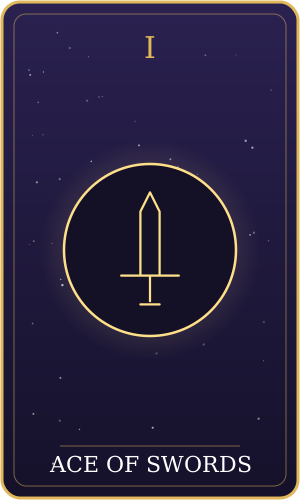
What the Ace of Swords means
Think of the moment when a muddled problem suddenly turns simple. You have been circling a question for days, and then one sentence arrives that explains everything. That click of understanding is the territory of the Ace of Swords, the first and purest expression of the suit.
Swords belong to the element of Air in tarot, which is the realm of thinking, speaking, reading and deciding. An ace is the seed of its suit, the raw potential before it gets complicated by relationships and circumstances. So this card is the seed of a clear mind.
Readers often describe it as a card of beginnings, but a particular kind. Cups begin with a feeling and Wands begin with a spark of drive. The Ace of Swords begins with an idea, a name for what is going on, or a truth that can no longer be ignored.
It is also a double-edged image, and good guides say so. A blade can cut through confusion, and it can also wound if swung carelessly. The card holds both possibilities, which is why its best readings talk about clarity delivered with some care.
The image and its symbols
In the traditional Rider-Waite-Smith picture, a single hand reaches out of a cloud against a pale sky. The hand grips the hilt of a straight, double-edged sword held point upward. Below stretch rugged, bare mountains, and the whole scene feels cold, bright and wide open.
At the top of the blade sits a crown, circled by a wreath of laurel and, on the other side, a palm branch. Tradition reads the crown as authority earned through thought, the laurel as victory and the palm as peace. Together they suggest that clear thinking can win something without a fight.
Six small drops hang in the air beside the blade, shaped a little like flames or falling sparks. Some writers link them to a mystical Hebrew letter and others simply see them as energy dripping from the clouds. You do not need a theory to feel the sense of something being poured down.
Our site shows its own artwork rather than the classic illustration, but these are the elements tradition attaches to it. The hand from a cloud appears on every ace, and it reads as a gift that arrives from outside your usual routine.
The Ace of Swords upright
Upright, the Ace of Swords points to clarity. Something that was blurry now has an outline. It might be a clear read on why a plan keeps stalling, a phrase that finally names a feeling, or an obvious solution you had missed because you were standing too close.
It also speaks of honesty. The card often shows up when a person is ready to say or hear something plainly, without padding. Many readers connect it with signing off on a decision, drafting a message that gets to the point and trusting the facts to carry weight.
There is a creative side too. Because Air governs ideas, the Ace can describe the moment a concept for a project, a story or a business arrives fully formed enough to write down. The task then becomes testing it against reality rather than polishing it forever.
As a question for reflection, an upright Ace might ask: what do I already know that I keep refusing to say out loud? The answer is often shorter and simpler than the dread around it.
The Ace of Swords reversed
Reversed, the Ace of Swords tends to describe a mind that cannot find its edge. Thoughts loop, facts conflict and every option seems to have an equal and opposite objection. The blade is still there, but it feels dull, or pointing in several directions at once.
Another reading is the opposite problem: clarity used without kindness. A reversed Ace may describe a blunt remark, a cutting email or a conclusion jumped to too quickly. Being right and being useful are not always the same thing, and this card nudges that distinction.
It can also point to an idea that is not ready. Perhaps the plan has gaps, the information is incomplete, or you have fallen for a theory because it was tidy. The reversed card does not say the idea is bad, only that it needs more checking.
None of this is a warning about what will happen. It is a reflective prompt for a foggy week, and the practical responses are modest: sleep, write things down, ask one trusted person to read your draft before it goes out.
The Ace of Swords in love and relationships
In love readings, the Ace of Swords is the card of the honest conversation. For a couple, it may describe a moment when a pattern is finally named without blame, such as noticing that every argument starts at the same time of day. Naming it does not fix it, but it makes it workable.
For single readers, the card often points to clearer standards. You may realize what you do and do not want, or recognize that a long-running situationship has never had a label because nobody asked for one. Clarity here is a gift even when the answer is uncomfortable.
As feelings, the Ace can describe someone who is thinking things over with intensity. They may be direct, a little cool in tone and more comfortable with words than gestures. It does not mean they feel little. It suggests they want to understand before they commit.
Reversed in love, the card may reflect mixed signals, a talk that keeps getting postponed or words that came out sharper than intended. A gentle approach is to wait a day, then say the same truth in a softer voice.
The Ace of Swords in career and work
At work, the Ace of Swords is associated with thinking tasks: writing, analysis, planning, research, negotiation and any role where precision matters. It often appears when someone gets a good idea for a project, or finally understands what a vague brief is really asking for.
It can also describe a clean start in communication. Perhaps you draft a proposal in one sitting, or a team meeting ends with a decision instead of another meeting. The card values short, direct language and a willingness to put a clear point on the table.
Learning is another theme. A person beginning a course, picking up a new skill or reading deeply on a topic may see this card, because the Ace marks the first firm grip on an unfamiliar subject. The early stages feel sharp and rewarding.
Reversed, it may suggest scattered priorities, unclear instructions or a message that landed badly with colleagues. The card offers themes only. It does not advise on job choices or money, which are best decided with real information and people you trust.
Is the Ace of Swords a yes or no card?
In the convention used by this site, the Ace of Swords is a yes. Most readers who use tarot for quick questions treat it as favorable, since clarity, truth and a good idea all lean toward going ahead with open eyes. This is an editorial convention, not an ancient rule, and it is the one our yes-or-no tool uses.
The reversed rule works like this: a reversed card moves one step toward no, so a yes becomes a maybe, a maybe becomes a no, and a no stays a no. A reversed Ace of Swords therefore reads as a maybe, which fits the foggy-thinking meaning of the card.
Reversed cards only appear in the yes-or-no tool if you tick "Include reversed cards", and that box starts unticked. With it off, every card is drawn upright and the Ace is simply a yes.
Treat a yes as encouragement to think the matter through, not as proof of anything. The format is for fun and reflection. Questions about health, money, law or safety need real information and qualified advice instead.
The Ace of Swords and astrology
In the Golden Dawn tradition, which shaped most modern decks, the four aces are tied to the four elements, and the Ace of Swords belongs to Air. This is a correspondence from tradition, and other systems differ, but it is the one this site follows.
Air is the element of the three air signs: Gemini, Libra and Aquarius. They are linked with communication, ideas, fairness and perspective. That matches the card closely, since the Ace is the root of thinking and speaking, before any particular style of thought develops.
To connect the card with your own chart, look at where your air signs fall. The Sun, Moon, Mercury or Ascendant in Gemini, Libra or Aquarius may make the Ace feel familiar, and Mercury is often read as the planet of everyday thinking and talking.
You can see those placements with our free birth chart calculator. Astrology here is a lens for self-reflection, and a correspondence is a thread to follow out of curiosity, not a statement about what will happen in anyone's life.
The Ace of Swords as advice
As advice, the Ace of Swords suggests finding the plain sentence. Try writing the situation in two lines, as if explaining it to a friend who has five minutes. If you cannot, that gap shows where the thinking is still unfinished.
It also invites you to separate facts from stories. List what you actually know, then list what you are assuming. Many problems shrink when the second list is written down and someone asks, gently, how you know.
Another use is preparing a hard conversation. Decide the one thing you most need to say, and then choose words that are accurate without being sharp. Clarity delivered with courtesy is usually heard better than clarity delivered as a verdict.
If the card comes up reversed, slow down and gather information before concluding anything. A decision made with half the facts rarely feels as sure on the following day, and the Ace is happy to wait until you have the rest.
Ace of Swords corresponds to the element of air. See your element balance.
Frequently asked questions
Is the Ace of Swords a good card?
Most readers see the Ace of Swords as a positive but serious card. It stands for clarity, truth and fresh ideas, which are helpful, though the truth is not always comfortable. Reversed, it describes foggy or harsh thinking rather than anything harmful. As with every card, it is a prompt for reflection and not a forecast.
What does the Ace of Swords mean in a relationship?
In a relationship, the Ace of Swords usually points to honest communication and clearer understanding. It may describe naming a pattern, setting a boundary or finally asking a direct question. For single readers it suggests knowing what you want. Reversed, it may reflect mixed messages or words that came out harsher than meant.
What does the Ace of Swords reversed mean?
Reversed, the Ace of Swords tends to describe confusion, indecision or blunt communication. The mind may be cluttered, the facts incomplete, or a message delivered too sharply. It is not a warning about events. The useful response is usually to slow down, check the details and give yourself time before deciding.
Is the Ace of Swords a yes or no card?
In this site's convention, the Ace of Swords is a yes, because clarity and good ideas lean toward encouragement. It is an editorial convention, not an ancient rule, and readers differ. If the card is reversed, our yes-or-no tool turns the yes into a maybe. That only happens when you tick "Include reversed cards".
What element and sign go with the Ace of Swords?
In the Golden Dawn tradition the Ace of Swords belongs to the element Air, shared by Gemini, Libra and Aquarius. That is a traditional assignment, not the only one in existence. If you have the Sun, Moon, Mercury or rising sign in an air sign, the card may feel personally familiar.
What does the Ace of Swords mean as feelings?
As feelings, the Ace of Swords can describe someone who is thinking carefully and wants clarity before committing. They may seem direct or reserved rather than openly emotional. A card cannot read another person's mind, so treat this as a thoughtful guess and a reason to ask them plainly. Asking them plainly is kinder than guessing. Asking them plainly is kinder than guessing.
 King of Cups
 Two of Swords
 The Star
 The Moon