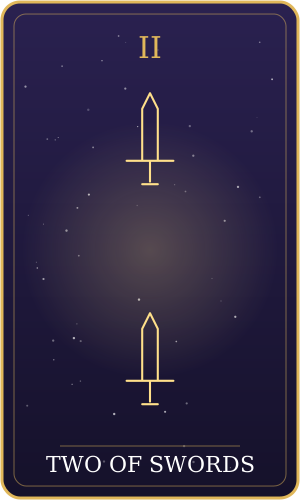
What the Two of Swords means
Some decisions are hard because both options are good, and some because both are costly. The Two of Swords belongs to the second kind of moment, when weighing things up has gone on so long that the weighing has become the activity. Nothing moves, and that is exactly the point of the card.
In a Swords sequence, the ace is a clear thought and the two is what happens when a second thought arrives that disagrees with the first. Two forces of equal strength meet and cancel. The result is balance, but a tense, held-breath kind of balance rather than a peaceful one.
Readers often describe the card as a truce or a stalemate. It can fit a negotiation in which both sides keep their arms folded, or a private dilemma where heart and head are each making a sensible argument. The card does not say which side is right.
What it does say is that avoiding the choice is itself a choice. A pause can be wise when information is missing, but the Two of Swords asks whether the pause is still protecting you or has simply become a habit.
Reading the picture
In the traditional Rider-Waite-Smith image, a woman sits very upright on a plain stone bench, her back to the water. A cloth covers her eyes. She holds a long sword in each hand and crosses them over her chest, so the blades form a barrier in front of her heart.
Behind her lies a calm, pale sea dotted with jagged rocks, and a thin crescent moon hangs in the sky above. The shoreline is empty. Nothing in the scene is chaotic, which is part of the unease: the stillness looks deliberate, as if the quiet were being guarded.
The blindfold is the heart of the symbolism. It can mean refusing to look, or it can mean shutting out noise to listen inward. Both readings are used. The question for the reader is whether this person is hiding from the facts or quietly resting from them.
Crossed swords stand for two ideas held in tension, and the sea behind suggests feelings she is not turning to face. Our site uses its own artwork instead of the classic illustration, but these are the details tradition attaches to the card.
The Two of Swords upright
Upright, the card points to a standoff that needs attention. You may be stuck between two jobs, two cities, two stories about what happened or two people's expectations. The mind keeps producing arguments for each side, and none of them tips the scale.
It can also describe a defensive peace. Two people may be avoiding a topic to keep the evening pleasant, or someone may keep their feelings behind an even tone because the alternative seems messy. The calm is real but fragile, and it takes effort to maintain.
A positive reading exists as well. Sometimes a person chooses to step back, close their eyes and let a heated situation cool before judging it. In that sense the Two of Swords can be a sensible time-out, particularly when the choice does not have to be made today.
As a question for reflection, an upright Two might ask: what am I afraid I will see if I take the blindfold off? Naming that fear often shifts the problem from impossible to merely uncomfortable.
The Two of Swords reversed
Reversed, the stillness breaks. One reading is that the blindfold slips and the facts arrive, whether you wanted them or not. A conversation happens, an email is read, a deadline appears, and the question can no longer be left on the shelf.
Another reading is overload. Too many opinions, too many tabs open, too many friends with advice. The mind is no longer balanced but flooded, and the reversed Two can describe the anxious spinning that follows a decision being forced from the outside.
A third reading, used by some readers, is that the card shows a lie or a half-truth being uncovered, either one told to others or one you were telling yourself. Handled kindly, this can be a relief, since it lets the stuck situation start moving.
None of these readings predicts an outcome. They describe moods and patterns, and a practical response is to write down the options, limit the number of advisors and set a gentle date for deciding. If worry feels constant, talking with a qualified professional is a better support than any card.
The Two of Swords in love and relationships
In love readings, the Two of Swords often points to a conversation that is being put off. Both people may sense that something needs to be said, yet each is choosing peace over honesty for the time being. The relationship is not necessarily in trouble; it is simply waiting.
For single readers, the card can describe holding back from dating because every possibility feels like a risk, or being torn between two people. It may also describe guarding the heart after a disappointment, with the crossed blades as a shield rather than a threat.
As feelings, the Two of Swords can describe someone who cares but is conflicted. They may seem even-tempered and hard to read, offering polite answers while the real thoughts stay private. It does not mean indifference. It suggests that they are weighing something.
Reversed in love, the card may signal pressure to choose, or a hidden matter surfacing and prompting a talk. A calm, curious question usually works better than a demand for an answer on the spot.
The Two of Swords in career and work
At work, the Two of Swords is associated with decisions delayed by uncertainty. A reader might be comparing offers, deciding whether to speak up in a disagreement, or choosing between two projects that both look worthwhile. The card describes the stalemate, not the answer.
It also fits negotiation. Both parties hold their positions, each protecting what matters to them, and progress depends on someone opening the conversation. Many readers connect the card with mediation, compromise and the skill of staying composed under pressure.
In team settings, it can describe a group that agrees to disagree and lets a question hang. That may be fine for a while, though the card gently asks whether the unresolved issue is quietly costing time and goodwill.
Reversed, it may suggest a deadline forcing the issue, or a flood of conflicting advice from colleagues. The card offers themes only and gives no career or financial guidance. Real choices deserve real information and trusted people.
Is the Two of Swords a yes or no card?
In the convention used by this site, the Two of Swords is a maybe. Most readers who use tarot for quick questions treat a stalemate as undecided, since the whole image is about balance and a choice not yet made. We offer that as a house convention rather than a traditional rule, and it is the reading our yes-or-no tool applies.
The reversed rule is simple: a reversed card moves one step toward no, so a yes becomes a maybe, a maybe becomes a no, and a no stays a no. A reversed Two of Swords therefore reads as a no, in the sense that the standoff is breaking down and the answer is not what the question hoped for.
Reversed cards only appear if you tick "Include reversed cards" in the yes-or-no tool, and that box begins unticked. With it off, the card always shows as an upright maybe.
A maybe is best treated as an invitation to gather more information rather than as a ruling. The format is for fun and reflection, and it is not suited to questions about health, money, law or safety.
The Two of Swords and astrology
In the Golden Dawn tradition, the numbered cards from two to ten are tied to decans, which are ten-degree slices of the zodiac. Each sign spans thirty degrees, so it has three decans, and each decan is given a planet. The Two of Swords is assigned the Moon in Libra.
Libra is an air sign, cardinal in quality and ruled by Venus. It is linked with fairness, partnership and weighing both sides, so the image of a scale fits the card well. The Moon adds feeling and instinct, which is why the balance here is emotional as much as logical.
To connect the card with your own chart, look at where the Moon and Libra sit. The Moon changes sign about every two to two and a half days, so your Moon sign depends on your birth date and, sometimes, birth time. A Moon or planets in Libra may make the card feel familiar.
You can find both placements with our free birth chart calculator. This is a tradition offered for self-reflection and curiosity, not a prediction about anyone's life.
The Two of Swords as advice
As advice, the Two of Swords suggests taking the blindfold off, at least a little. Write down what each option would look like after a month, then after a year. Seeing both futures sketched out often reveals which one you have been avoiding.
It also supports setting a deadline. Open-ended deliberation can last forever, while a date on the calendar gives the mind permission to settle. Choose a day, collect the facts you need before it, and then let the decision be made on that day.
If the dilemma involves another person, consider telling them where you are in the process. Saying that you are torn, and that an answer is coming by Friday, is kinder than silence and takes pressure off the situation.
If the card comes up reversed, reduce the noise. Fewer opinions, one quiet walk and a plain list of priorities usually help more than another round of research. Whatever you decide, the choice can be revisited later as you learn more.
Two of Swords belongs to the decan of Moon in Libra: in the Golden Dawn tradition each minor card from two to ten rules ten degrees of the zodiac. Find Moon in your chart or read about Libra rising.
Frequently asked questions
Is the Two of Swords a good or bad card?
The Two of Swords is neither good nor bad. It describes a pause, a stalemate or a hard choice that has not been made yet. That can be sensible rest or uncomfortable avoidance depending on context. Reversed, it points to pressure or overload rather than anything harmful. As with all tarot, it is a prompt for reflection and not a forecast.
What does the Two of Swords mean in a relationship?
In a relationship, the Two of Swords often points to a conversation being avoided or a decision being delayed. Both people may be keeping the peace at the cost of honesty. For single readers it can mean guarding the heart or feeling torn between options. A calm, open question usually helps more than waiting.
What does the Two of Swords reversed mean?
Reversed, the Two of Swords tends to describe the standoff breaking. Facts may surface, advice may pile up, or a deadline may force a choice. Some readers also link it with a lie being uncovered. It is not a prediction. A useful response is to limit the noise, list your priorities and set a date for deciding.
Is the Two of Swords a yes or no card?
In this site's convention the Two of Swords is a maybe, since the image is about balance and a decision not yet made. That is an editorial convention, not an ancient rule, and readers differ. If it is reversed, our yes-or-no tool shifts the maybe to a no, but only when "Include reversed cards" is ticked.
Which planet and sign go with the Two of Swords?
In the Golden Dawn tradition the Two of Swords corresponds to the Moon in Libra, a decan assignment. Libra is an air sign linked with balance and partnership, and the Moon adds instinct and feeling. This is a traditional correspondence, not the only one. Check your own chart for the Moon or Libra placements.
What does the blindfold on the Two of Swords mean?
The blindfold has two common readings. It can mean refusing to look at the facts, or it can mean closing out distraction to listen inward. Which one fits depends on the question. The card asks whether the pause still protects you or has become avoidance, and what you might see once the cloth is lifted.
 Ace of Swords
 Three of Swords
 The Star
 The Moon