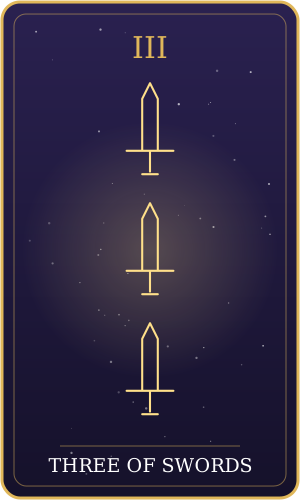
What the Three of Swords means
The Three of Swords looks stark at first glance, and many newcomers flinch. It helps to remember what the card is actually doing. It names a hurt out loud. In everyday life, naming a hurt is often the first step toward being able to carry it.
Within the Swords suit, which concerns thought and speech, the three is the place where honesty has an emotional cost. A truth has been said or discovered, and it stings. The card is about the sting, not about blame or about what has to happen next.
Readers connect it with disappointment, loss, separation, a friendship that has changed, or a plan that fell through. It can also cover quieter things, like realizing that something you hoped for is not coming. The unifying thread is sadness that is real and deserves to be acknowledged.
Importantly, the card does not say the pain is permanent. Tarot readers often point out that the picture shows a moment, with storm clouds that pass. The weather is part of the scene precisely because weather changes.
The picture and its symbols
In the traditional Rider-Waite-Smith image, a large red heart floats in the middle of the card. Three straight swords pass through it, one vertical and two angled, converging at the center. There is no person in the scene. The heart is the whole subject.
Behind the heart, a heavy gray sky releases steady rain, and thick clouds fill the frame. The weather matches the mood without exaggerating it. Rain in tarot also tends to symbolize emotion that finally falls instead of being held in, which hints at release.
The number three often stands for growth or expression in tarot. In this suit it can be read as the point where an idea or a relationship meets an unwelcome truth and has to adjust. The three blades converge on one place, which suggests a single clear source of hurt.
Our site shows its own artwork rather than the classic illustration, but these are the details tradition attaches to the card. Its bluntness is deliberate: the deck is willing to show sorrow so that readers feel permitted to feel it.
The Three of Swords upright
Upright, the card points to heartache or disappointment that is being felt in full. It may relate to an ending, a harsh conversation, a betrayal of trust or simply news that was hard to hear. The emotion tends to be clean and unmistakable, with little confusion about what it is.
Many readers see value in the plainness. Pain that is denied often leaks out sideways as irritability or numbness, while pain that is named can start to move. The upright Three invites permission to say that something hurt, without arguing yourself out of it.
It can also describe grief shared. A person may find that telling a friend the whole story, tears included, brings relief. The card honors that kind of honesty, and it often appears when someone needs to talk more than they need to fix anything.
A card is not a substitute for support from people you trust or from a qualified professional, and anyone whose sadness feels heavy or lasting deserves that kind of help. As a reflective prompt, the upright Three simply asks: what do I need to acknowledge before I can feel lighter?
The Three of Swords reversed
Reversed, the Three of Swords is usually read as healing in progress. The blades are working their way out, slowly, and the rain thins. Many readers see forgiveness, acceptance or the first mornings when a loss is not the first thing on your mind.
Another reading is hurt that is being held in. A reversed Three may describe someone who has not allowed themselves to feel the sadness, or who keeps replaying an old wound and cannot put it down. Recovery is neither tidy nor quick, and this version of the card acknowledges that.
It can also describe pain from the past resurfacing, perhaps triggered by an anniversary, a song or a situation that echoes an earlier one. This is common and not a sign of failure. Healing usually moves in loops rather than in a straight line.
A reversed card is a prompt for reflection, not a verdict. Gentle responses include rest, time outdoors, writing a letter you do not send, and spending time with people who are easy to be around. Talking with a counselor or doctor is wise whenever feelings seem to stay stuck.
The Three of Swords in love and relationships
In love readings, the Three of Swords is the best-known heartbreak card, though it is more nuanced than that label suggests. It may describe the sting of a breakup, a quarrel that revealed something painful, or the sadness of realizing that two people want different things.
It can also appear inside lasting relationships. A couple may go through a hard patch in which one person feels unheard or let down, and the card marks the moment the hurt is finally spoken. In that case, honesty, however uncomfortable, can be the start of repair.
For single readers, the card can point to lingering feelings about a past relationship or to disappointment in dating. It does not say that love is out of reach. It reflects the tenderness of the present moment and the value of being gentle with yourself.
As feelings, the Three of Swords can describe someone who is hurting, grieving or processing a letdown. They may be withdrawn or sad rather than angry. If you are worried about a person, a simple, kind question tends to serve better than a guess from a card.
The Three of Swords in career and work
At work, the Three of Swords is associated with setbacks that sting: a project cancelled, a colleague leaving, critical feedback or a role that did not turn out as hoped. It describes disappointment, not failure, and it often appears at moments when effort and results did not match.
The card also relates to difficult messages. Delivering or receiving a hard truth, such as a team restructure or a frank performance review, fits its themes. The best readings stress doing this with honesty and care so that the hurt is not larger than it has to be.
There is a quiet professional lesson here too. People who allow themselves a short time to be disappointed often recover their footing sooner than those who rush past it. The card supports taking a breath, then deciding what to learn.
Reversed, it may reflect recovery after a setback, or old workplace resentments that need to be set down. The card offers only themes and no career or financial advice. Practical choices deserve real information and people you trust.
Is the Three of Swords a yes or no card?
In the convention used by this site, the Three of Swords is a no. Most readers who use tarot for quick questions treat it as unfavorable for the question asked, because its themes of sorrow and disappointment lean away from a happy outcome. That is a convention chosen by this site, not a rule from tradition, and our yes-or-no tool follows it.
Our reversal rule works the same way every time: yes slides to maybe, maybe slides to no, and no remains no. The Three of Swords is already a no, so it stays a no whether it lands upright or reversed.
Reversed cards only appear in the yes-or-no tool when you tick "Include reversed cards", and the box begins unticked. Either way, the answer for this card does not change.
A no from this card is best heard as a gentle reality check and not as a sentence. The yes-or-no draw is meant as light entertainment and a prompt for thought. Questions about health, money, law or safety need real information and qualified advice.
The Three of Swords and astrology
In the Golden Dawn tradition, the numbered cards from two to ten are attached to decans, which are ten-degree slices of a zodiac sign. Each sign spans thirty degrees, so it has three decans. The Three of Swords is assigned Saturn in Libra.
Libra is a cardinal air sign whose ruler is Venus. It is linked with relationships, fairness and harmony, which explains why the card centers on a heart. Saturn is the planet of limits, time and lessons, and it adds the idea that some hurts teach us what matters.
Saturn spends about two and a half years in each sign, so people born within the same stretch share a Saturn sign. To connect the card with your chart, check where Saturn and Libra fall for you. Saturn in Libra may make the card resonate in questions of partnership and commitment.
Our free birth chart calculator will show where each of them falls for you. This correspondence is a thread to follow for self-reflection and curiosity, not a prediction about anyone's life.
The Three of Swords as advice
As advice, the Three of Swords suggests letting yourself feel what is there. That might mean a quiet evening, a long walk or a conversation with someone who listens without hurrying to fix things. Sadness that is acknowledged tends to soften sooner.
It also encourages gentle honesty. If you need to say something difficult, choose words that are truthful and free of cruelty. If you are on the receiving end, give yourself time before responding, since the first reaction is rarely the most considered one.
A simple writing exercise can help: list what happened, what you feel, and one thing you still value in spite of it. Keeping the three lists separate stops the pain from swallowing the rest of the story.
If the card comes up reversed, the advice is patience. Healing has its own pace, and a good day followed by a hard one is ordinary. Lean on friends, family or a professional when the weight is more than a card or a notebook can hold.
Three of Swords belongs to the decan of Saturn in Libra: in the Golden Dawn tradition each minor card from two to ten rules ten degrees of the zodiac. Find Saturn in your chart or read about Libra rising.
Frequently asked questions
Is the Three of Swords a bad card?
The Three of Swords is a sad card, but sad is not the same as bad. It acknowledges heartache and disappointment honestly, which many people find a relief. Reversed, it usually points to healing. Like every tarot card, it is a prompt for reflection and not a forecast of what will happen to you.
What does the Three of Swords mean in love?
In love, the Three of Swords describes hurt feelings, the sadness of an ending or a painful truth finally spoken. It does not decide what happens next. Some couples find that honesty at this point begins repair, while others recognize a need to part. It is a reflective card, not a prediction about any relationship.
What does the Three of Swords reversed mean?
Reversed, the Three of Swords often means healing is underway: forgiveness, acceptance or relief after a loss. It can also describe holding pain in or old hurt resurfacing. Recovery moves in loops, not straight lines, so be patient. If sadness feels heavy or lasting, a trusted person or professional can support you in ways a card cannot.
Is the Three of Swords a yes or no card?
In this site's convention the Three of Swords is a no, since its themes of sorrow and disappointment lean away from a happy outcome. That is an editorial convention, not an ancient rule. Reversed, the reading stays a no, because a no cannot move further. Reversed cards appear only if "Include reversed cards" is ticked.
What does the Three of Swords mean as feelings?
As feelings, the Three of Swords can describe someone who is hurt, sad or processing a disappointment. They may be quiet or withdrawn rather than angry. A card cannot read another person's mind, so treat this as a gentle guess and a reason to be kind. A direct, caring question is the best way to find out.
Which planet and sign go with the Three of Swords?
In the Golden Dawn tradition the Three of Swords corresponds to Saturn in Libra, a decan assignment. Libra is an air sign tied to relationships and fairness, and Saturn stands for time and lessons. It is a traditional correspondence, not the only one. Check your chart for Saturn or Libra placements.
 Two of Swords
 Four of Swords
 The Star
 The Moon