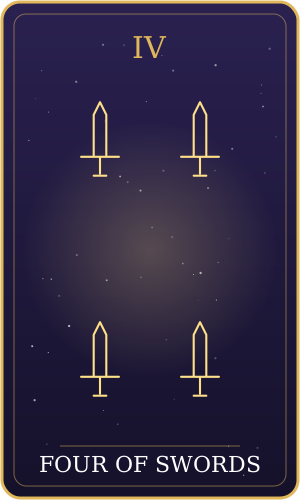
What the Four of Swords means
Rest has a poor reputation in busy cultures, which is partly why this card matters. The Four of Swords treats rest as a skill and a legitimate part of the process. Its message is that a mind which never stops is not a sharper one, only a more tired one.
Look at where the four sits in the suit. The ace brought a clear thought, the two a standoff and the three a painful truth. The four arrives after that run of tension, and it responds in the only sensible way: stop, lie still, and let things settle.
Readers often describe it as a retreat. That could mean recovery after a demanding season, a quiet weekend with the phone switched off, or a stretch of meditation or prayer. The key idea is intention. This is a break chosen for the sake of recovery, not an escape from responsibilities.
The card is also about mental stillness. Swords concern thinking, so the Four of Swords is the moment the thinking pauses. Insight tends to arrive in the gaps, and the card quietly trusts that effect.
The image, step by step
In the traditional Rider-Waite-Smith picture, the setting is the inside of a church or chapel. A stone figure of a knight lies on top of a tomb, hands pressed together in prayer, in the stillness of a carved effigy. Nothing about the scene is hurried.
Three swords hang on the wall above the knight, pointing downward, and a fourth lies flat beneath the tomb. Tradition reads this as a clear picture of conflict put away. The weapons are present but resting, and nobody needs them for now.
A stained-glass window shows a small scene of a figure with a robed companion, in rich colors set against the gray stone. Some readers see it as a nudge toward comfort and care, as if the resting knight is held in a larger story of kindness.
Our site uses its own artwork rather than the classic illustration, but these are the details tradition attaches to it. The tomb makes some newcomers uneasy, yet the card is not about death. Think of an effigy as a figure of stillness, nothing more.
The Four of Swords upright
Upright, the Four of Swords points to a time for rest and recovery. It may appear after intense effort, a stressful event, a period of heavy caregiving or a stretch of poor sleep. The card suggests that the best next step is a temporary step back.
It also describes strategic withdrawal. Sometimes a person pulls out of conversation or social plans for a while, not out of coldness but to hear their own thoughts. Quiet time can bring perspective that constant activity hides.
A reader might see this card when they need to turn off notifications, cancel a few commitments or take a real day off. The advice is practical: protect a block of time and treat it as seriously as a meeting.
As a prompt for reflection, an upright Four might ask: what would I do with a week of no obligations, and what is stopping me from carving out even an afternoon? Often the answer reveals what has been running on empty.
The Four of Swords reversed
Reversed, the card tends to describe rest that is not happening or not working. The body may be still while the mind races, or a person may be pushing through exhaustion because stopping feels like falling behind. The tomb is empty, so to speak, and the knight is up.
Another reading is restlessness. After a period of quiet, energy returns and the urge to act grows. The reversed Four can mean the rest is ending, and the person is getting ready to rejoin the world, sometimes a little eagerly.
It can also warn gently of burnout, in the sense that accumulated tiredness has started to show up as irritability, forgetfulness or a flat mood. Nothing here predicts a hard stretch. It is a mirror for a depleted stretch.
Practical responses are modest: schedule a recovery day, trim one commitment, go to bed earlier. If exhaustion feels constant or overwhelming, a doctor or counselor is the right place to talk, and a card is only a prompt.
The Four of Swords in love and relationships
In love readings, the Four of Swords often describes a period of calm after conflict. A couple may be taking space to cool down, or may simply be in a quiet phase with no big developments. The card suggests that stillness is not the same as distance.
For single readers, it may point to a break from dating after a busy or disappointing stretch. Resting from romance for a time can be a healthy choice, and the card supports it. Taking time alone to recover does not close the door on anything.
As feelings, the Four of Swords can describe someone who is tired, overwhelmed or needing space. They may withdraw for a while to recharge, which can feel like a snub but is often unrelated to you. A short, kind message is usually enough.
Reversed in love, the card may reflect a pair who are too busy to connect, or someone who is restless to reopen contact. Booking a simple, unhurried evening together can serve better than a long analysis.
The Four of Swords in career and work
At work, the Four of Swords is associated with recovery after a deadline, a launch or a demanding season. It might show up as a nudge to take vacation days you have been postponing or to hand over a task so you can breathe. Rest is part of productive work.
It also relates to planning in quiet. A person might use a calm week to think through next steps rather than react to every message. Many readers connect the card with sabbaticals, study breaks and deliberate slow periods between projects.
In a team, the card can describe a group that needs a pause between sprints. Retrospectives, breaks and a few unscheduled afternoons often help more than another push. The card values sustainable pace over heroics.
Reversed, it may suggest overwork, a return to full speed before recovery is complete, or a mind that cannot switch off on weekends. The card offers themes only and gives no career or financial advice. Real decisions deserve real information.
Is the Four of Swords a yes or no card?
In the convention used by this site, the Four of Swords is a maybe. Most readers who use tarot for quick questions treat a rest card as not yet: the timing is paused, and the answer may become clearer after some time. Consider it a house convention instead of an old rule; the yes-or-no tool on this site is built around it.
Reversal always shifts the reading one notch toward no, so yes becomes maybe, maybe becomes no, and no holds steady. A reversed Four of Swords therefore reads as a no, in the sense that the pause was skipped or cut short and the moment is not ready.
The tool shows reversed cards only if "Include reversed cards" is ticked, and it is off at the start. With it off, the card always shows up as an upright maybe.
Hearing a maybe from this card can be freeing: nothing needs to be settled today. The format is for fun and reflection, and it is not meant for questions about health, money, law or safety.
The Four of Swords and astrology
In the Golden Dawn tradition, the numbered cards from two to ten are assigned to decans, which are ten-degree slices of a zodiac sign. A sign spans thirty degrees and so has three decans. The Four of Swords is given Jupiter in Libra.
Venus rules Libra, which is cardinal and belongs to the air element. It is associated with balance, harmony and fair dealing. Jupiter is the planet of growth, perspective and generosity, and it spends about a year in each sign. Their pairing suggests a restful pause that restores a wider view.
To connect the card with your own chart, look at where Jupiter and Libra sit. Jupiter's sign depends mostly on your birth year, while Libra placements depend on where the Sun, Moon and planets fell on your birth date. Either may make the card feel familiar.
You can look up both with our free birth chart calculator. This is a tradition to explore for self-reflection and curiosity, not a prediction about anyone's life.
The Four of Swords as advice
As advice, the Four of Swords suggests scheduling rest before you need it. Put a recovery block in the calendar, tell the people involved and protect it. A short, regular pause often does more than a long collapse after the fact.
It also suggests simplifying. Choose one or two things that matter this week and let the rest wait. Reducing inputs, such as news, notifications and extra errands, gives the mind the quiet it needs to sort itself out.
A small ritual can help: ten minutes of silence at the same time each day, a walk without headphones, or a slow cup of tea with nothing to read. The point is to practice stillness until it feels normal.
If the card comes up reversed, ask what rest you have been postponing and what is making it hard to take. Even a modest change, such as an earlier night, can start the repair. When tiredness is stubborn, a professional can help in ways a card cannot.
Four of Swords belongs to the decan of Jupiter in Libra: in the Golden Dawn tradition each minor card from two to ten rules ten degrees of the zodiac. Find Jupiter in your chart or read about Libra rising.
Frequently asked questions
Does the Four of Swords mean death?
No. The tomb and the lying figure look serious, but the card is about rest and recovery, not death. The knight is a stone effigy, a symbol of stillness, with swords laid aside for now. On this site no tarot card predicts physical death. Read it as a reminder to pause, recharge and let the mind settle.
Is the Four of Swords a good card?
Most readers see the Four of Swords as a gentle, supportive card. It values rest and recovery, which many busy people need. It can feel frustrating if you want to act immediately. Reversed, it points to skipped rest or restlessness. Like the rest of the deck, it works as a reflective prompt rather than a prediction.
What does the Four of Swords mean in a relationship?
In a relationship, the Four of Swords usually describes a quiet phase, a cooling-off period or a need for personal space. It does not mean the relationship is over. For single readers it can support taking a break from dating. Reversed, it may point to restlessness or being too busy to connect.
What does the Four of Swords reversed mean?
Reversed, the Four of Swords often points to rest that was skipped, cut short or ineffective. It can show restlessness, burnout or a return to activity before you are ready. It is not a prediction. A useful response is to schedule real recovery time. If tiredness feels constant, a doctor or counselor can help.
Is the Four of Swords a yes or no card?
In this site's convention the Four of Swords is a maybe, because the card is about a pause and a decision not yet ready. It is a house reading, not a traditional rule. If it is reversed, our yes-or-no tool moves the maybe to a no, but only when "Include reversed cards" is ticked.
Which planet and sign go with the Four of Swords?
In the Golden Dawn tradition the Four of Swords corresponds to Jupiter in Libra, a decan assignment. Libra is an air sign tied to balance and fairness, and Jupiter stands for growth and perspective. Other systems assign it differently. You can look up both placements in your birth chart. Look up both in your own chart.
 Three of Swords
 Five of Swords
 The Star
 The Moon