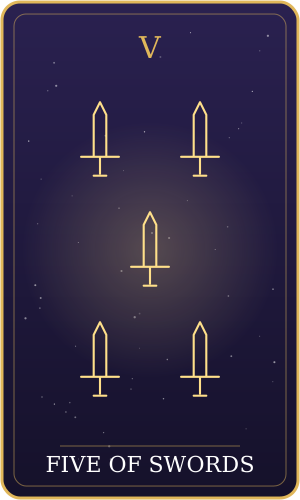
What the Five of Swords means
Most people have won an argument and felt strangely worse afterward. The other person went quiet, the room cooled, and the satisfaction lasted about ten seconds. That aftertaste is exactly what the Five of Swords describes: a win that costs more than it earned.
In the minor arcana, fives are the rank of friction. Something has been disturbed, and the comfortable balance of the fours is gone. In the suit of Swords, which governs thought and speech, the friction takes the form of words, rivalry, pride and the urge to be right.
Readers connect the card with disputes, competition, gossip and situations in which people look after themselves at the expense of the group. It can also describe a conflict that one person is winning on paper while quietly losing something more important, like trust.
Importantly, it is a mirror and not a judgment. The card does not call anyone the villain. It asks a practical question: what is this fight really about, and what would it take to stop fighting it?
What the picture shows
In the traditional Rider-Waite-Smith image, a man with a sly half-smile stands in the foreground, holding one sword in his hand and resting two more against his shoulder. Two further swords lie on the ground, discarded or taken. His posture is relaxed, almost satisfied.
Behind him, two figures move away toward the water, their shoulders slumped and their backs turned. They are unarmed, and one seems to be covering his face. The distance between them and the man in front tells the story without any dialogue.
The sky is wild: ragged clouds streak across it in a windy, unsettled way, and the shore below looks rough. The mood is that of the moment after an argument, when the adrenaline has faded and everyone is standing in the mess.
Our site shows its own artwork instead of the classic illustration, but these are the details tradition attaches to the card. The key is the smile. It asks whether the winner has noticed what the victory actually cost.
The Five of Swords upright
Upright, the Five of Swords points to conflict or competition in which the way someone wins matters. It might be an office dispute where one person scores points, a family disagreement that drags up old business, or an inner argument in which you beat yourself up to prove a point.
The card often highlights pride. The urge to have the last word, to be proven right or to avoid looking weak can push people into tactics they regret. Readers sometimes see it as a nudge to check whether the goal is the result or the feeling of winning.
It can also describe a situation where you feel outmaneuvered. The card then speaks to the sting of walking away from something unfair, and to the possibility that leaving is a legitimate and dignified choice rather than a defeat.
As a prompt for reflection, an upright Five might ask: if I got exactly what I wanted from this argument, what would I have afterward? A clear answer helps decide whether to keep going or step back.
The Five of Swords reversed
Reversed, the Five of Swords usually softens. The fight has run out of energy, and what is left is regret, apology or a plain wish to move on. Some readers see reconciliation in this card, in the sense of one side willing to say they went too far.
Another reading is unfinished business. The conflict may have ended on paper while resentment carries on underneath, with grudges stored for later. The reversed card can describe the cold silence that follows an argument that was never actually settled.
It may also point to someone who refuses to give up a lost cause, continuing a battle long after its value has gone. The card then invites a fresh look at whether continued effort serves anything beyond habit.
None of this predicts how a dispute will end. The useful reflections are practical: what would a sincere apology look like, who needs to be heard, and what part of this can I let go of without losing my self-respect?
The Five of Swords in love and relationships
In love readings, the Five of Swords describes arguments where winning is not the same as being happy. A couple may be stuck in a cycle of points scored and replayed, such as who forgot what, who said what and who is more tired. The card asks whether both people still feel on the same team.
For single readers, it can point to dating that has turned into game-playing or to old wounds that make you defensive. It may also describe feeling competitive with a friend over a person, or the lingering sting of a quarrel with an ex.
As feelings, the Five of Swords can describe someone who is irritated, defensive or hurt but unwilling to show it. They may bristle easily and prefer to win a point than admit vulnerability. A calm, curious tone from you is usually more effective than a debate.
Reversed in love, the card may suggest a truce, an apology or the realization that a fight was never worth the price. It does not predict that a relationship will mend, and it leaves that choice to the people involved.
The Five of Swords in career and work
At work, the Five of Swords fits rivalry, office politics and projects where credit becomes more important than results. It may show up when a colleague takes the spotlight, a team splits into camps, or a negotiation turns into a contest of wills.
It can also relate to ethics. Sharp tactics may achieve a short-term gain while damaging trust, and the card gently asks how the win will look in a few months. Many readers use it as a prompt to think about reputation, fairness and the culture a person wants around them.
On the other side, the card can describe knowing when to leave a battle that is not yours to win. Declining to engage with a toxic exchange, setting a limit or choosing a different team may be the stronger move.
Reversed, it can suggest repairing a working relationship or cooling things down after a heated meeting. The card offers themes only and gives no career, legal or financial advice. Serious workplace issues deserve proper channels and qualified guidance.
Is the Five of Swords a yes or no card?
On this site, the Five of Swords counts as a no. Plenty of readers who ask quick questions take it that way, since the card is about friction and victories that cost too much, and neither leans toward an easy yes. Treat that as an editorial convention rather than an ancient rule. It is the setting our yes-or-no tool applies.
Our reversed rule moves a card one step toward no: yes turns into maybe, maybe turns into no, and no stays no. Because the Five of Swords is already a no, flipping it upside down does not change the answer.
You will only meet reversed cards in the tool if you tick "Include reversed cards", which starts out unticked. Left alone, every draw is upright.
Take a no from this card as a prompt to pause and weigh the cost, not as a ruling on your question. The format exists for fun and reflection. Health, money, legal and safety questions belong with qualified professionals.
The Five of Swords and astrology
Golden Dawn tradition links the cards from two to ten with decans, the ten-degree thirds of each zodiac sign. A sign covers thirty degrees, so each has three decans. For the Five of Swords, the assigned pairing is Venus in Aquarius.
Aquarius is an air sign, fixed in quality, ruled by Saturn in the traditional scheme with Uranus as the modern co-ruler. It is linked with independence, ideals and group life. Venus is the planet of values, affection and what we find attractive, and it moves through a sign in roughly one to two months, sometimes longer in a retrograde year.
The pairing is an interesting tension. Venus values harmony, while Aquarius values principles and independence, and the card shows what happens when principle outranks warmth. Where Venus and Aquarius sit in your chart may hint at how you handle disagreement with people you care about.
Our free birth chart calculator shows both placements. Treat this as a thread for reflection and curiosity, not a prediction about anyone's life.
The Five of Swords as advice
As advice, the Five of Swords suggests asking what you actually want from the conflict. Write it in a sentence. If the sentence is an outcome, such as an apology or a fair split, you can aim for it. If it is simply to win, the card suggests that the prize is thin.
It also encourages choosing your battles. Some disagreements deserve full effort, and others only drain the people involved. A useful test is whether the issue will still matter in a month, and whether the relationship at stake is worth more than the point.
When emotions run high, a short delay helps. Wait before replying to a provocative message, and draft the reply you would be proud of tomorrow. Gentle firmness gets further than a clever takedown.
If the card comes up reversed, consider making the first move toward repair. A simple sentence such as I handled that badly can end a standoff that logic could not. You do not have to give up your view to offer respect.
Five of Swords belongs to the decan of Venus in Aquarius: in the Golden Dawn tradition each minor card from two to ten rules ten degrees of the zodiac. Find Venus in your chart or read about Aquarius rising.
Frequently asked questions
Is the Five of Swords a bad card?
The Five of Swords is a difficult card, but it is more of a mirror than a curse. It highlights conflict, pride and the cost of winning, which can help someone see a pattern. Reversed, it often points to apology or letting go. As with every tarot card, it is a prompt for reflection and not a forecast.
What does the Five of Swords mean in a relationship?
In a relationship, the Five of Swords usually describes an argument where scoring points matters more than understanding. It asks whether both people still feel like a team. For single readers it may point to guarded or competitive dating. A calm, curious tone and a willingness to listen are the card's quiet advice.
What does the Five of Swords reversed mean?
Reversed, the Five of Swords often means a fight is winding down. It can show regret, apology, reconciliation or simply being tired of the argument. It can also describe resentment that was never resolved. It is not a prediction about outcomes. Reflection on what you would like to repair or release is the best use of the card.
Is the Five of Swords a yes or no card?
In this site's convention the Five of Swords is a no, since it is about conflict and victories that cost too much. This is an editorial convention, not an ancient rule. Reversed, it stays a no because a no cannot move further. Reversed cards show up only if you tick "Include reversed cards" in the tool.
What does the Five of Swords mean as feelings?
As feelings, the Five of Swords can describe someone who is defensive, irritated or hurt and does not want to show it. They may be competitive or reluctant to admit fault. A card cannot read another person's mind, so treat it as a thoughtful guess and a reason to have a calm, direct conversation.
Which planet and sign go with the Five of Swords?
In the Golden Dawn tradition the Five of Swords corresponds to Venus in Aquarius, a decan assignment. Aquarius is a fixed air sign associated with independence and principle, and Venus relates to values and affection. Not every school agrees with this assignment. Look for Venus or Aquarius in your own chart.
 Four of Swords
 Six of Swords
 The Star
 The Moon