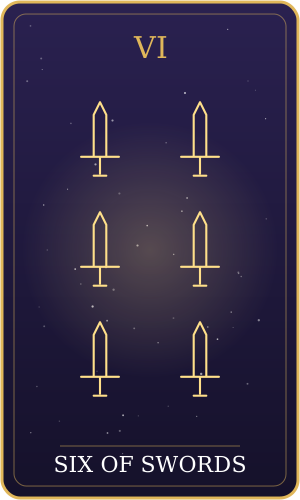
What the Six of Swords means
Transitions rarely feel like triumphs. More often they feel like sitting in a car with a few boxes, leaving a place that was hard, unsure what exactly comes next. The Six of Swords belongs to that in-between feeling, and it treats it with respect.
Coming after the conflict of the Five, the Six is the aftermath. Something has been left behind, whether a job, a place, a habit or an old way of seeing things. The suit of Swords governs thought, so the crossing is as much mental as physical.
Readers connect the card with moving on, healing at a measured pace, travel, a change of environment and the relief of leaving a tense situation. Its mood is quiet and sober rather than celebratory. Progress is steady, and nobody is in a hurry.
The card is hopeful without being naive. The water ahead is calm, but the boat is still carrying weight. It suggests that change is possible and that it is easiest when you are honest about what you are bringing along.
Looking at the picture
In the traditional Rider-Waite-Smith image, a ferryman stands at the back of a small flat boat, pushing it forward with a long pole. In front of him sit two passengers, a woman and a child, wrapped in heavy cloaks and facing away. Their heads are bowed.
Six swords stand upright in the bottom of the boat, their points up and their weight resting there. They are the cargo: worries, memories, lessons or burdens that cannot simply be tossed overboard. The boat moves, and so do they.
The water divides the picture. On the near side it ripples and churns, and on the far side it is smooth and level, with a distant shore rising beyond. The line between them is the passage the boat is crossing, from agitation to something close to peace.
We use original artwork instead of the classic illustration; the symbols described here are the traditional ones. The passengers do not look back, and the ferryman does not look anxious, which gives the scene its patient feeling.
The Six of Swords upright
Upright, the Six of Swords describes a passage toward calmer conditions. It could be an actual move or trip, or a more private shift such as finishing a hard chapter, ending a stressful routine or deciding it is time to go. The card honors the decision to leave.
It also speaks of recovery that happens gradually. A person might not feel fully better yet, but the direction is clear. Small signs, such as sleeping more easily or thinking about the future without a knot in the stomach, count as progress.
Another theme is accepting help. The ferryman is a guide, and the card is often read as a nod to mentors, advisors or friends who make a transition smoother. You do not need to row the whole way alone.
As a question for reflection, an upright Six might ask: what am I ready to leave, and what am I carrying that I would like to set down on the other side? The answer is often practical and surprisingly specific.
The Six of Swords reversed
Reversed, the boat may be going nowhere. The Six of Swords then points to a transition that is stalling, perhaps because of indecision, logistics or reluctance to leave something familiar. The shore ahead is visible, but the pole is stuck in the mud.
Another reading is baggage. A person may have physically moved on while emotionally staying put, or may keep returning to the same worries on every new horizon. The upright swords in the boat remain, and the reversed card asks which ones are worth keeping.
It can also describe resistance. Change that comes from outside, like a decision made by others, can feel like being forced into the boat. The reversed card acknowledges that kind of reluctance without judging it.
Nothing here is a forecast. Helpful responses include listing the obstacles, asking one person for practical help and choosing a small step toward the move. If lingering worries feel heavy, a counselor or other qualified professional is the better support.
The Six of Swords in love and relationships
In love readings, the Six of Swords is the card of moving forward after a rough stretch. A couple might be coming out of a difficult period and finding a calmer rhythm. A person who has left a relationship may be adjusting to a quieter life, and starting to feel lighter.
For single readers, it can point to new surroundings that bring new people, or to a gradual openness to dating again. It does not say that someone special is arriving. It describes the willingness to head toward calmer water at your own speed.
As feelings, the Six of Swords can describe someone who is working through something and slowly feeling better. They may seem quiet or thoughtful, and cautious about big declarations. It can also mean they are trying to leave a conflict behind and would appreciate patience.
Reversed in love, the card may reflect old hurt that keeps traveling with you, or a partnership in which one person is ready to move forward and the other is not. Honest talk about pace is usually more useful than pushing.
The Six of Swords in career and work
At work, the Six of Swords relates to transitions: changing teams, starting a new role, relocating, wrapping up a draining project or shifting to a calmer workload. It suggests a deliberate move away from a hard environment and toward a more workable one.
It can also describe handing over responsibilities with grace. A person leaving a position might document their work, say thoughtful goodbyes and take the lessons forward. The card values orderly exits and sensible preparation.
In terms of skills, the Six pairs well with communication and problem-solving. Mercury, the traditional planet of this card, rules thinking and talking, so a calm, well-organized explanation is often the key to a smooth shift.
Reversed, it may suggest delays, red tape or reluctance to commit to a change. Treat that as theme and not guidance on jobs or money. Choices about jobs and money are best made with real facts and trusted people.
Is the Six of Swords a yes or no card?
This site treats the Six of Swords as a yes. When readers pose quick questions, most take a card about steady progress and calmer water as favorable. That is an editorial convention, not an ancient rule, and different readers weigh it differently. It is the reading our yes-or-no tool uses.
Our reversed rule nudges every card one step toward no: yes becomes maybe, maybe becomes no, and no stays no. So a reversed Six of Swords reads as a maybe, which suits its stalled-boat meaning, where the way forward exists but the timing or readiness is uncertain.
Reversed cards turn up in the tool only when "Include reversed cards" is ticked. The box is unticked by default, so a standard draw gives the upright yes.
Hear a yes from this card as support for a measured step, not as a promise. A yes-or-no draw is best treated as play and self-reflection. Questions on health, money, law or safety need qualified advice and solid information.
The Six of Swords and astrology
According to the Golden Dawn tradition, cards two through ten are matched to decans, the ten-degree thirds of a zodiac sign. A sign has thirty degrees and therefore three decans. The Six of Swords is given Mercury in Aquarius.
Aquarius is a fixed air sign, ruled by Saturn in the traditional scheme with Uranus as modern co-ruler, and it is associated with ideas, community and looking ahead. Mercury is the planet of thought, speech and travel of the everyday sort, and it usually spends two to four weeks in a sign.
That pairing suits the picture well: an organized, thoughtful move that involves planning, conversation and a willingness to try a new way of doing things. Mercury in Aquarius is often described as a mind that likes fresh perspectives.
To connect the card with your chart, find where Mercury and Aquarius sit with our free birth chart calculator. This is a tradition to explore for self-reflection and curiosity, and it says nothing definite about anyone's life.
The Six of Swords as advice
As advice, the Six of Swords suggests choosing a direction and moving at a sustainable pace. A transition does not need drama. Make a short list of the next three steps, do the first one, and let momentum build gradually.
It also suggests sorting the cargo. Take a moment to write down what you are carrying from the old situation, such as lessons, grudges, habits or memories, and decide which belong in the new place. Some things are worth keeping and some can stay on the shore.
Accept help from the ferryman figures in your life. A friend who has made a similar move, a mentor or a practical advisor can save effort. Asking for directions is not weakness; it is how most crossings get done.
If the card comes up reversed, look for the specific snag. Is it a task, a fear or a person? Naming it turns a vague stall into something you can work on, even if only a little at a time.
Six of Swords belongs to the decan of Mercury in Aquarius: in the Golden Dawn tradition each minor card from two to ten rules ten degrees of the zodiac. Find Mercury in your chart or read about Aquarius rising.
Frequently asked questions
Is the Six of Swords a good card?
Most readers see the Six of Swords as a gently positive card. It stands for moving on, recovery and calmer conditions, though it admits that transitions carry weight. Reversed, it describes stalling or baggage rather than anything harmful. It is a reflective prompt, in the way all tarot is, and it makes no forecast.
What does the Six of Swords mean in a relationship?
In a relationship, the Six of Swords often describes moving forward after a rough patch, with things slowly calming down. For someone who has ended a relationship, it can point to adjusting and healing. For single readers it suggests gradual openness. It does not promise outcomes, and it respects a slow pace.
What does the Six of Swords reversed mean?
Reversed, the Six of Swords usually points to a transition that is stuck or incomplete. There may be reluctance to leave, unresolved baggage or practical delays. It is not a prediction. A helpful response is to name the specific obstacle, ask for support and take one small step. Heavy worry deserves support from a professional.
Is the Six of Swords a yes or no card?
In this site's convention the Six of Swords is a yes, because steady progress toward calmer water leans favorable. This is an editorial convention, not an ancient rule, and readers differ. If it is reversed, our yes-or-no tool turns the yes into a maybe. That only applies when you tick "Include reversed cards".
Does the Six of Swords mean travel?
The Six of Swords is often linked with travel because it shows a boat, but the crossing is just as likely to be a change of job, home or mindset. Many readers use it for any kind of transition. A card cannot confirm a trip. Treat the travel reading as one possible theme.
Which planet and sign go with the Six of Swords?
In the Golden Dawn tradition the Six of Swords corresponds to Mercury in Aquarius, a decan assignment. Aquarius is a fixed air sign linked with ideas and the future, and Mercury governs thinking and communication. Traditions differ on this assignment, and it is offered as one of several. You can check your chart for both.
 Five of Swords
 Seven of Swords
 The Star
 The Moon