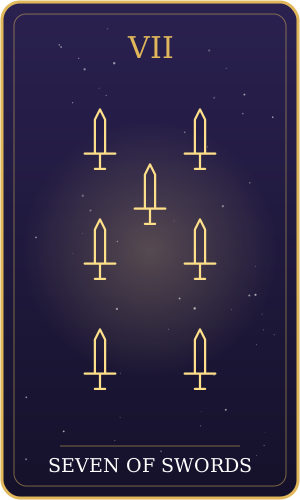
What the Seven of Swords means
Not everything clever is dishonest, and not everything careful is cowardly. The Seven of Swords lives in that gray area where a person is acting quietly, perhaps cutting a corner or choosing not to say everything. The card invites you to look at your own motives.
Sevens in the minor arcana tend to be about testing and assessing, a moment of pausing to ask whether the approach is working. In Swords, the suit of thought, the test falls on tactics: are you using your mind to solve a problem or to avoid it?
Readers connect the card with strategy, discretion, independence and sometimes deception. That last word needs context. The deception can come from you, toward others, or from others toward you, and in many readings it is a smaller thing like leaving out a detail or keeping a plan private.
The card does not accuse anyone. It asks for awareness. A person may be quite right to keep a plan confidential, yet the same behavior in another context can erode trust. The surrounding cards, and honesty with yourself, decide which it is.
The scene on the card
In the traditional Rider-Waite-Smith image, a man in a bright cap and boots steps lightly across an open field, carrying five swords bundled in his arms. His body leans forward in a deliberate tiptoe, but his head is turned to look back over his shoulder.
Two swords remain stuck upright in the ground behind him, which suggests that he could not or would not carry everything. Beyond them, a cluster of tents belonging to a camp occupies the background, with a few figures gathered near them, apparently unaware.
The sky is pale yellow and the ground sparse, so the scene feels exposed. Nothing is hidden by scenery. That openness makes the sneaking feel a bit comic, as if the man has decided he is invisible when in fact the whole field can see him.
The artwork on this site is original, not the classic illustration, though the details above come from tradition. Note the swords left behind. They hint at the limits of any plan that tries to carry too much alone.
The Seven of Swords upright
Upright, the Seven of Swords points to a strategy being carried out quietly. It might be perfectly innocent, like planning a surprise, preparing a job search in private, or choosing to keep a sensitive matter off a group chat. Discretion is a skill, and the card respects it.
It can also describe avoiding a direct approach. A person might work around a problem instead of confronting it, hint rather than ask, or take a shortcut that skirts the rules. The card then asks if that route is saving effort or just storing up trouble.
Another theme is self-reliance to a fault. The man carries the swords by himself, and the reading may be that you are taking on too much without involving anyone. Doing it all alone can look efficient and still leave things behind.
As a prompt for reflection, an upright Seven might ask: is there something I am not saying, and if so, am I protecting a plan or avoiding a conversation? Honest answers tend to point to a next step.
The Seven of Swords reversed
Reversed, the Seven of Swords tends to bring things into the open. A secret may be revealed, a plan reconsidered, or a conscience may begin to nag. Some readers see the card as a person deciding to put the swords back, or to confess before being found out.
Another reading is being caught off guard. The reversed card can describe the moment when a shortcut stops working, a half-truth no longer holds, or someone notices a gap. It can be uncomfortable, though it often also brings relief.
It may also point to suspicion. Perhaps you doubt someone's story, or you feel watched. The card does not confirm that anything is wrong, and it is wise to rely on facts rather than hunches before drawing conclusions about another person.
None of this is a prediction. Practical reflections include asking what you would be comfortable having everyone know, and what small correction would restore your peace of mind. A trusted friend or advisor can help with something that feels tangled.
The Seven of Swords in love and relationships
In love readings, the Seven of Swords is about candor. It can describe a person holding something back, whether a worry, a plan or a past detail, and the card asks if that silence is protecting the relationship or quietly wearing it down. Small omissions can grow into distance.
It may also appear for people who avoid direct conversation, preferring hints, tests or indirect signals. Both partners benefit when needs are stated plainly. The card suggests that asking clearly is often kinder and faster than sneaking around a topic.
As feelings, the Seven of Swords can describe someone who is guarded, strategic or unsure how much to share. They may be keeping their options open or protecting themselves after a past hurt. It does not prove dishonesty, and a gentle, direct question is the fairest way to learn more.
Reversed in love, the card may signal a confession, a conversation that clears the air or a re-evaluation of how open you are being. The card cannot say whether trust will be repaired, which depends on the people involved.
The Seven of Swords in career and work
At work, the Seven of Swords suits strategy, competitive intelligence, negotiation and any setting where timing and discretion matter. A person might be quietly preparing a proposal, keeping a job search private, or working on a solution before presenting it. Done openly with the right people, this is just good planning.
The card also carries an ethical thread. Cutting corners, taking undue credit or avoiding accountability can all fall under its shadow. Readers often use it as a prompt to review whether a method would stand up to daylight.
On the practical side, the Seven can indicate trying to do too much alone. Delegating or sharing information might look riskier than going solo, yet it frequently produces better results and prevents the dropped swords left behind in the field.
Reversed, it may suggest a mistake coming to light, a plan being rethought or an honest correction. No career, legal or money guidance is intended here; the card only suggests themes. Serious workplace matters deserve proper channels and qualified guidance.
Is the Seven of Swords a yes or no card?
The Seven of Swords counts as a maybe on this site. Many readers who ask quick questions see a card about strategy and half-truths as unsettled: possible, but with a catch worth checking first. We offer that as an editorial convention rather than an ancient rule, and it is the reading our yes-or-no tool applies.
The reversal rule shifts a card one step toward no. Yes softens to maybe, maybe sharpens to no, and no stays no. A reversed Seven of Swords therefore reads as a no, in the sense that the plan is coming undone or needs to be redone.
Reversed cards come up only when "Include reversed cards" is ticked, and that box starts out unticked. With it off, the draw is always the upright maybe.
Take a maybe from this card as a suggestion to check the details before going ahead. The format is for fun and reflection, and questions about health, money, law or safety belong with qualified professionals.
The Seven of Swords and astrology
Golden Dawn tradition pairs the cards from two to ten with decans, the ten-degree thirds of each zodiac sign. A sign spans thirty degrees and so contains three decans. The Seven of Swords is given the Moon in Aquarius.
Aquarius is a fixed air sign, ruled by Saturn in the traditional scheme with Uranus as modern co-ruler. It is linked with independence, unconventional thinking and a certain detachment. The Moon stands for instinct and feeling, and it changes sign about every two to two and a half days.
The combination suits the card: feelings expressed through a cool, independent exterior, and a habit of doing things one's own way. It also hints at an inner life that does not always match what is shown on the outside.
To connect the card with your own chart, look up the Moon and Aquarius with our free birth chart calculator. The Moon sign depends on your birth date and sometimes your birth time. This is a tradition for self-reflection and curiosity, not a prediction about anyone's life.
The Seven of Swords as advice
As advice, the Seven of Swords suggests checking whether your plan could be explained openly. If the thought of telling the people involved is uncomfortable, ask why. Sometimes the plan is fine and only the nerves need attention, and sometimes the plan needs adjusting.
It also encourages sharing the load. Think about the two swords left in the field and ask who could help you carry the rest. Involving others early can protect you from errors that only show up when you work alone.
When you need privacy, choose it deliberately. Discretion about a surprise or a draft is healthy, while secrecy about something that affects others tends to grow heavier over time. A good rule of thumb is to keep the plan quiet, not the truth.
If the card comes up reversed, consider coming clean about the small thing before it becomes a large one. A brief, honest sentence usually costs less than the effort of maintaining a story, and it tends to bring a sense of relief.
Seven of Swords belongs to the decan of Moon in Aquarius: in the Golden Dawn tradition each minor card from two to ten rules ten degrees of the zodiac. Find Moon in your chart or read about Aquarius rising.
Frequently asked questions
Is the Seven of Swords a bad card?
The Seven of Swords is ambiguous rather than bad. It can describe smart strategy and healthy privacy as well as shortcuts and half-truths. The card asks you to examine your motives and methods. Reversed, it often points to honesty returning. Treat it as a reflective nudge in the manner of any tarot card, never as a forecast.
Does the Seven of Swords mean someone is lying?
Not necessarily. The card can describe secrecy, avoidance or a one-sided plan, but those are also normal parts of life, like planning a surprise. It may invite you to be honest with yourself. A card cannot tell whether a specific person is lying, so rely on facts and a direct, calm conversation.
What does the Seven of Swords mean in a relationship?
In a relationship, the Seven of Swords usually points to something unsaid, such as a worry, a plan or an indirect approach. It asks whether the silence protects the bond or slowly strains it. For single readers it may suggest guardedness. Clear, kind communication is the card's quiet advice. Honest, kind conversation is the card's gentle advice. Honest, kind conversation is the card's gentle advice.
What does the Seven of Swords reversed mean?
Reversed, the Seven of Swords often means a hidden matter is coming to light, a plan is being rethought or conscience is speaking up. It can feel uncomfortable but often brings relief. It is not a prediction. Reflecting on what you would like to correct or say plainly is the most useful response.
Is the Seven of Swords a yes or no card?
In this site's convention the Seven of Swords is a maybe, since strategy and half-truths suggest a catch worth checking. Our convention is editorial and has no ancient authority behind it. If it is reversed, our yes-or-no tool moves the maybe to a no, but reversed cards only appear when "Include reversed cards" is ticked.
Which planet and sign go with the Seven of Swords?
In the Golden Dawn tradition the Seven of Swords corresponds to the Moon in Aquarius, a decan assignment. Aquarius is a fixed air sign linked with independence and unconventional thinking, and the Moon relates to instinct and feeling. Other schools of tarot make different matches. Check your chart for either.
 Six of Swords
 Eight of Swords
 The Star
 The Moon