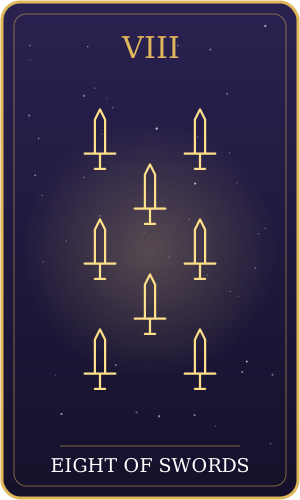
What the Eight of Swords means
Picture a person standing in a shallow stretch of water on bare, damp ground. A strip of cloth wraps the body from shoulders to knees, and a blindfold covers the eyes. Eight upright swords are planted around the figure, four on each side, forming a loose cage with gaps between the blades.
In the traditional Rider-Waite-Smith picture, a castle stands on a rocky hill in the background, far off but plainly visible. The sky is gray. Our site shows its own artwork for this card, but the symbols described here are the ones tradition attaches to it, and they carry the whole message.
The central irony is that the bindings are loose and the swords do not form a closed ring. Nothing in the scene physically prevents the figure from stepping out. What holds them is the blindfold and the belief that there is nowhere to go. That is why readers often call this the card of the mind as the jailer.
Swords belong to the suit of thought, language and decisions. Eight swords gathered into a fence suggest a thought pattern that has hardened into a rule: I cannot, I must not, there is no way. The card does not say the situation is easy. It says the walls may be partly made of interpretation.
Reading the symbols
The blindfold is the most important detail. A person who cannot see tends to rely on assumptions, and assumptions made in worry are rarely generous. Many readers take the cloth as a picture of a narrowed point of view, where only the most discouraging reading of events gets any airtime.
The wrapped arms and body stand for restriction that has become familiar. Notice that the figure is not struggling. Habit, fatigue or a sense of duty can make a limitation feel like a fact of life. The binding is a posture as much as an object.
The water at the feet is often linked to emotion, a reminder that fear and feeling sit underneath the logic. Thinking alone rarely fixes a problem that is partly emotional. The card quietly asks what feeling is hiding behind the argument.
The distant castle can be read two ways. Some see safety and structure that feel out of reach. Others see the authority whose rules the figure has absorbed. Either way, it sits at the edge of the picture as a reminder that a wider world exists beyond the ring of blades.
The Eight of Swords upright
Upright, this card describes a moment when options seem to have vanished. It might be a decision that keeps circling without landing, a situation where every path appears to have a catch, or a belief about yourself that closes doors before you try them. The feeling is of being stuck, though the cause is often internal.
Typical themes include self-doubt, overthinking, perceived powerlessness and rules taken on from someone else. A person drawing it may be repeating a sentence in their head so often that it sounds like truth. The card invites a gentle audit: whose voice is saying that, and what evidence supports it?
It does not say the person is to blame. Some limits are real, and some circumstances are genuinely tight. The card is better read as a question about how much of the tightness is external and how much is a story built around it. Even a small gap in the fence is useful information.
Many readers find that the card has a reassuring side. Seeing that the ropes are loose means a first step is smaller than expected. It rarely calls for a dramatic exit. More often it asks for one honest look at the situation with the blindfold pushed up.
The Eight of Swords reversed
Reversed, the Eight of Swords shows the knots coming undone. The blindfold slips, the view widens and the swords look more like a fence with a gate than a prison. It often describes the first real sense of choice after a long period of feeling hemmed in.
Common themes are release, clarity, self-advocacy and a willingness to ask for help. A person may realize that a rule they followed was never theirs, or that they have more room to maneuver than they believed. Taking that room usually starts with small, quiet moves.
A reversed card can also be more cautious. Some readers see the figure who has loosened the cloth but has not yet walked away, standing in the doorway of change. Relief and nervousness can sit side by side here, and that is normal.
If the reversed card appears during a stressful time, it is a prompt and not a prescription. Anxiety, rumination and a sense of being trapped can be heavy, and a card is not a substitute for support from people you trust or a qualified professional.
The Eight of Swords in love and relationships
In relationship readings, this card often points to a feeling of being caught in a pattern: the same argument, the same silence, a belief that the relationship cannot change or that you cannot ask for what you need. It may also describe staying quiet to avoid friction until the silence itself becomes the problem.
For single readers, it can show up as a story about dating that closes the door early. Thoughts like nobody will understand me or I always pick the wrong person act like swords in the ground. The card suggests testing those sentences against actual experience.
As feelings, the Eight of Swords can describe someone who feels conflicted or unsure how to speak. They may care but feel boxed in by obligation, fear of judgment or past hurt. Because a card cannot read a mind, it is wise to treat this as a prompt for a kind, direct conversation.
Reversed in love, the card tends to describe loosening: saying the thing that was unsaid, setting a boundary, or realizing a pattern can be changed. It can also describe a person who finally allows themselves to want something. If a relationship feels unsafe or distressing, reach out to someone you trust or a professional.
The Eight of Swords in career and work
At work, this card often describes a feeling of having no good options: a role that feels like a dead end, a manager whose expectations seem immovable, or a plan with too many obstacles to start. It can also describe perfectionism that holds a project in place because nothing feels good enough to release.
It is a useful card for noticing the difference between limits that are structural and limits that are assumed. Not every constraint is imaginary, but many people find that a quick list of what is actually fixed is shorter than the list they carry in their head.
In practical terms, the card may suggest talking to a colleague or mentor who can see the situation from outside. A fresh view is a form of taking off a blindfold. It does not offer career decisions or advice; those deserve real information, not a card draw.
Reversed, it points to regaining footing: asking a question you were afraid to ask, updating a plan, or giving yourself permission to try. Themes of agency and small, steady steps run through it. Nothing here is a forecast about any job or income.
Is the Eight of Swords a yes or no card?
On this site the Eight of Swords counts as a no. Plenty of readers treat cards about restriction and stalled movement as unfavorable for a quick yes-or-no question, and that is the convention behind our tool. It is an editorial habit and not a rule handed down from tradition, and different readers will sort the card differently.
A no from this card is best heard as a pause. It suggests that the question may be framed through fear, or that the picture is missing something. Rather than treating it as a closed door, many people use it as a cue to look for the gaps in the fence.
Our tool applies one shift to reversed cards: yes becomes maybe, maybe becomes no, and no stays no. So a reversed Eight of Swords is still a no. Reversed cards only appear when you tick "Include reversed cards" in the yes-or-no tool, and the box starts unticked.
Tarot is for fun and reflection. It cannot confirm what will happen, and questions about health, money, law or safety belong with qualified people and real information.
The Eight of Swords and astrology
In the Golden Dawn tradition, which shaped most modern decks, the Eight of Swords is assigned to Jupiter in Gemini. That is a correspondence from tradition, and other systems differ, but it is the one used here.
The idea behind it is the decan, a ten-degree slice of a sign. Each numbered card from two to ten is linked with a planet moving through one of these slices. Gemini is an air sign, mutable in quality and ruled by Mercury, so it is tied to words, questions and the mind in motion.
Jupiter is the planet of expansion, belief and meaning, and it takes about a year to pass through a sign. Placing it in Gemini is a striking contrast with the card: a planet of growth in a sign of thoughts, set inside a picture of thinking that has grown too tight. Beliefs can expand a life or fence it in.
To connect the card with your chart, look at where Jupiter sits in your birth chart, and at the house that holds Gemini. These can hint at where your beliefs are generous and where they may be rigid. You can find both with our free birth chart calculator. Treat it as a prompt for self-reflection, not a prediction.
The Eight of Swords as advice
As advice, the card suggests testing the walls. Write down the thought that feels most like a fact, then ask three questions: is it certain, who told me this, and what would I say to a friend who believed it? The exercise often shows a loose rope.
It also recommends a small, concrete move rather than a grand one. Send the email, make the phone call, say the sentence out loud to someone patient. Because the figure is already free enough to step, a single step can change the picture.
Consider asking for another perspective. A trusted friend, a mentor or a counselor can describe what they see from outside the ring of swords. That is not weakness; a blindfolded person naturally benefits from a second pair of eyes.
If the card comes up reversed, the suggestion is to protect the momentum. Notice what helped, keep it simple and avoid rushing back into old rules. And if heavy anxiety or low mood is part of the picture, support from someone you trust or a professional will do far more than any card can.
Eight of Swords belongs to the decan of Jupiter in Gemini: in the Golden Dawn tradition each minor card from two to ten rules ten degrees of the zodiac. Find Jupiter in your chart or read about Gemini rising.
Frequently asked questions
Is the Eight of Swords a bad card?
It is an uncomfortable card, but not a doom card. It describes the experience of feeling stuck and shows that the restraints are looser than they appear. Many readers find it helpful because it names a hard feeling without pretending the person is powerless. Reversed, it points toward release. Like every card, it is a prompt for reflection rather than a forecast.
What does the Eight of Swords mean in love?
In love, it often describes feeling caught in a pattern, staying silent to keep the peace, or believing a relationship cannot change. For single readers, it can mean a story about dating that closes doors early. The card suggests testing those beliefs and having an honest, kind conversation. It does not predict whether a relationship continues or ends.
What does the Eight of Swords mean as feelings?
As feelings, it can describe someone who is conflicted, unsure how to speak, or held back by fear of judgment or past hurt. They may care more than they show. A card cannot read another person's mind, so treat this as a thoughtful guess and a reason to ask directly, with patience.
What does the Eight of Swords reversed mean?
Reversed, the card shows the bindings loosening. The blindfold slips, options come into view and a person starts reclaiming a bit of choice. It can also describe the nervous stage before the first step. If stress or anxiety feels heavy, remember that a card is not a substitute for support from people you trust or a professional.
Is the Eight of Swords a yes or no card?
In our yes-or-no tool it is a no, which is a convention many readers share for cards about restriction. Reversed it stays a no, because the reversed rule moves yes to maybe and maybe to no, while no does not change. Reversed cards appear only if you tick the box for them. It is for fun and reflection.
Which zodiac sign and planet go with the Eight of Swords?
In the Golden Dawn tradition the Eight of Swords corresponds to Jupiter in Gemini, the first decan of that sign. Gemini is an air sign ruled by Mercury, and Jupiter is the planet of belief and expansion. This is a traditional assignment and not the only one. Your own Jupiter or Gemini placements may make the card feel familiar.
 Seven of Swords
 Nine of Swords
 The Star
 The Moon