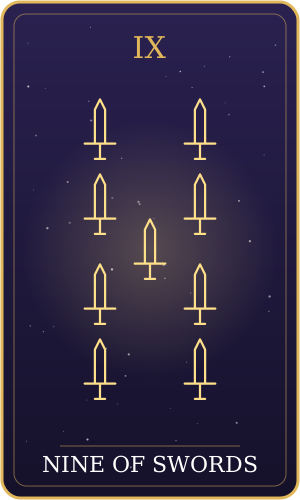
What the Nine of Swords means
The traditional Rider-Waite-Smith image is simple and domestic. A person sits up in bed in the dark, face buried in both hands. Nine swords hang in a row on the black wall behind them, set horizontally above the blanket, and nothing in the room is actually touching the sleeper.
That detail matters. The blades are suspended on the wall, not pointed at anyone. They represent thoughts: the replayed conversation, the what-if, the worst-case list. The card is about how a thought can feel like a physical weight when it arrives at 3 a.m., even though the room itself is quiet and safe.
Our site uses its own artwork for the card instead of the classic illustration, but tradition keeps the same ingredients: the bedroom, the darkness, the hands over the face and a long row of swords. Together they say that the mind is working overtime while the body would like to rest.
In the language of tarot, swords stand for thought and communication, and nine is a number close to the end of a cycle, when strain has built up. The Nine of Swords is therefore the pressure of too much thinking, not an event. Many readers find that naming the feeling is already the first relief.
Reading the symbols
The hands over the face are the clearest symbol. They can suggest grief, shame, exhaustion or the simple wish to shut out the room. In older readings the gesture is read as sorrow. Many modern readers prefer a broader reading: a person overwhelmed by their own mental noise.
The blanket in the traditional image is often described as patterned with roses and small astrological signs. Those details are usually read as a reminder of the life that continues around the worry: warmth, care and the ordinary things that make a bed a refuge.
The carved bed frame is sometimes said to show a scene of struggle. Readers differ about its meaning, but a common view is that it hints at a past event that the mind keeps returning to, even though it is over and carved in wood.
The black background is the plainest detail. Darkness narrows what we can see, which is exactly how worry behaves. Problems look larger at night, and many people notice that the same list reads quite differently after sleep, food and daylight.
The Nine of Swords upright
Upright, the card describes mental strain: anxious thinking, replayed regrets, sleepless nights or a feeling of dread about something that has not happened. The key idea is that the pain here is largely produced by thought, and thoughts, unlike facts, can be examined and softened.
Common themes include worry, guilt, self-criticism and the sense of carrying more than one person can hold alone. It may describe the stretch before a big conversation, a period after a mistake, or a long season of pressure with little rest. The card says: this is heavy, and it is also human.
It carries an invitation as well. When a mind spins, the most useful step is rarely more analysis. Writing the worries down, talking them through with a patient person, or moving the body for a while tends to loosen the grip. The card does not claim a solution; it points toward company and rest.
A card draw cannot replace support. If worry or low mood is frequent, intense or affecting daily life, please talk with someone you trust or a qualified professional. The Nine of Swords is best used as a reflective mirror, one that says you are not the only person to sit up in the dark.
The Nine of Swords reversed
Reversed, the Nine of Swords usually signals that the worst of the strain is passing. The hands come away from the face, the night shortens and perspective starts to return. It is the card of the morning after a hard night, when things look more ordinary.
Another reading is that the worry is finally being spoken. Telling someone how you feel, or admitting something you have been carrying, often lightens it more than expected. Reversed, the card can describe reaching out, asking for help or finding words.
A more cautious reading is that the thoughts are still there but have lost some of their volume. The mind is learning not to treat every alarm as an emergency. Progress like that is often uneven, with calm days followed by restless ones.
Some readers also note that the reversed card can point to bottling things up, putting on a brave face while the strain continues unseen. If that rings true, the quiet suggestion is the same: let one trusted person know how things really are.
The Nine of Swords in love and relationships
In relationship readings, the card often describes anxiety about the connection: worry about being left, replaying a hard conversation, or imagining what a partner or a date might be thinking. The imagined version can be far harsher than the real one, which is the card's core lesson.
For single readers, it may point to nerves around dating, loneliness at night or fear of repeating an old pattern. The suggestion is to treat those feelings kindly and to remember that a lonely hour is not a verdict on your future.
As feelings, the Nine of Swords can describe someone who is troubled, preoccupied or carrying guilt about something. They may seem distracted and short-tempered because their head is busy, and not because they care less. A card cannot read a mind, so a gentle question beats a guess.
Reversed in love, the card tends to show worries easing, an honest talk clearing the air, or a couple finding that the thing they dreaded was smaller in daylight. It does not predict whether any relationship continues or what a partner will do.
The Nine of Swords in career and work
At work, the card often reflects pressure that follows people home: replaying a meeting, dreading an email, or lying awake over a deadline. It can also describe a perfectionist streak, where the standard being applied is far harsher than anything a colleague would ask.
A useful reading is that the worry is trying to tell you something about workload, boundaries or unclear expectations, and that it is worth turning the vague dread into a concrete list. Written down, ten things rarely feel as large as one shapeless fear.
In practice, the card nudges toward rest, a conversation with a trusted colleague or manager, and a clearer line between work hours and sleep. It does not offer career decisions or advice, and no card can say how a job, a review or an income will turn out.
Reversed, it often suggests a workload becoming manageable, a decision that has been made, or the relief of finally asking for what was needed. Themes of recovery and perspective run through it.
Is the Nine of Swords a yes or no card?
By the convention this site uses, the Nine of Swords is a no. Most readers who sort cards for quick questions put worry and anguish on the unfavorable side, so this is the one our yes-or-no tool follows. It is an editorial habit, not an ancient rule, and plenty of readers would sort it differently.
A no from this card is better heard as a signal to slow down than as a verdict. When a question arrives wrapped in anxiety, the answer is rarely clear, and the card suggests resting, talking it over and asking again in daylight.
The tool shifts reversed cards one step toward no: a yes becomes a maybe, a maybe becomes a no, and a no remains a no. So the Nine of Swords stays a no even when reversed. Reversed cards only appear if you tick "Include reversed cards", which starts off.
All of this is for fun and reflection. For questions about health, money, law or safety, speak to qualified people and use real information, not a card.
The Nine of Swords and astrology
The Golden Dawn tradition, which influenced most modern decks, links the Nine of Swords with Mars in Gemini. That is a correspondence from tradition, and other systems vary, but it is the one this site follows.
Cards from two to ten are tied to decans, which are ten-degree thirds of a zodiac sign, each paired with a planet. Gemini is an air sign, mutable in quality and ruled by Mercury, so it is connected to thoughts, chatter and quick movement between ideas.
Mars is the planet of drive, friction and urgency, and it usually spends about six to seven weeks in a sign. A restless planet in a restless, talkative sign makes a fitting match for a mind that will not settle: energy that has nowhere to go but round and round.
To connect the card with your chart, look at where Mars sits in your birth chart and which house holds Gemini. Those placements may hint at where your energy runs hot and where your thoughts tend to race. You can find both with our free birth chart calculator. It is a point of reflection, not a prediction.
The Nine of Swords as advice
As advice, the card suggests moving the worry out of the dark. Keep a pen by the bed, write the thought down, and tell it it can wait until morning. Many people find that a captured worry quiets faster than a chased one.
It also advises reaching toward people. Sending a message to a friend, sitting with family or booking time with a counselor puts another voice in the room, and another voice is often what a spinning mind needs.
Try a small evening routine: something warm to drink, dim lights, a few slow breaths and a short list of what is actually within reach tomorrow. The list should be modest. The aim is to lower the volume, not to solve everything before sleep.
If the card appears reversed, the suggestion is to notice what is helping and keep doing it. And if sleeplessness or anxiety is frequent or hard to bear, please speak with someone you trust or a qualified professional. A tarot card is company for reflection, not a replacement for care.
Nine of Swords belongs to the decan of Mars in Gemini: in the Golden Dawn tradition each minor card from two to ten rules ten degrees of the zodiac. Find Mars in your chart or read about Gemini rising.
Frequently asked questions
Is the Nine of Swords a bad card?
It is a heavy card, but a compassionate one. It names anxiety, guilt and sleepless thinking without blaming anyone for them, and it shows that the swords are hanging on a wall rather than striking the sleeper. Many readers find that recognizing the pattern is the first step toward easing it. It is a prompt for reflection, never a forecast.
What does the Nine of Swords mean in love?
In love, it often points to worry about the relationship, replaying a difficult talk, or imagining a partner's thoughts in the harshest light. It can also show nerves around dating. The card suggests checking those fears against what has really happened and having a calm, honest conversation. It does not predict any relationship outcome.
What does the Nine of Swords mean as feelings?
As feelings, it can describe someone who is anxious, preoccupied or carrying guilt. They may seem distant because their mind is crowded, not because they have stopped caring. A card cannot read another person's mind, so treat the idea as a gentle guess and a reason to check in with kindness.
What does the Nine of Swords reversed mean?
Reversed, the Nine of Swords usually shows worry easing, perspective returning and rest coming back. It can also describe finally talking about something that has been weighing on you. If anxiety or poor sleep is a regular problem, a card is not a substitute for support from people you trust or a professional.
Is the Nine of Swords a yes or no card?
In our yes-or-no tool, it is a no, a convention many readers share for cards about anguish. The tool moves each reversed card one step toward no, and since this card is already a no, reversed it stays a no. Reversed cards appear only when you tick the box to include them. Treat the result as light reflection.
Which zodiac sign and planet go with the Nine of Swords?
The Golden Dawn tradition assigns the Nine of Swords to Mars in Gemini, the second decan of that sign. Gemini is an air sign ruled by Mercury, and Mars is the planet of energy and urgency. This is a traditional assignment, not the only one. Your own Mars or Gemini placements may make the card feel personal.
 Eight of Swords
 Ten of Swords
 The Star
 The Moon