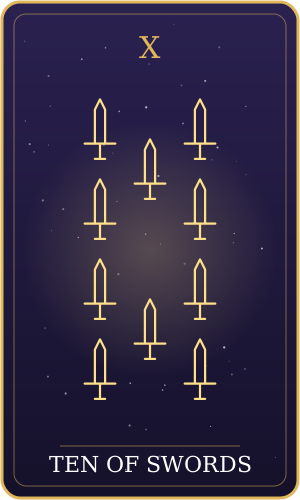
What the Ten of Swords means
In the classic Rider-Waite-Smith illustration, a figure lies face down on dark ground with ten swords standing along the back. The scene is theatrical on purpose. Tarot tends to use bold pictures for ideas, and this one stands for the point where a difficult situation has gone as far as it can.
Look past the swords to the horizon. Behind the figure, a band of pale light spreads across the sky, and the water in the distance is calm. Tradition reads this as the dawn after the lowest hour. Darkness at the top of the picture, brightness at the edge, and that contrast is the real message.
Our site uses its own artwork instead of the classic image, but tradition attaches the same elements: the many blades, the prone figure, the black sky and the thin line of daylight. None of it is meant to be taken literally. This is a symbolic card about endings, exhaustion and the relief of having nothing left to defend.
Swords are the suit of thought and decisions, and ten is the last number in a suit. The card therefore stands for a pattern of thinking, a conflict or a hard season that has run its full course. Because it cannot get worse in the picture, many readers see it as the doorway to something quieter.
The symbols, one at a time
The number of swords is easy to misread as a measure of pain. It is better understood as completeness. Ten means the cycle is finished, and the heap of blades says that there is no more argument to be had, no further point to prove.
The red cloak over the figure is often read as the last bit of cover, a trace of warmth and life in an otherwise bare scene. Some readers see it as a sign that the person is still there, only resting at the bottom of something.
The black sky is the old story, the long stretch of strain. The yellow glow at the horizon is the new one. Notice that the figure cannot yet see it, because the face is turned down. The card suggests that relief is on the way before the person has noticed.
The still water is a gentle detail. After conflict comes a flat calm, a place where nothing needs to move yet. Many readers find that this stillness is the most useful part of the picture, since it shows that an ending can be quiet.
The Ten of Swords upright
Upright, the card describes a definite ending: a situation, belief or pattern that has run out. It may be the close of a draining project, the final stretch of a hard season, or the moment you finally admit that a plan is over. The tone is of completion, with a sense of being worn out.
Common themes are release, exhaustion, acceptance and a fresh start waiting nearby. The card often suits a time when someone has done everything they could and the result is simply out of their hands. In that sense it can feel almost merciful, because the struggle is no longer needed.
It is also a card about not exaggerating. Because the picture is dramatic, people sometimes read their own situation as more terrible than it is. A calmer reading asks what exactly has ended, what remains, and what a good first small step would be after the dust settles.
If a hard time feels heavy right now, a card is not a substitute for support from people you trust or a qualified professional. The Ten of Swords can offer a reflective frame: this chapter is closing, and the light on the horizon is part of the picture.
The Ten of Swords reversed
Reversed, the Ten of Swords commonly points to recovery that is underway but slow. The worst has passed, and the figure is beginning to stir, though stiffness and tenderness remain. It is the card of the first weeks after something difficult.
Another reading is reluctance to let an ending be an ending. A reversed Ten can describe replaying old events, holding on to a grievance or going back over a finished story in hope of a different result. The suggestion is to treat that pull with compassion and to notice what it is protecting.
Some readers also connect the reversed card to a dramatic way of describing things. When every setback is told as a catastrophe, it becomes harder to see the dawn. Putting the facts in proportion can lower the temperature without denying that something hurt.
Used well, the reversed card reminds you that healing seldom follows a straight line. Good days and tired days both belong to the process, and patience with yourself is a sensible response.
The Ten of Swords in love and relationships
In love readings, the card often describes the close of a chapter: the end of a pattern, a stage of a relationship or a long period of conflict. It does not say a relationship will end. It says that something has reached its limit and that the next move can be different.
For single readers, it can point to the final stretch of getting over someone, a time when the sadness has been fully felt and the way forward is opening. It encourages being gentle with yourself and not rushing into the next thing to fill the quiet.
As feelings, the Ten of Swords may describe someone who feels worn out, resigned or ready to stop fighting. They may also feel relief. Because a card cannot read a person, the most dependable way to learn how someone feels is to ask, kindly and without pressure.
Reversed in love, the card suggests a slow mending, or a struggle to let go of something that is over. For heartbreak and hardship, a trusted friend or a professional offers support that no card can.
The Ten of Swords in career and work
At work, the Ten of Swords can stand for the end of a demanding project, a role that has run its course, or the point of exhaustion after a long push. It names a feeling many people recognize: nothing left in the tank, and a plain wish for this phase to finish.
It can also describe a decision that has been taken out of your hands, such as a plan that is ending whether or not you wanted it to. The card does not say whether that is good or bad. It says the old structure is complete and asks what you would like to build next.
In practical terms, many readers use it as a prompt to rest, to close loose ends and to write down what was learned. It does not offer career decisions or advice, and it makes no claim about any job, income or review.
Reversed, it can describe slow recovery after burnout, or hesitation about moving on from something that has already finished. The themes are pacing, patience and giving the next step a bit of room.
Is the Ten of Swords a yes or no card?
On this site, the Ten of Swords is a no. That follows a common reading among people who use tarot for quick questions, who treat endings and exhausted situations as unfavorable to a plain yes. It is an editorial convention, not a law of the cards, and some readers would sort it differently.
A no from the Ten is often read as a clean one: this version of the plan is finished. That can be a relief, because it frees energy for something else. The card pairs its no with a sunrise, so it is not a harsh answer.
Our tool shifts reversed cards by one step: yes becomes maybe, maybe becomes no, and no stays no. A reversed Ten of Swords is therefore still a no. Reversed cards show up only if you tick "Include reversed cards" in the yes-or-no tool, and the box starts unticked.
This is entertainment and reflection. Questions about health, money, law or safety deserve qualified advice and real information, not a card.
The Ten of Swords and astrology
The Golden Dawn tradition, which shaped most modern decks, assigns the Ten of Swords to the Sun in Gemini. That is a correspondence from tradition, and other systems differ, but it is the one used here.
A decan is a ten-degree third of a zodiac sign, and the cards from two to ten are tied to planets moving through those thirds. The Ten of Swords closes the Gemini series. Gemini is an air sign, mutable in quality and ruled by Mercury, linked with curiosity, speech and ideas.
The Sun spends about thirty days in each sign and stands for identity and vitality. A bright center in a sign of thought and talk fits the card's dawn: the story you have been telling is finished, and a new, clearer sense of self can come into view.
To connect the card with your chart, look at your Sun sign and at the house that holds Gemini. These hint at where you tend to turn the page and start again. You can find both with our free birth chart calculator. It is a lens for reflection, not a prediction.
The Ten of Swords as advice
As advice, the card suggests letting something be over. Name what has ended in one plain sentence, then name one thing that remains. Looking at both at once often shrinks the drama and shows the ground that is still solid.
It also invites rest. After a long strain, the body and mind need quiet, and the calm water in the picture is an image of that. Rest is not giving up. It is part of how a person gets ready for whatever comes next.
Gather what the chapter taught you. A short list of what you would do the same and what you would change gives the experience a shape, and a lesson can be carried forward when the story itself is put down.
If the card arrives reversed, the advice is patience with slow healing and gentleness with lingering feelings. Reach for people who care about you, and for professional help where the weight is heavy. A card is a mirror for reflection and not a replacement for that kind of support.
Ten of Swords belongs to the decan of Sun in Gemini: in the Golden Dawn tradition each minor card from two to ten rules ten degrees of the zodiac. Find Sun in your chart or read about Gemini rising.
Frequently asked questions
Is the Ten of Swords a bad card?
It looks dramatic, but most readers see it as a card of completion rather than doom. It marks the end of a hard stretch, and the sunrise on the horizon is part of the image. It does not predict harm to anyone. Treat it as a reflective prompt about what has finished and what can begin next.
Does the Ten of Swords mean a relationship is over?
No. The card describes an ending of some kind, which may be a pattern, a phase or a conflict, and not necessarily the relationship itself. It asks what has run its course and what could be done differently. Tarot cannot say whether any relationship continues, so use the card as a starting point for an honest talk.
What does the Ten of Swords mean as feelings?
As feelings, it may describe someone who is exhausted, resigned or ready to stop struggling, and who might also feel some relief. A card cannot read another person's mind, so take this as a thoughtful guess. Asking directly and kindly, at a calm moment, will tell you far more than any draw.
What does the Ten of Swords reversed mean?
Reversed, the card often points to slow recovery, lingering hurt or difficulty letting a finished chapter close. It reminds us that healing is uneven. Be patient with yourself, and lean on people you trust or a qualified professional when things feel heavy, because a card cannot stand in for real support.
Is the Ten of Swords a yes or no card?
In our yes-or-no tool it counts as a no, following a common reading of endings. Reversed it is also a no, because the reversed rule moves yes to maybe and maybe to no, while no does not change. Reversed cards appear only when you tick the option to include them. It is light entertainment and reflection.
Which zodiac sign and planet go with the Ten of Swords?
The Golden Dawn tradition links the Ten of Swords to the Sun in Gemini, the last decan of that sign. Gemini is an air sign ruled by Mercury, and the Sun stands for identity and vitality. This is a traditional assignment, not the only one. Your own Sun sign may give the card a personal flavor.
 Nine of Swords
 Page of Swords
 The Star
 The Moon