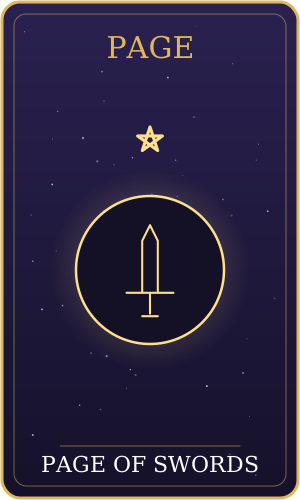
What the Page of Swords means
The Page of Swords is the first of the four court cards in the suit of swords, which stands for thought, language and decisions. In tarot, pages are the learners. They are not fully formed experts yet, and they carry the energy of a new interest, a first lesson or a message just received.
In the traditional Rider-Waite-Smith picture, a youthful figure stands on a grassy hilltop, gripping a long sword with both hands and raised toward the sky. Wind tosses the hair and tunic, clouds roll across the sky, and a few birds fly high overhead. Our site uses its own artwork for the card, but these are the symbols tradition attaches to it.
The pose gives the card its flavor. The page is alert, slightly braced and looking around, as if listening for something. Nothing here is aggressive. It is more like the posture of a person who has just heard an interesting argument and wants to understand every part of it.
Court cards in this deck are read as personality styles or stages of an element, not as a particular person to meet. So the Page of Swords can describe a way of thinking you are using right now, or a quality in somebody around you, and it can just as well describe an approach to a situation.
Reading the symbols
The raised sword is the page's tool and the clearest emblem of the suit. A blade cuts, separates and defines. For this card, that means distinguishing one idea from another, asking precise questions and noticing what does not add up. The skill is real, though not yet seasoned.
The wind is the most important detail of the scenery. Air is the element of the suit, and here it is moving everywhere at once. It suggests a mind that is quick to pick up new input, sometimes faster than it can sort it.
The clouds and distant birds add to the sense of an open, changeable sky. Readers often take the birds as ideas in flight, many of them promising, none yet caught. The page looks up at them, not down at the ground, which is both a strength and a small risk.
The firm stance on uneven ground suggests that the energy is real but the balance is still being learned. Thin footing and a lot of enthusiasm are typical of this stage, and it is a perfectly good place to be when you are starting something new.
The Page of Swords upright
Upright, the Page of Swords stands for curiosity, mental energy and a desire to learn. It often appears when someone is starting a course, reading widely, trying a new way of communicating or simply asking more questions than usual. The mood is quick, bright and a little impatient.
Common themes include new ideas, honest talk, vigilance and a love of facts. The page is happy to ask the obvious question that everyone else has been avoiding. Often that candor clears the air and saves a lot of guessing, so long as it is delivered with some care.
The card also touches on news and messages: a text, an email, a piece of information that sets thoughts in motion. It does not predict what the news will be. It simply points to a period when information is moving and attention is sharp.
A gentle note of caution belongs here. The page's enthusiasm can run ahead of experience, so the upright card often asks to verify, listen and take a breath before sending the message. Curiosity is the gift; patience is the practice.
The Page of Swords reversed
Reversed, the card describes the shadow side of quick thinking. Thoughts scatter, a plan stays in the head and never reaches the page, or words are said fast and land harder than intended. It can feel like having ten browser tabs open and finishing none of them.
Common reversed themes include gossip, hasty conclusions, talking more than doing and sharp humor that stings. A reversed page may also point to a defensive streak, where questions turn into cross-examination. The remedy is almost always to slow down and check what is actually known.
Another reading is a lack of mental focus or hesitation to speak. Some people draw the reversed page when they are holding back a question because they fear sounding naive. In that case the card is encouraging: the question is probably better than you think.
None of this is a judgment of character. A reversed court card shows a style slipping out of balance, and the usual answer is small and practical: finish one thing, ask a kind version of the question, or sleep on the email.
The Page of Swords in love and relationships
In relationship readings, the Page of Swords tends to describe a connection built on conversation. It suggests curiosity about each other, long messages, playful debate and a delight in learning how the other person thinks. Early dating often looks like this.
For people in a long relationship, the card can ask for more open talk. Questions that have been put off, such as what each of you wants this year, are easier to raise with the page's directness, as long as tone stays warm.
As feelings, the Page of Swords may describe someone who is interested, observant and a little nervous about showing it. They may express affection through banter, links, questions and quick replies. Since a card cannot read a mind, it is wiser to ask than to assume.
Reversed in love, the card may point to careless words, mixed signals, gossip or too much overthinking about what a message meant. It does not predict any outcome. A clear and kind sentence usually does more than a long analysis.
The Page of Swords in career and work
At work, the Page of Swords is the new hire with the sharp questions, the intern who notices the flaw in the process, or anybody in a stage of rapid learning. It often points to research, studying, drafting and early-stage planning.
The card favors fields and tasks built on language and analysis, such as writing, editing, teaching, coding or investigating. It does not suggest a particular career, only the flavor of energy that is available: quick, inquisitive and detail-minded.
Its caution is about follow-through. A page enjoys the start of a project more than the middle, so a list, a deadline or a patient colleague can help turn good ideas into finished ones. The card offers themes and not career advice.
Reversed, it may reflect scattered attention, messy communication or a tendency to react before the facts are in. A short pause before replying, and a habit of rereading, are the quiet fixes.
Is the Page of Swords a yes or no card?
In the convention this site uses, the Page of Swords is a maybe. Many readers treat the young court cards as open-ended, since a page brings questions and not answers, and this is the one our yes-or-no tool follows. It is an editorial habit and not a traditional rule, and other readers will assign it differently.
A maybe from this card says that more information is needed. It suggests gathering facts, asking the next question and checking details before deciding. That is a reasonable response to many everyday queries.
The tool shifts reversed cards one step toward no: yes becomes maybe, maybe becomes no, and no stays no. So a reversed Page of Swords reads as a no, suggesting the question is not ready or the details are muddled. Reversed cards only appear when you tick "Include reversed cards", and the box starts unticked.
Tarot is for fun and reflection and cannot confirm outcomes. For health, money, law or safety questions, turn to qualified people and real information.
The Page of Swords and astrology
In the Golden Dawn tradition, the court cards are tied to elements, and the Page of Swords belongs to Air, the element of the whole suit. Other systems make different assignments, but this is the one this site follows, and it is stated as tradition.
Air is associated with thought, communication, ideas and social exchange. In astrology, the air signs are Gemini, Libra and Aquarius. The page shows Air in its youngest form: curious, quick, a bit scattered, eager to share what it has just learned.
Court cards are best read as stages or styles of an element, so the page can be thought of as the first spark of Air before it has settled into a particular sign. It is the questioning phase, not the conclusion.
To connect the card with your chart, look at where your air signs sit in your birth chart: your Mercury, your Sun or Moon if they fall in Gemini, Libra or Aquarius, and the houses those signs occupy. These can hint at where you think and talk most easily. Our free birth chart calculator finds them. Treat it as reflection, not prediction.
The Page of Swords as advice
As advice, the Page of Swords says to keep asking. Write the question you have been avoiding, and then write two ways it might be answered. The exercise turns a vague unease into something you can work with.
It also says to double-check. Before sharing a hot take or sending a long message, reread it once and ask whether the tone matches what you mean. A small pause is the page's way of growing up.
Try finding a mentor or a friend who thinks differently. The page learns fastest from someone who can say, kindly, here is what I see that you may be missing. That kind of company sharpens the blade without dulling the curiosity.
If the card comes up reversed, the suggestion is to finish one thing before starting another and to speak slowly when emotions run high. Curiosity is a good gift, and it works best when it is paired with listening.
Page of Swords corresponds to the element of air. See your element balance.
Frequently asked questions
What does the Page of Swords mean?
The Page of Swords stands for curiosity, new ideas and an eagerness to learn and ask questions. It is the beginner stage of the suit of thought, bright, alert and sometimes a bit scattered. Read as a personality style or a mood, it suggests gathering facts and speaking with care. It is a reflective prompt and not a forecast.
What does the Page of Swords mean in love?
In love, the card describes a connection driven by conversation, curiosity and playful back-and-forth. It can mean getting to know someone through long messages, or asking questions in a long relationship that have waited too long. Reversed, it points to careless words or overthinking. It does not predict whether any relationship will last.
What does the Page of Swords mean as feelings?
As feelings, the Page of Swords can describe someone who is interested, curious and watchful, and perhaps a little nervous about showing it. They may flirt through banter or questions. A card cannot read another person's mind, so treat this as a thoughtful guess and a reason to ask openly.
What does the Page of Swords reversed mean?
Reversed, the card points to scattered thinking, hasty conclusions, gossip or words that land sharper than intended. It can also mean holding back a question out of worry about sounding naive. It is not a judgment of character. The usual advice is to slow down, check the facts and finish one task at a time.
Is the Page of Swords a yes or no card?
In our yes-or-no tool, the Page of Swords is a maybe, a convention that fits a card about questions rather than answers. Reversed, the tool moves maybe to no. Reversed cards only appear if you tick the box to include them. All of this is for entertainment and reflection, not for decisions.
Which zodiac sign or element goes with the Page of Swords?
In the Golden Dawn tradition, court cards correspond to elements, and the Page of Swords belongs to Air, the element of its suit. Air connects with Gemini, Libra and Aquarius in astrology. This is a traditional assignment, not the only one. Your own air placements may make the card feel familiar.
 Ten of Swords
 Knight of Swords
 The Star
 The Moon