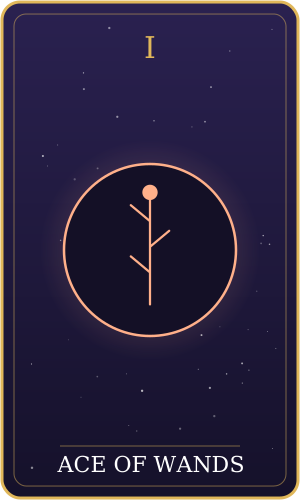
What the Ace of Wands means
Before a project has a plan, a name or a budget, it usually has a feeling: a restless sense that something is worth trying. The Ace of Wands is that feeling turned into a picture. It is not the finished work, and it is not even the first step. It is the moment the wish becomes strong enough to move you.
In the traditional Rider-Waite-Smith design, a single hand reaches out of a cloud and grips a thick wooden staff. The staff is still alive. Fresh green leaves sprout along it, and a few of them drift down through the air as if the branch were shaking off its own seeds. Far below lies a gentle landscape with a winding river, soft hills and a distant castle on a rise.
Our site shows its own artwork for the card instead of the classic illustration, but the traditional symbols are worth knowing because they explain how readers talk about it. The hand suggests that the offer comes from outside your usual routine, like a lucky idea or a conversation that lights something up. The living branch suggests that the energy is real, growing and ready to be used.
Aces in general are read as seeds. Each one hands over the pure essence of its suit, before experience has shaped it. For Wands, the essence is drive: ambition, curiosity, appetite for action and the confidence to try something new without a guarantee.
The symbols, one at a time
The cloud is the least obvious symbol, yet it matters. It says the gift arrives from somewhere you did not plan. Many readers connect this with the way good ideas tend to appear in the shower, on a walk or halfway through a different task. The cloud also hints that the opportunity is not yet solid, and that you still have to take hold of it.
The hand does exactly that. It is closed around the wood in a firm grip, and that grip is the card's quiet instruction. An idea left alone fades; an idea held, even clumsily, begins to turn into a project. The card does not tell you what to do with the staff, only that it is yours to hold.
The falling leaves are often read as potential scattering in many directions. Some of the energy will not land anywhere, and that is acceptable. A beginning generates more sparks than any one person can use. Choosing which spark to follow is part of the work.
The castle in the distance appears in several Wands cards. It can stand for a goal you can already see but have not reached, a long way off and small on the horizon. Between you and it lies open country, which is why the card feels hopeful rather than hurried.
The Ace of Wands upright
Upright, this card describes a surge. A person drawing it may feel unusually awake to a possibility, whether that is a creative idea, a trip, a course, a side project or a personal goal that suddenly seems doable. The mood is eager, direct and a little impatient, in the best sense of the word.
Common keywords include inspiration, initiative, courage and vitality. The card favors starting over polishing. It suggests that a rough first attempt will teach more than another week of thinking, and that confidence often grows after the first move rather than before it.
There is also a sense of permission. Many people carry an idea for months because they are waiting to feel ready. The Ace of Wands is a reading in which readiness is not required. It works as a nudge to write the first paragraph, make the first call or sketch the first rough draft.
For reflection, the upright Ace invites a plain question: what has been tugging at my attention lately, and what would a tiny experiment look like? A one-hour trial is often a kinder test than a big announcement.
The Ace of Wands reversed
Reversed, the spark still exists, but something interferes with it. The most common readings are delay, a false start and low motivation. The card can describe an idea that excites you on Monday and feels flat by Thursday, or a goal you keep circling without ever touching.
Another reading is scattered energy. Too many sparks and not enough kindling can leave a person busy yet unsatisfied, jumping between projects without finishing any. In that case the reversed card is less about missing fire and more about missing focus.
A third reading is simple tiredness. Enthusiasm is not endless, and a reversed Ace may show up when the real need is rest, not a new venture. It can also reflect frustration when circumstances block a plan, such as a closed door, a slow reply or a schedule that has no gaps.
None of this is a judgment. A reversed Ace is a snapshot of a stalled moment, and the usual suggestion is to shrink the task. Pick the smallest version of the idea and give it twenty minutes. If even that feels heavy, the card may be asking what you actually want, and that is worth sitting with before starting anything.
The Ace of Wands in love and relationships
In love readings, the Ace of Wands is chemistry, curiosity and a spark that feels new. For single readers it often describes the early thrill of interest in someone, the kind where messages are quick and the next meeting is already on your mind. It can also point to renewed enthusiasm for dating after a quiet stretch.
For people in a relationship, the card tends to be read as fresh energy returning. That could mean planning something spontaneous, trying a hobby together or having the kind of playful conversation that had become rare. It does not promise that a partnership will last or end; it describes a lively moment.
As feelings, the Ace of Wands can suggest someone who is genuinely excited by you, perhaps a little forward, perhaps eager to make plans. It can also describe a person whose interest is strong but still undefined, so it is worth asking what they actually want instead of reading everything into the card.
Reversed in love, it may describe a flirtation that fizzles, mismatched timing or one person feeling more enthusiastic than the other. The gentle advice is honesty about pace. If the spark is faint, small shared experiences often show whether there is anything to build on.
The Ace of Wands in career and work
At work, this is the card of the new idea and the person willing to say it aloud. It often appears around launches, pitches, first drafts, side projects and any situation where someone has to start without all the answers. The theme is initiative: volunteering, prototyping, asking the question that opens up a stalled meeting.
It also speaks to a feeling of energy at the start of a role or a new responsibility. A reader might use the card to ask which task currently feels most alive, and then notice how that differs from the tasks that feel like a chore. The contrast can be useful information about what suits you.
In creative fields, the Ace of Wands is a good sign for generating material, such as brainstorming, sketching or testing a concept. Its weakness is follow-through, which is why many readers pair it with the practical suits. A spark needs a place to land.
Reversed, the card can show creative block, a project that will not launch, or enthusiasm that has drained away under pressure. It is a prompt for reflection, not career advice. Decisions about jobs or income are best made with solid information and people who know your situation.
Is the Ace of Wands a yes or no card?
In the convention used by this site, the Ace of Wands is a yes. Most readers who use tarot for quick yes-or-no questions treat aces as open doors, and the Ace of Wands is among the most forward-leaning of them. This is an editorial convention, not an ancient rule, and readers differ on it. It is the one our yes-or-no tool uses.
A yes from this card is best heard as encouragement to begin, not a prediction that things will work out. It says the question carries energy and that trying looks worthwhile. How far the idea goes depends on effort, timing and circumstances no card can see.
Reversed cards only appear if you tick "Include reversed cards" in the yes-or-no tool, since the box starts unticked. When you do, the rule moves every reversed card one step toward no: a yes becomes a maybe, a maybe becomes a no, and a no stays a no. A reversed Ace of Wands therefore reads as a maybe, which fits its meaning of a spark that needs better timing or a clearer aim.
The yes-or-no format is for fun and reflection. For questions about health, money, law or safety, a tarot card is not the right tool, and qualified advice is.
The Ace of Wands and astrology
In the Golden Dawn tradition, which shaped most modern decks, the four aces are assigned to the four classical elements, and the Ace of Wands belongs to Fire. This is a correspondence from tradition, and other systems arrange things differently, but it is the one this site follows.
Fire is the element of energy, will and initiative. In astrology it covers three signs: Aries, Leo and Sagittarius. Aries is the cardinal fire sign, ruled by Mars, and it is the one that most clearly mirrors this card, since Aries is the sign of starting. Leo adds warmth and creative display, and Sagittarius adds the appetite for exploration.
To link the card to your own chart, look at where your fire signs sit. Planets placed in Aries, Leo or Sagittarius, and the houses those signs occupy, can hint at the areas of life where you tend to act first and think afterward. Someone with a Sun, Moon or Mars in a fire sign may find the Ace of Wands feels familiar.
You can find those placements with our free birth chart calculator. Astrology here is a lens for self-reflection, and a card correspondence is a thread to follow out of curiosity, not a prediction about anyone's life.
The Ace of Wands as advice
As advice, the Ace of Wands suggests doing the first small thing today. Not the plan, not the perfect version, but a visible step: open the document, send the message, buy the notebook, put the date in the calendar.
It also suggests protecting the spark from too much commentary. Early ideas are fragile, and sharing them with the wrong audience can drain them quickly. Many people find it helps to tell one supportive person, or to keep the idea private until it has a little shape.
Try a ten-minute exercise. Write down three things you feel curious about right now, pick the one that makes you slightly nervous in a good way, and list the smallest action that would count as starting. Then do it before the week ends.
If the card arrives reversed, the advice is to lower the stakes and check your energy. Rest, simplify, and choose one spark to feed instead of five. The Ace of Wands never insists on a grand launch; it only asks you to pick up the staff and see what grows.
Ace of Wands corresponds to the element of fire. See your element balance.
Frequently asked questions
What does the Ace of Wands mean in tarot?
The Ace of Wands stands for a spark of inspiration, a new beginning and a surge of motivation. It is the seed of the fire suit, linked with drive, creativity and the courage to try something. Readers often take it as an invitation to act on an idea instead of waiting until everything feels perfect, while treating it as a prompt for reflection rather than a forecast.
Is the Ace of Wands a yes or no card?
In the convention this site uses, the Ace of Wands is a yes, because its themes of new energy and fresh starts lean toward encouragement. That is an editorial convention and not an ancient rule, and other readers may assign it differently. A yes here means the question feels promising, not that any outcome is certain. Reversed, our tool turns it into a maybe.
What does the Ace of Wands reversed mean?
Reversed, the Ace of Wands usually describes a stalled or fading spark. It can point to delays, a false start, scattered focus or plain tiredness. The card is not a warning. It suggests shrinking the task, checking whether you are overextended and choosing one idea to feed. Reversed cards only appear in our yes-or-no tool when you tick the option.
What does the Ace of Wands mean in love?
In love, the Ace of Wands often describes chemistry, curiosity and a lively new spark, whether with a new person or inside an existing relationship. It points to enthusiasm and playfulness more than long-term commitment. Reversed, it can suggest a flirtation that fades or mismatched pacing. It is a mood to reflect on, not a promise about any future event.
Which element and sign go with the Ace of Wands?
In the Golden Dawn tradition the Ace of Wands corresponds to the element Fire. Fire covers Aries, Leo and Sagittarius, and Aries, the sign of beginnings ruled by Mars, fits the card especially well. This is a traditional assignment and not the only one in use. If you have fire placements in your birth chart, the card may feel personally familiar.
What does the Ace of Wands mean as feelings?
As feelings, the Ace of Wands can describe someone who is excited, interested and eager to move things forward, though their intentions may still be taking shape. A card cannot read another person's mind, so treat this as a thoughtful guess and a reason to start an honest conversation instead of assuming how they feel.
 The World
 Two of Wands
 The Star
 The Moon