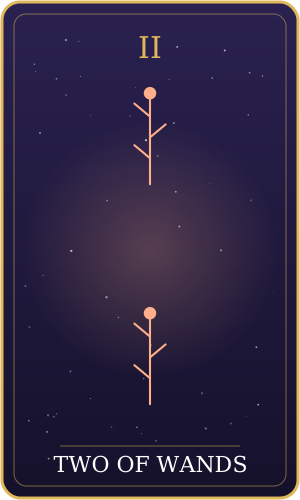
What the Two of Wands means
Where the Ace of Wands is a sudden burst of energy, the Two of Wands is what comes next: the quieter, more thoughtful moment when you ask what to do with it. Twos in the tarot tend to deal with balance and choice, and in the fire suit that means weighing ambition against comfort, the familiar against the unknown.
The traditional Rider-Waite-Smith picture shows a figure in a rich robe on the top of a castle wall. In one hand is a small globe, and the other rests on a tall staff that is fastened to the stone beside him. A second staff stands in a bracket nearby. Behind him lies a calm sea, a few fields and a scatter of hills, with a small harbor in the distance.
Our site uses its own artwork for the card, but these are the symbols tradition attaches to it. The figure is not rushing anywhere. He is looking out over water, and the whole mood is one of surveying: here is what I have, here is what could be out there.
That is why readers often connect the card with planning and decision points. It is not a card of crisis. It describes a person who is already doing reasonably well, and who has the freedom, and perhaps the restlessness, to want more.
The symbols, one at a time
The wall is the first thing worth noticing. It gives the figure height, which stands for perspective, and it also keeps him enclosed. Many readers see it as a picture of comfort that has become slightly confining: a secure place that no longer holds all his attention.
The globe is the most direct symbol. A small version of the world in the palm of a hand suggests that the choices on offer are large, yet within reach. Some readers take it as ambition, others as an invitation to think about a bigger scale than the current routine.
Two staves appear in the scene. One is held, the other is fixed in place. A common reading says that one wand represents what you already have, and the other represents what you might reach for. Neither is wrong; the card simply points out that you are holding both ideas at once.
The sea beyond the wall is the unknown. It is wide, calm and slightly intimidating, which captures the mix of excitement and nerves that usually comes with a big decision. Notice that the water is still. The card suggests there is time to think before acting.
The Two of Wands upright
Upright, the Two of Wands describes a time for planning. A person drawing it may be considering a move, a change of direction, a new phase in a project or a risk they are not quite ready to take. The energy is steady and focused, closer to strategy than to impulse.
Typical keywords include vision, discovery, future planning and personal authority. The card respects what has already been built and does not ask you to throw it away. It only observes that you now have enough ground under your feet to look farther out.
There is also an element of courage, but the quiet kind. Standing on the wall and admitting you want something different is a real step, even though nothing has visibly changed yet. Readers sometimes describe the card as the moment of private decision, before anyone else knows.
For reflection, the upright card can prompt questions such as: what do I already hold that I value, what am I curious about beyond it, and what small research would make the next choice less foggy? Gathering information is a perfectly good response to this card.
The Two of Wands reversed
Reversed, the Two of Wands often points to hesitation. The view is there, but the person stays on the wall. Fear of leaving a comfortable situation, worry about getting it wrong or an unwillingness to commit can all hold the plan in place. The globe stays in the hand, and nothing moves.
A second reading is poor planning. The urge to go is strong, yet the details are not worked out, so energy gets spent on a vague wish rather than a workable path. In that case the reversed card is a polite reminder to draw up the map before setting out.
A third reading is playing small. Sometimes the reversed card shows someone who has talked themselves out of a larger ambition because it feels presumptuous. The suggestion is to examine whether that smallness is a considered choice or a habit.
This is not a warning or a verdict. Indecision is human and often temporary. A good response is to name the specific fear in a sentence, because a named fear is usually easier to weigh than a vague one.
The Two of Wands in love and relationships
In love readings, the Two of Wands usually appears at a crossroads of the heart. For someone in a relationship, it can describe a conversation about the future: moving in, changing cities, deciding what each person wants over the next few years. The mood is one of planning together, or of realizing that your plans may differ.
For single readers, the card tends to describe a person who is comfortable alone but curious about what else is possible. They may be weighing whether to try dating after a break, or whether to look beyond their usual circle. The card does not point to a specific person arriving.
As feelings, the Two of Wands can suggest someone who is interested but still making up their mind. They might like you and also be thinking about work, travel or independence. It is not a cold card, only a thoughtful one, and it is worth talking about timing openly.
Reversed in love, it may describe fear of commitment, one person stalling a decision or a couple who avoid discussing where they are headed. The gentle suggestion is to bring one honest question to the table, such as what each of you hopes the next year looks like.
The Two of Wands in career and work
At work, the Two of Wands is a strategy card. It tends to show up when someone is comparing offers, thinking about a new role, planning an expansion or deciding whether to stay in a position that has become comfortable. The key theme is choosing with perspective instead of reacting.
It also relates to preparation. A reader might use the card to list what they have already built, such as skills, relationships and experience, and then identify what they would like to try next. That kind of inventory often reveals more options than expected.
In leadership, the card can describe a person who sees the long view and has to communicate it to others. It supports surveying the field, researching competitors or collaborators, and testing ideas before committing resources.
Reversed, it may reflect staying in a role from inertia, analysis paralysis or a plan that has no real next step. This is a prompt for reflection, not career advice. Decisions about work and income deserve solid information, and the opinions of people who know your circumstances.
Is the Two of Wands a yes or no card?
In the convention used by this site, the Two of Wands is a maybe. Most readers who use tarot for quick yes-or-no questions see this card as unfinished: the vision is there, but the decision has not been made. This is an editorial convention, not an ancient rule, and different readers assign it differently. It is the one our yes-or-no tool uses.
A maybe from this card reads as a prompt to plan, weigh and clarify. It suggests that the answer depends on choices still ahead of you, so gathering information and naming your priorities may help more than a quick verdict.
Reversed cards only appear when you tick "Include reversed cards" in the yes-or-no tool; the box starts unticked. If you do, the rule moves every reversed card one step toward no: yes becomes maybe, maybe becomes no, and no stays no. A reversed Two of Wands therefore reads as a no, in the sense of not yet, because hesitation or a half-built plan is holding things up.
The yes-or-no format is for fun and reflection. For questions about health, money, law or safety, a card is the wrong tool, and qualified advice is the right one.
The Two of Wands and astrology
In the Golden Dawn tradition, the numbered cards from two to ten are tied to decans, the three ten-degree sections of each zodiac sign. The Two of Wands is assigned to Mars in Aries, the first decan of Aries. This is a correspondence from tradition, and other systems arrange the cards differently, but it is the one this site follows.
The pairing is easy to picture. Aries is a fire sign, cardinal in quality, ruled by Mars, and it is the sign of starting and asserting. Mars is the planet of drive, courage and appetite for challenge. Together they describe the part of you that wants to move, measure the odds and act on a personal goal.
To connect the card to your own chart, look at where Mars sits by sign and house, and where Aries falls in your houses. Those placements can hint at how you pursue what you want, how you react when a decision is due and which areas of life stir your competitive or adventurous side. Someone with Mars in Aries, or a strong Aries Sun, may recognize the figure on the wall.
You can find these placements with our free birth chart calculator. Astrology here is a lens for self-reflection, and a card correspondence is a thread to follow out of curiosity, not a prediction about anyone's life.
The Two of Wands as advice
As advice, the Two of Wands suggests turning daydreams into a simple plan. Write the options down, with one honest advantage and one honest cost for each. The act of seeing them on paper often settles part of the question.
It also advises honesty about what you already have. Before reaching for something new, notice what is working. The card does not ask you to be dissatisfied; it only asks you to know what you would be trading.
Try a short exercise. Imagine the same scene a year from now in two versions: one where you stayed with the current path, and one where you tried the new idea. Describe an ordinary Tuesday in each. Whichever description makes you lean forward is worth examining.
If the card comes up reversed, the advice is to find the smallest step that tests your fear. Ask one question, visit one place or have one conversation. The Two of Wands never demands a leap; it asks you to get a good look before you decide.
Two of Wands belongs to the decan of Mars in Aries: in the Golden Dawn tradition each minor card from two to ten rules ten degrees of the zodiac. Find Mars in your chart or read about Aries rising.
Frequently asked questions
What does the Two of Wands mean in tarot?
The Two of Wands represents planning, weighing options and looking toward the future from a position of relative security. It shows the moment after a first spark, when you decide what direction to take. Readers often link it with ambition, discovery and personal authority, and treat it as a prompt for reflection rather than a forecast.
Is the Two of Wands a yes or no card?
In the convention this site uses, the Two of Wands is a maybe, because it describes a decision still being weighed. That is an editorial convention and not an ancient rule, and other readers may assign it differently. Reversed, our tool turns the maybe into a no, meaning not yet, and only when you tick the reversed option.
What does the Two of Wands reversed mean?
Reversed, the Two of Wands usually points to indecision, fear of leaving a comfortable situation or a plan that lacks detail. It can also suggest playing smaller than you want to. The card is not a verdict. A helpful response is to name the specific fear and take one small step that tests it.
What does the Two of Wands mean in love?
In love, the Two of Wands often marks a crossroads, such as a talk about the future, a decision about timing or a wish for something more. For single readers it can show curiosity beyond the usual circle. Reversed, it may suggest commitment worries or avoided conversations. It describes a mood to reflect on, not a promise.
Which planet and sign go with the Two of Wands?
In the Golden Dawn tradition the Two of Wands corresponds to Mars in Aries, the first decan of Aries. Mars is the planet of drive and courage, and Aries is the fire sign of beginnings. This is a traditional assignment and not the only one in use. Your own Mars and Aries placements may make the card feel familiar.
What does the Two of Wands mean as feelings?
As feelings, the Two of Wands can describe someone who is interested but still deciding how, or whether, to act on it. They may be thinking about timing, independence or other goals. A card cannot read another person's mind, so treat this as a thoughtful guess and a reason to ask them directly.
 Ace of Wands
 Three of Wands
 The Star
 The Moon