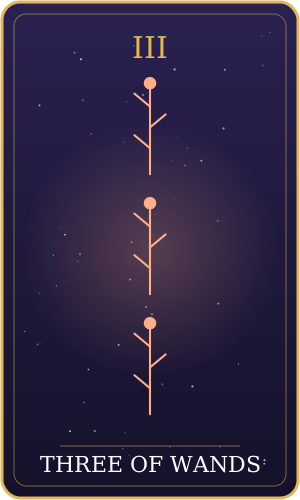
What the Three of Wands means
Think of the moment after you press send on an application, a proposal or an invitation. The work is done, the next step is out of your hands, and you are left looking toward the horizon with some mix of hope and impatience. The Three of Wands is that moment.
In the traditional Rider-Waite-Smith image, a figure in a long robe stands on a rocky ledge with his back to us. Three tall staves are planted in the ground around him, and he grips one of them lightly. Below, a broad stretch of sea lies under a pale yellow sky, and several small ships are crossing it, with distant mountains on the far side.
Our site uses its own artwork for the card, but these are the traditional symbols. Because we see the figure from behind, we look where he looks. The viewer is placed in the same position as the person asking the question: aware that something has been set in motion, and curious about what will come back.
In the numbered sequence of the suit, the Three follows the Two. The Two weighs choices, and the Three acts on one. That is why readers often describe it as the card of enterprise, planning that has left the harbor, with the first results still out of sight.
The symbols, one at a time
The three staves are firmly rooted. Unlike the loose, falling energy of the Ace, these are established, which suggests that the groundwork is done. The figure is not holding up a flimsy idea; he is standing among tools that have been placed with care.
The ships are the most important detail. They are small, they are far away, and they are moving. Readers often take them as the visible form of past effort, such as messages, applications, products or plans that are now out in the world doing their own work. Nothing can be done to speed them.
The sea is wide and open, which gives the card its sense of scale. Some readers see it as opportunity beyond the local, such as new markets, new cities, new audiences or a bigger life than before. Others see it as the vast space between effort and result.
The figure's back is turned. This reads as steadiness, not detachment. He does not pace or fret. He has made his preparations and now chooses to watch with calm attention, a posture worth borrowing when your own results are still on the way.
The Three of Wands upright
Upright, the Three of Wands is a card of progress that is already underway. A person drawing it may have launched a project, applied for something or begun a plan that needs time to show results. The tone is confident, forward-looking and patient.
Typical keywords include expansion, foresight, enterprise and long-range thinking. The card favors those who prepared well and can now afford to look beyond the immediate task. It can also point to cooperation with people at a distance, such as remote colleagues, overseas contacts or anyone whose help arrives from outside your usual circle.
There is a reminder in it, too: waiting is part of the process. Many plans stall not because they were bad but because their authors lost nerve in the quiet stretch before results appeared. The upright Three suggests holding steady during that stretch.
For reflection, the card prompts questions like: what have I already set in motion, what am I tempted to micromanage and what would a wider view of my goals look like? Sometimes the best use of this card is to notice how much has already been done.
The Three of Wands reversed
Reversed, the Three of Wands often describes delays and obstacles. The ships are late, the message has gone unanswered, and the figure begins to wonder whether the plan was sound. The card can show frustration with timing or the sense that results are slower than they should be.
Another reading concerns foresight. A reversed Three may point to a plan that did not account for everything, such as a missing step, an overlooked cost or a support that was assumed instead of confirmed. In that case the card is a quiet suggestion to review the groundwork.
A third reading is a narrow view. When the horizon shrinks, people tend to fixate on a single outcome and lose sight of other routes. The reversed card may suggest widening the question: if this path stays closed for a while, which other directions are open?
None of this is a judgment of the plan. Delays happen to well-made projects, too. A calm response is to check in with the people involved, adjust the timeline and keep the rest of your life from depending on one result.
The Three of Wands in love and relationships
In love readings, the Three of Wands often relates to distance, expansion and shared plans. It can describe a relationship that stretches across cities or time zones, or a couple who are building something together, such as a home, a business or a long-term direction. The sense is of growth that takes time.
For single readers, the card suggests widening the circle. It might mean joining a new group, traveling, meeting people through unfamiliar channels or simply being open to connections that do not look like your usual type. It does not say that a specific person is arriving.
As feelings, the Three of Wands can suggest someone who is invested and thinking ahead, perhaps picturing how the two of you might fit into a larger plan. It can also describe a person who keeps an eye on you from a distance while they sort out their own circumstances. Asking directly is better than guessing from a card.
Reversed in love, the card may describe delays in a long-distance arrangement, plans that keep slipping or one person feeling left to wait. The gentle suggestion is to agree on small, concrete dates, because even a modest shared calendar can steady the connection.
The Three of Wands in career and work
At work, this is the card of expansion. It tends to appear when a business is growing, a team is branching out or a person is thinking about a bigger stage, such as a new region, a larger client base or a role with wider reach. The theme is enterprise supported by preparation.
It also describes the patience required after a launch. A reader might use the card to ask what they have already sent out into the world, and what follow-up would be useful without being pushy. Sometimes the answer is nothing but time.
In collaborative settings, the Three of Wands can point to partnerships with people elsewhere, clear delegation and trust that other hands will do their part. It is a card of vision shared, not vision hoarded.
Reversed, it may reflect setbacks, slow replies, supply or scheduling hiccups, or a plan that depends too heavily on one outcome. It is a prompt for reflection, not career advice. Real decisions about jobs or income belong with solid information and trusted people.
Is the Three of Wands a yes or no card?
In the convention used by this site, the Three of Wands is a yes. Most readers who use tarot for quick yes-or-no questions treat it as favorable, because its theme is plans already in motion and results on the way. This is an editorial convention, not an ancient rule, and different readers assign it differently. It is the one our yes-or-no tool uses.
A yes from this card is best read as encouragement to continue, with some patience attached. It suggests that the matter has momentum, and that waiting calmly may serve better than forcing a quick conclusion. It is not a promise about any outcome.
Reversed cards appear only if you tick "Include reversed cards" in the yes-or-no tool; the box starts unticked. When you do, the rule moves every reversed card one step toward no: yes becomes maybe, maybe becomes no, and no stays no. A reversed Three of Wands reads as a maybe, which matches its theme of plans delayed or in need of review.
The yes-or-no format is for fun and reflection. For questions about health, money, law or safety, a card is not the right tool, and qualified advice is.
The Three of Wands and astrology
In the Golden Dawn tradition, the Three of Wands is assigned to the Sun in Aries, the second decan of Aries. This is a correspondence from tradition, and other systems arrange the numbered cards differently, but it is the one this site follows. A decan is one of three ten-degree slices of a sign, and each slice carries its own planetary flavor.
Aries is a fire sign, cardinal in quality, ruled by Mars, and it is the sign of initiative. The Sun, in astrology, stands for identity, vitality and the sense of purpose. Put together, they describe energy that is confident and self-directed, and wants to be seen working toward something that matters.
To link the card with your own chart, look at where the Sun sits by sign and house, and at where Aries falls among your houses. Those placements can hint at what you identify with and where you feel most alive when pursuing a goal. A person with an Aries Sun, or a prominent Aries emphasis, may find this card especially familiar.
You can find those placements with our free birth chart calculator. Astrology here is a lens for self-reflection, and a card correspondence is a thread to follow out of curiosity, not a prediction about anyone's life.
The Three of Wands as advice
As advice, the Three of Wands suggests trusting the groundwork you have done. If you prepared reasonably, give the plan room to work before changing course. Constant tinkering often hurts more than it helps.
It also suggests keeping your eyes up. Look beyond the next week, and ask where your efforts might lead in a year. A longer view often reveals options that daily pressure hides.
Try a simple exercise. List everything you have sent out into the world over the last few months, such as messages, applications, drafts or proposals. Mark which ones still deserve a polite follow-up, and let the rest rest. The list alone can be calming.
If the card arrives reversed, the advice is to review before you push. Check the weak link in the plan, ask someone you trust for a second view, and widen your options. The Three of Wands never pretends that waiting is easy; it only suggests that watching the horizon calmly beats chasing every ripple.
Three of Wands belongs to the decan of Sun in Aries: in the Golden Dawn tradition each minor card from two to ten rules ten degrees of the zodiac. Find Sun in your chart or read about Aries rising.
Frequently asked questions
What does the Three of Wands mean in tarot?
The Three of Wands stands for expansion, foresight and plans that have been set in motion. It pictures the pause after launching something, when the work is done and results are still on their way. Readers often treat it as a card of patient confidence and wider horizons, and use it as a prompt for reflection rather than a forecast.
Is the Three of Wands a yes or no card?
In the convention this site uses, the Three of Wands is a yes, because its themes of progress and momentum lean toward encouragement. That is an editorial convention and not an ancient rule, and other readers may assign it differently. Reversed, our tool turns it into a maybe, and only when you tick the reversed option.
What does the Three of Wands reversed mean?
Reversed, the Three of Wands usually points to delays, obstacles or a plan that needs a second look. It can also suggest a narrow outlook that sees only one possible route. The card is not a warning. It invites you to review the groundwork, ask for input and keep your options open while you wait.
What does the Three of Wands mean in love?
In love, the Three of Wands often relates to distance, shared plans and growth that takes time. For single readers it can suggest widening your circle. Reversed, it may show delays or plans that keep slipping. It describes a mood and a theme to reflect on, not a promise about a particular person or outcome.
Which planet and sign go with the Three of Wands?
In the Golden Dawn tradition the Three of Wands corresponds to the Sun in Aries, the second decan of Aries. The Sun stands for identity and vitality, and Aries is the fire sign of initiative. This is a traditional assignment and not the only one in use. Your own Sun and Aries placements may make the card feel familiar.
What does the Three of Wands mean as feelings?
As feelings, the Three of Wands can describe someone who is invested and thinking ahead, or who is waiting to see how things develop before committing more. A card cannot read another person's mind, so treat this as a thoughtful guess and a reason to ask them about their plans and expectations.
 Two of Wands
 Four of Wands
 The Star
 The Moon