What the Eight of Cups means
Most tarot cards about loss show someone sitting in the wreckage. The Eight of Cups is different, because nothing has been destroyed. The cups are all there, lined up and full, and the figure has chosen to go anyway. The card is about the quieter kind of ending, the one that happens when satisfaction runs out before the circumstances do.
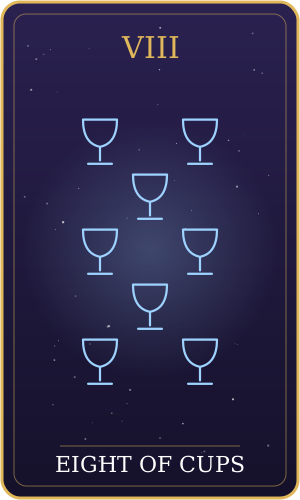
In the traditional Rider-Waite-Smith picture, a traveler in a red cloak and red boots strides away from a neat arrangement of eight golden cups, five in a lower row and three above, with a conspicuous gap in the top row where a ninth would fit. The traveler holds a tall staff and heads up a rocky bank beside a slow river, toward dark hills.
The sky holds a pale moon with a human face that seems to be watching the departure, and a smaller sun shape sits inside its curve, as if daylight were being swallowed. Our site shows its own artwork rather than that classic illustration, but these are the details tradition attaches to the card.
The overall mood is calm and a little melancholy. Nobody is angry. The card gives the feeling of a person who has thought it through at night, packed without fuss, and left before morning.
Reading the symbols
The stack of cups is the first thing readers notice. Cups stand for emotion, relationships and what feeds us, so a tidy row of eight reads as a life built carefully: effort, loyalty, years of tending. The arrangement looks complete, which is exactly the point. The traveler is not fleeing a mess, and that makes the choice harder to explain to others.
The gap in the upper row is often read as the piece that never arrived. Something was missing from the start, or has gone missing since, and no amount of polishing the rest could replace it. Some readers prefer a kinder interpretation: the gap is the opening the traveler slips through.
The staff suggests a long walk and a willingness to rely on oneself. The red clothing reads as courage and heat, a reminder that leaving can take real nerve even when it looks soft from outside. Wet ground and a river run through the scene, tying the departure to the water element of the suit.
The mountains ahead are not welcoming. They are dark and unmarked, and the path is rough. The card does not promise that the next place will be better, only that the traveler would rather search than stay.
The Eight of Cups upright
Upright, the Eight of Cups is the card of a deliberate walk away. It often describes a moment when a job, a friendship, a routine or an old ambition has stopped feeling like yours. You can still see its good points. You simply can no longer pretend they are enough.
Common keywords include moving on, disillusionment, seeking a deeper purpose and letting go without drama. The departure is usually quiet: a resignation letter drafted at midnight, a decision to stop answering a group chat that drains you, a long evening spent wondering whether the life you built is the one you want.
There is also a note of grief. Leaving something good is rarely tidy, and the card does not pretend otherwise. Sadness and relief can sit side by side. Readers often see the Eight of Cups as permission to feel both without rushing to resolve them.
A useful reflection question is what, exactly, has gone quiet. Naming it, whether it is learning, closeness, adventure or honesty, turns a vague restlessness into something you can work with, in whichever direction you choose.
The Eight of Cups reversed
Reversed, the traveler stops at the bank. The Eight of Cups reversed commonly describes hesitation: a person who knows they are unfulfilled yet keeps postponing the exit. Reasons pile up, such as timing, guilt, comfort and fear of what others will say, and the cups stay stacked a little longer.
Another reading is aimless motion. Instead of walking toward something, the figure drifts from place to place, changing scenery without asking what is missing. Someone who keeps starting fresh projects or friendships and dropping them might recognize this pattern, and the card invites a pause to ask what they are actually searching for.
It can also describe a return. A person may head back to something they left, either out of nostalgia or because they realize they judged it too fast. Whether that is wise depends on whether anything has changed, in the situation or in them.
None of these meanings is a judgment. Staying put can be a perfectly sound choice when it is made with open eyes. The reversed card simply asks whether the staying is a decision or a habit.
The Eight of Cups in love and relationships
In relationship readings, the Eight of Cups often points to a connection that has lost its emotional depth. There may be no fighting at all. Two people share a home, a calendar and a streaming account, and one of them has quietly stopped feeling reached. The card gives that feeling a name, which is a relief for many readers.
It does not say a relationship must end. It says that something needs an honest conversation or an honest look. The walk in the image can be read as a literal exit, or as a step back to see what the two of you actually want from each other.
For single readers, the card may describe stepping away from dating that feels hollow, or from a person who looks right on paper but never quite lands. It can be a reminder that taking a break to rebuild your own sense of direction is not failure.
As feelings, the Eight of Cups can describe someone who is emotionally withdrawing, tired of waiting for more, or privately weighing whether to leave. It can equally describe a person who is going through a personal search that has little to do with you. A card cannot read a mind, so a direct and kind question is the better tool. If a breakup or loneliness weighs on you, talk with people you trust or a professional, because a card is not a substitute for support.
Reversed in love, the card may show someone clinging to a situation out of fear of being alone, or a couple circling the same unresolved topic. It can also describe a reunion attempt that deserves a careful look at what is different this time.
The Eight of Cups in career and work
At work, the Eight of Cups is the card of the slow realization that the job no longer fits. The salary may be fair, the colleagues pleasant and the title respectable, and yet the Sunday-evening feeling has become hard to ignore. Readers often use the card to talk about meaning, not about pay.
It can point to a change of field, a long-postponed training course, or a decision to step back from ambition that was inherited more than chosen. The card suggests looking at what you are leaving as well as what you are heading toward, since the departure should be about something real and not just fatigue.
In a team, it may describe a person who has mentally checked out, or a project that has lost its purpose. A practical response is to ask what would need to change for the work to feel worth doing, and to say so plainly.
Reversed, the card may reflect staying in a role from inertia, or jumping between jobs without learning what you want. It offers themes only. Decisions about income, contracts or leaving a position are best made with concrete information, trusted advisers and a realistic plan.
Is the Eight of Cups a yes or no card?
In the convention this site uses, the Eight of Cups is a no. Most readers who use tarot for quick yes-or-no questions treat it as a card of leaving, so it answers a question about holding on, continuing or committing with a gentle negative. This is an editorial convention, not an ancient rule, and other readers rate the card differently. Our yes-or-no tool applies it as written.
Notice that a no from this card is more about direction than disaster. Asked whether a situation will fulfill you, it suggests the answer is not yet, or not like this. Asked whether you should move on, the same card can sound more like encouragement. Phrasing your question carefully matters.
If the card lands reversed, our rule keeps the answer at no. The convention shifts yes to maybe and maybe to no, while a no stays a no, so the Eight of Cups does not change. Reversed cards only appear when you tick "Include reversed cards" in the yes-or-no tool, which starts unticked.
Treat the result as a prompt for thought and not as a prediction. Questions about health, money, law or safety need qualified advice and real information, not a card.
The Eight of Cups and astrology
In the Golden Dawn tradition, the numbered cards from two to ten are tied to a planet in a sign, a pairing known as a decan. Each sign spans thirty degrees, and each third of it, ten degrees, is assigned to one of the cards. The Eight of Cups is given to Saturn in Pisces. This is a tradition, and other systems differ, but it is the one this site follows.
Pisces is a water sign, mutable in quality, ruled by Jupiter in the traditional scheme with Neptune as the modern co-ruler. It is linked with imagination, compassion, dissolving boundaries and longing for something larger than daily life. Saturn, by contrast, stands for structure, limits and responsibility, and its cycle takes about 29.5 years.
Put the two together and the card makes sense: dreamy water meets a stern planet of boundaries, and the result is a person who finally draws a line around what their heart will no longer carry. The emotional ache is real, and so is the discipline of walking away.
To connect the card with your own chart, look at where Saturn and Pisces fall in your birth chart. The house holding Saturn can show where you tend to feel responsibility and restraint, and any planets in Pisces may show where you feel pulled toward something bigger. Our free birth chart calculator finds those placements. Astrology here is a lens for self-reflection, not a forecast.
The Eight of Cups as advice
As advice, the Eight of Cups suggests honoring a feeling that has been quietly growing. If something has stopped satisfying you, it helps to say so, at least to yourself, before deciding what to do about it. A page in a notebook is often enough to start.
It also advises leaving well. The traveler does not smash the cups or blame anyone. A graceful exit, whether from a job, a group or a habit, tends to keep the good parts of what came before intact and spares you a lot of rehashing later.
Try a short exercise. Draw two columns and list what the situation still gives you and what it no longer does. Then ask which column you would choose to live inside for another year. The answer may surprise you, in either direction.
If the card comes up reversed, the advice is gentler: set a small, dated step, such as a conversation, an application or a weekend away, so that the decision stops living only in your head. And if the search feels heavy, lean on friends or a qualified professional, because you do not need to carry it alone.
Eight of Cups belongs to the decan of Saturn in Pisces: in the Golden Dawn tradition each minor card from two to ten rules ten degrees of the zodiac. Find Saturn in your chart or read about Pisces rising.
Frequently asked questions
Is the Eight of Cups a bad card?
Not really. It is a bittersweet card about moving on, and many readers find it validating because it names a feeling that is hard to explain: leaving something good because it no longer feels right. It carries sadness, but also honesty and courage. Reversed, it describes hesitation or drifting. As with all tarot, it works as a prompt for reflection, not as a forecast.
What does the Eight of Cups mean in love?
In love, the Eight of Cups often describes emotional distance: a bond that still looks fine from outside but no longer feels close. It may point to a quiet conversation that is overdue, or to stepping back from dating that feels hollow. It does not say a relationship must end. Think of it as an invitation to look honestly at what you each need.
What does the Eight of Cups mean as feelings?
As feelings, the card can describe someone who is withdrawing, disappointed or privately questioning whether to stay. It can also describe a person in the middle of a personal search that is not really about you. Tarot cannot read another person's mind, so treat this as a thoughtful guess and ask them directly and kindly.
What does the Eight of Cups reversed mean?
Reversed, the traveler hesitates. The card often points to fear of leaving, putting off a needed change, wandering without a clear aim, or returning to something you already outgrew. Staying can be a fine choice if it is deliberate. The reversed card just asks whether you decided to stay or simply never decided at all.
Is the Eight of Cups a yes or no card?
In our yes-or-no convention it is a no, because it is a card of walking away and not of committing. That is an editorial choice, and other readers differ. When reversed cards are switched on, the rule moves yes to maybe and maybe to no, while a no stays a no, so the Eight of Cups reads as no either way.
Which zodiac sign goes with the Eight of Cups?
In the Golden Dawn tradition, the Eight of Cups corresponds to Saturn in Pisces, a pairing of the strict planet of limits with the softest water sign. That is one tradition among several. If Saturn or Pisces features in your birth chart, the card may feel personally familiar.
 Seven of Cups
 Nine of Cups
 The Star
 The Moon