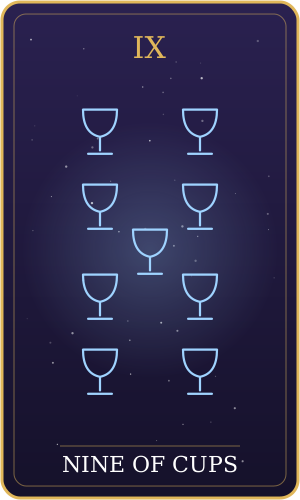
What the Nine of Cups means
Some cards describe a struggle and some describe a lesson. The Nine of Cups describes a good afternoon. It is about the moment when effort has paid off enough that you can sit down, look at what you have, and feel plainly glad about it. There is no twist hiding behind the smile.
In the traditional Rider-Waite-Smith image, a stout, cheerful man sits on a wooden bench with his arms folded across his chest. He wears a red cap and a bright robe, and his expression is that of someone who has just finished an excellent meal. Behind him, on a blue-draped table, nine golden cups are arranged in a long, curved shelf.
The background is plain yellow, which keeps the focus on the figure and his satisfaction. Our own artwork on this site looks different from the classic illustration, though the elements above are the traditional ones.
Because of that pose, the card has picked up the nickname of the wish card. Some readers tell a story where it means a request has been granted. A more grounded reading is that it describes the feeling of having enough, and of knowing it.
Reading the symbols
The folded arms are the most telling detail. They can look defensive, but here they read as ease and mild pride, a posture of someone who is not reaching for anything. Compare that with the cards of striving, where hands are always full. This figure has set everything down.
The nine cups on the shelf are displayed, not guarded. They are lined up where visitors might see them, which hints that part of the pleasure is sharing the abundance, or at least being seen to have it. Some readers find this a little vain, and the reversed meaning picks up that thread.
The red headwear and colorful clothing give the scene warmth and a festive note. The plain backdrop strips away context, as if to say that this is not about where or when. Contentment is not tied to a place.
One small and often-missed point is that the cups are empty of detail. The card does not show what they hold. It leaves the wine, the memories or the simple good company up to you, which is part of why the card works so well as a mirror for what you personally count as enough.
The Nine of Cups upright
Upright, this card points to contentment and the enjoyment of what is already yours. It can follow a long stretch of work, a hard season or a patient wait. The mood is of relaxed gratitude: the garden is planted, and today you are allowed to sit in it.
Typical keywords include satisfaction, comfort, pleasure, abundance and wishes coming true. The last one deserves care. Many people read it as a feeling that a hope has been met in some form, not as a promise that a specific outcome will arrive.
The card is also sensual in a friendly way. A good dinner, a favorite song, a soft blanket, a long laugh with an old friend: these are the kinds of scenes that belong to the Nine of Cups. It reminds readers that enjoyment is a legitimate goal, not a distraction from the real business of life.
For reflection, you might ask what, specifically, feels like enough right now. Naming it can anchor you when the next round of wanting begins, and it often shifts how the rest of the week looks.
The Nine of Cups reversed
Reversed, the Nine of Cups tends to describe pleasure that has gone a bit hollow. The shelf is full, but the satisfaction is not arriving. This can happen when a long-wanted thing finally comes and feels smaller than imagined, or when indulgence stands in for real fulfillment.
Another reading is complacency. The upright figure has earned his rest; the reversed one may be resting from habit, assuming the good times need no tending. Smugness, showing off, or measuring your life by what you display can all fit here.
It can also describe a wish that has not been granted, at least not in the form hoped for. Disappointment sits close by in this reading, and the useful question is whether the wish itself needs adjusting, not whether you did something wrong.
None of this is a warning. The reversed card is a prompt to check whether comfort has become a way of avoiding something. If overindulgence in food, drink, spending or screens is starting to feel hard to control, a conversation with a qualified professional is a better resource than a card.
The Nine of Cups in love and relationships
In love readings, the Nine of Cups often describes emotional ease. Two people feel comfortable together, share small pleasures and do not need to perform. It can fit a relationship that is quietly happy, as well as the glow of an early connection that feels simple and warm.
For single readers, the card commonly points to being content on your own and enjoying your freedom, with no urgent need for anyone to complete the picture. That ease can make dating more fun. People who are comfortable in their own company often come across as relaxed company.
As feelings, the Nine of Cups can describe someone who is happy, satisfied and enjoying the connection. They may be generous with treats, invitations and attention. It is a sunny read, but a card cannot confirm what another person feels, so use it as a conversation starter rather than a verdict.
Reversed in love, the card may suggest that the surface looks lovely while something underneath goes unspoken, or that one partner is taking the comfort for granted. It can also reflect a longing for a particular kind of romance that real life has not delivered. A small honest question, such as what would make this feel richer, can move things along.
The Nine of Cups in career and work
At work, the Nine of Cups is the card of job satisfaction. It may describe a stretch when the tasks suit you, the people are decent, and you finish the day feeling that your effort counted. Many readers use it to mark an achievement worth pausing over, such as a finished project or a hard-won skill.
It also speaks to enjoying the process. A person drawing this card might ask whether they have given themselves credit lately. Careers that run on constant pushing often skip the moment of appreciation, and the card gently asks for it.
In a team, the Nine of Cups can stand for good morale: shared snacks, a lunch that turns into a real conversation, a manager who says thank you and means it. It is the sort of card that favors goodwill and gratitude as workplace habits.
Reversed, it may point to coasting, to rewards that feel empty, or to showing off success instead of building on it. These are themes only. Decisions about pay, contracts or career moves deserve real information and trusted advice, not a draw.
Is the Nine of Cups a yes or no card?
In the convention this site uses, the Nine of Cups is a yes. Most readers who work with tarot for quick yes-or-no questions treat it as one of the most favorable cards in the deck, because satisfaction and wishes met lean naturally toward a positive answer. This is an editorial convention, not an ancient rule, and different readers assign it differently. That is the reading our yes-or-no tool applies.
If the Nine of Cups lands reversed, our rule turns the yes into a maybe, because the pleasure may be thinner than it looks or the wish may arrive in a different shape. Reversed cards only appear when you tick "Include reversed cards" in the yes-or-no tool, and the box starts unticked. The wider rule is that yes becomes maybe, maybe becomes no, and no stays no.
A yes here is best heard as encouragement, a sense that the question is pointed at something you would likely enjoy. It is not a guarantee. The yes-or-no format is for fun and reflection, so keep questions about health, money, law or safety for qualified advisers.
The Nine of Cups and astrology
In the Golden Dawn tradition, the cards from two to ten are matched with a planet in a sign, called a decan. A decan is a ten-degree slice of a thirty-degree sign. The Nine of Cups is assigned to Jupiter in Pisces. Other systems assign these cards differently; the Golden Dawn scheme is the one our site uses.
Pisces is the last water sign, mutable in quality, and Jupiter is its traditional ruler while Neptune is the modern co-ruler. It is linked with imagination, empathy and a soft sense of boundaries. Jupiter stands for growth, generosity and optimism, and it takes about twelve years to circle the zodiac.
Here Jupiter sits in a sign it traditionally rules, which is often described as a comfortable fit. The card's satisfied, generous mood is a natural match: abundance expressed through feeling, hospitality and gratitude.
To connect the card with your own chart, look at where Jupiter falls in your birth chart. Its sign and house can hint at where you tend to feel expansive and lucky in your own eyes, and where generosity comes easily. Any planets in Pisces may show where you absorb moods from others. Our free birth chart calculator finds these placements. Treat the pairing as a prompt for self-reflection and nothing more predictive.
The Nine of Cups as advice
As advice, the Nine of Cups says to notice what is going well and to enjoy it on purpose. That might mean hosting the dinner you keep postponing, buying the good coffee, or taking an actual lunch break away from your desk.
It also encourages gratitude with substance. Instead of a vague wave of thanks, name what you appreciate and tell the person responsible. A thank-you note that mentions a specific moment tends to land well and costs very little.
Try a brief exercise. At the end of each day this week, write down one thing that felt like enough, and one thing you would happily share. Patterns often emerge about which pleasures nourish you and which merely distract.
If the card comes up reversed, the advice is to check whether the pleasure you are chasing is the one you actually want. Slow down, ask what is missing, and be kind to yourself about unmet wishes. And if comfort habits are starting to feel out of your control, reach out to someone you trust or a professional.
Nine of Cups belongs to the decan of Jupiter in Pisces: in the Golden Dawn tradition each minor card from two to ten rules ten degrees of the zodiac. Find Jupiter in your chart or read about Pisces rising.
Frequently asked questions
Is the Nine of Cups a good card?
Yes, most readers rank the Nine of Cups among the happiest cards in the deck. It describes contentment, enjoyment and a sense of having enough. Reversed, it points to hollow pleasure or complacency rather than anything harmful. Like every card, it is a prompt for reflection and not a promise about what will happen in your life.
Why is the Nine of Cups called the wish card?
The nickname comes from the picture of a satisfied figure surrounded by his cups, which readers took to mean a wish has been granted. A more grounded view is that the card describes the feeling of fulfillment, and that it invites you to notice what already feels like enough. It does not guarantee that any specific wish will come true.
What does the Nine of Cups mean in love?
In love, the Nine of Cups usually points to ease, warmth and enjoyment of each other's company. For single readers it often suggests contentment with your own life, which can make dating lighter. Reversed, it may describe a pleasant surface with something unspoken beneath it, or taking a good thing for granted.
What does the Nine of Cups reversed mean?
Reversed, the card often describes satisfaction that feels thin: a wish that did not land as hoped, comfort that has become complacency, or indulgence standing in for fulfillment. It is not a warning, only a prompt to ask what is really missing. If habits around food, drink or spending feel hard to manage, seek support from a qualified professional.
Is the Nine of Cups yes or no when drawn reversed?
Upright, our yes-or-no tool treats the Nine of Cups as a yes. If you have ticked "Include reversed cards" and it lands reversed, the rule moves one step toward no, so the yes becomes a maybe. A maybe stays a hint to wait or look closer. It is our own convention, intended for fun and reflection only.
Which zodiac sign goes with the Nine of Cups?
In the Golden Dawn tradition, the Nine of Cups corresponds to Jupiter in Pisces, linking the planet of growth and generosity with the most imaginative water sign. This is one tradition among several. If Jupiter or Pisces is prominent in your birth chart, the card may feel especially familiar.
 Eight of Cups
 Ten of Cups
 The Star
 The Moon