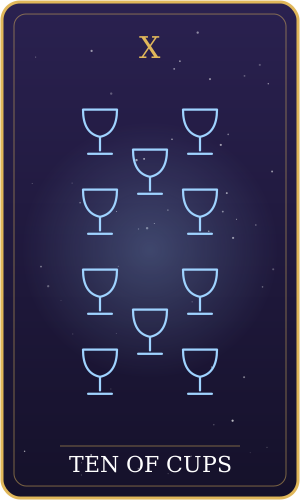
What the Ten of Cups means
Where the Nine of Cups is private satisfaction, the Ten of Cups is satisfaction shared. It is the last card of the suit, and in the way tarot counts, ten often means a cycle reaching its natural fullness. For Cups, which deal in feeling and connection, that fullness looks like people who belong to each other.
In the traditional Rider-Waite-Smith scene, a couple stands side by side on a grassy rise, facing a small house among trees. One of them lifts an arm toward the sky and the other rests an arm around their partner. Two children skip about nearby, holding hands and joining in the celebration. A river winds through the lower ground.
Above the group, ten golden cups are fixed in a curved band across the sky, set against a rainbow. The art on our site is original, while the elements above come from the classic tradition.
The scene is deliberately uncomplicated. Nobody is explaining or negotiating. The card shows what it looks like when affection, safety and a shared place line up, which is why it is often a favorite among readers.
Reading the symbols
The rainbow of cups is the heart of the image. In many traditions a rainbow marks the end of a storm, and here the cups are the emotional gifts that remain once the hard weather has passed. Ten cups also close the suit, so the arc can be read as the completion of everything Cups has been learning about love.
The raised arms suggest gratitude. The adults are not demanding or grasping; they are greeting the sky, the way people do when they feel unexpectedly lucky. Their closeness to each other matters as much as the gesture itself.
The children stand for openness and play, and for the idea that happiness is something handed down and shared. A modern reader need not take them literally. They can equally stand for the young, playful parts of anyone, which tend to come out when a place feels safe.
The house and the river complete the picture. Home gives a base, and the water gives movement. The scene is settled but alive, which is a useful reminder that harmony does not mean stillness.
The Ten of Cups upright
Upright, this card points to emotional fulfillment and the comfort of belonging. It might describe a household that feels warm, a group of friends who feel like family, or a team in which you are simply liked. The mood is wholehearted and unguarded.
Common keywords are harmony, joy, home, alignment and shared values. Many readers also connect the card with the feeling that your inner life and outer life match, so that the way you live reflects what you care about. That match is rarer than it sounds and worth noticing when it appears.
The card can arrive at ordinary moments. A Sunday meal that stretches for hours, a group chat that is full of in-jokes, a quiet evening with someone who needs no explanation: these are Ten of Cups scenes. You do not need a house with a garden to qualify.
A good reflection question is where you feel most at ease being yourself, and with whom. Following that thread, in whatever small ways are available, is often more useful than chasing an idealized picture of happiness.
The Ten of Cups reversed
Reversed, the Ten of Cups tends to show a gap between the picture and the reality. A family gathering looks warm in photos while one person quietly dreads it. A relationship ticks every box, and still something feels unsaid. The rainbow is there, but the people below are not looking at each other.
Another reading is pressure to appear happy. Social media, holiday traditions and old family expectations can make anyone feel that their life should resemble the card. When it does not, the reversed Ten of Cups may mark the sting of comparison.
It can also describe disconnection from a group, a home that does not feel like home, or tension that is simmering without a name. The card does not say the situation is broken. It points out that closeness takes tending, and that unspoken things have a way of growing.
If family conflict, loneliness or sadness are weighing on you, a card is not a substitute for support. Friends you trust, or a qualified professional, can offer more than any spread.
The Ten of Cups in love and relationships
In love readings, the Ten of Cups often describes a relationship in which both people feel secure, appreciated and on the same page about the basics. The pair may share routines, humor and long-term values. It points to the quality of the bond, not to a specific milestone or outcome.
For people who are dating, the card can suggest looking beyond chemistry to compatibility in daily life. Do your weekends look alike? Do you handle disagreements in ways both of you can live with? The Ten of Cups likes the kind of love that holds up on an ordinary Tuesday.
As feelings, the card can describe someone who sees you as part of their world, who wants to introduce you to the people they love, or who simply feels at home around you. Since a card cannot read minds, treat this as a pleasant possibility and let their actions fill in the rest.
Reversed in love, the Ten of Cups may signal a mismatch in expectations, such as one person picturing a quiet life at home while the other wants more adventure. It can also point to a relationship under pressure from outside opinions. A calm conversation about what each of you actually wants usually clears more fog than waiting.
The Ten of Cups in career and work
At work, the Ten of Cups is a card of belonging. It might describe a workplace where people look out for each other, a project whose purpose you share with your colleagues, or a role that fits your values as well as your skills. It is as much about culture as about tasks.
Readers often use the card to ask what kind of environment brings out their best. Some people thrive in small, close-knit teams and others prefer a looser arrangement. The Ten of Cups favors whatever lets you feel part of something and not just a cog in it.
It can also relate to the overlap of work and home life, such as a family business, a role that supports your caring responsibilities, or a flexible setup that leaves room for the people you love. These are themes only and carry no advice on what to choose.
Reversed, it may suggest a team that looks harmonious but avoids honest talk, or the strain of trying to balance work with family expectations. Decisions about jobs and income are best made with concrete information and trusted advisers.
Is the Ten of Cups a yes or no card?
Our convention gives the Ten of Cups a yes. Most readers who use tarot for quick yes-or-no questions regard it as a strongly positive card, because harmony and fulfillment point toward an affirmative answer. No ancient rule fixes this; it is an editorial convention, and readers disagree. Our yes-or-no tool is built on that choice.
If the card lands reversed, our rule turns the yes into a maybe. The idea is that the foundations may be good, but something unspoken needs attention first. The reversed draw is an opt-in: it only happens once "Include reversed cards" is ticked, and the tool starts with it off. For the record, the full rule is that yes becomes maybe, maybe becomes no, and no stays no.
A yes from the Ten of Cups is best taken as encouragement and not as a promise. The yes-or-no format is meant for fun and reflection, and questions about health, money, law or safety belong with qualified advisers.
The Ten of Cups and astrology
In the Golden Dawn tradition, the cards from two to ten are matched with a planet in a sign, known as a decan. A decan is a ten-degree slice of a thirty-degree sign, so each sign has three. The Ten of Cups is assigned to Mars in Pisces. Tarot systems disagree on such assignments, and we follow the Golden Dawn's.
Pisces, a mutable water sign, belongs to Jupiter in the older scheme and shares modern rulership with Neptune. It is associated with empathy, imagination and merging with others. Mars stands for drive, courage and assertion, and it spends roughly six to seven weeks in a sign, with a retrograde about every two years.
Together they make an interesting pair. Mars brings energy and loyalty to the soft, flowing sign of Pisces, and the card can be read as feeling that is acted upon: love expressed through showing up, protecting what matters and working for the people in your circle.
To connect the card with your own chart, look at where Mars falls in your birth chart. Its sign and house can hint at how you pursue what you care about, and at what you tend to go out of your way to defend. Any planets in Pisces may show where you feel most porous and caring. Our free birth chart calculator will list them for you. Take the link as food for thought about yourself, not as a forecast.
The Ten of Cups as advice
As advice, the Ten of Cups suggests investing in the bonds that already carry you. That might mean a standing call with a sibling, a monthly dinner with friends, or simply being fully present at the table instead of half on your phone.
It also invites you to define happiness on your own terms. The card's picture is traditional, but your version may look different: a studio apartment with a cat, a chosen family, a shared flat. What matters is that you feel at home in it.
Here is a tiny experiment. List three people or places where you feel completely relaxed, then note one small thing you could do this week to spend time there. Repeat monthly and watch how the list changes.
If the card appears reversed, the advice is to say the thing that has been waiting. A gentle, honest sentence offered at a calm moment can loosen tension that months of politeness have tightened. And if the strain is heavy, lean on trusted friends or a qualified professional.
Ten of Cups belongs to the decan of Mars in Pisces: in the Golden Dawn tradition each minor card from two to ten rules ten degrees of the zodiac. Find Mars in your chart or read about Pisces rising.
Frequently asked questions
Is the Ten of Cups a good card?
Most readers see the Ten of Cups as one of the most positive cards in the deck. It is about harmony, belonging and shared happiness. Reversed, it points to strained connections or pressure to appear happy, not to anything harmful. As with all tarot, it works as a prompt for reflection and not as a forecast.
What does the Ten of Cups mean in love?
In love, the Ten of Cups tends to describe emotional security, shared values and a bond that works well in everyday life. It speaks to the quality of the connection and does not promise any particular milestone. For single readers, it can suggest looking for compatibility in ordinary routines as well as chemistry.
What does the Ten of Cups mean as feelings?
As feelings, the card can describe someone who feels at home with you, values the connection and imagines you as part of their circle. A card cannot read another person's mind, so treat the idea as a possibility and let their behavior over time tell you more than any single draw.
What does the Ten of Cups reversed mean?
Reversed, the Ten of Cups often points to a gap between how things look and how they feel: a family or relationship that seems fine but has unspoken tension, or pressure to live up to an ideal picture of happiness. It suggests an honest, kind conversation. For heavier struggles, trusted people or a professional can help.
Does a reversed Ten of Cups change the yes or no answer?
Yes. Upright, our tool treats the Ten of Cups as a yes. If you have ticked "Include reversed cards" and it lands reversed, the yes shifts to a maybe, meaning the foundations may be sound but something needs attention. This is our own convention for fun and reflection, and the box is unticked by default.
Which zodiac sign goes with the Ten of Cups?
In the Golden Dawn tradition, the Ten of Cups corresponds to Mars in Pisces, a decan pairing of the planet of drive with the most empathic water sign. Other traditions pair it differently. If Mars or Pisces is prominent in your birth chart, the card may feel personally relevant.
 Nine of Cups
 Page of Cups
 The Star
 The Moon