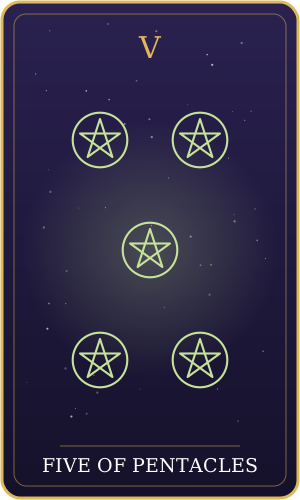
Reading the Five of Pentacles with care
Cards with a bleak picture tend to make people flinch, so it helps to say plainly what this one is. The Five of Pentacles is a portrait of a difficult season, not a prophecy. It names a feeling that many people know: cold, tired, worried and sure that everyone else is somewhere warmer.
In the traditional Rider-Waite-Smith picture, two figures trudge through falling snow at night. One is bent over and wrapped in a ragged shawl, and the other moves on crutches with bells at the neck. Beside them, a church window glows with five coins arranged in the glass. The pair do not glance at it.
Our site shows its own artwork, not the classic illustration, but the details described are the traditional ones. The picture is spare and quiet. Nothing in it is dramatic; it simply shows how heavy a long hard stretch can feel.
The key detail is that help is part of the scene. The shelter is right there. The card does not say that hardship is final; it asks whether a way to reach support is going unnoticed.
The symbols, one at a time
The snow stands for a cold season, whether literal or emotional. It covers the ground and blurs the edges of things, a good image for the way worry narrows attention. When it is snowing in the mind, the closest source of warmth can be hard to see.
The two figures walk together but separately. Neither speaks, and neither looks at the other. Many readers take this to mean that people in difficulty can feel alone even when someone is nearby, and that shared hardship does not automatically bring closeness.
The crutches and the bells are older details. In earlier centuries, bells were sometimes carried as a signal to others. A modern reader can simply see a person who is struggling visibly and a person who is struggling quietly, which are both common.
The stained glass window is the heart of the card. Five coins glow inside a place of shelter, which suggests that warmth, community or resources are available. Looking at it, a reader might ask what stops the pair from knocking: pride, tiredness, shame or simply not noticing.
The Five of Pentacles upright
Upright, the card describes a period of strain. It may touch on work, living situation, energy or confidence, and it often carries a sense of being outside looking in. Keywords include hardship, worry, isolation and feeling overlooked.
Importantly, tarot readers also see resilience here. The figures keep walking. They have not given up, and the card honors that persistence. It suggests that being in a tough spot says little about someone's worth and a lot about circumstances.
The Five also speaks of help that goes unseen. Support may exist in the form of a friend, a community group, a family member or a professional, and the difficulty can be reaching out to it. The card gently raises the question of what might make asking easier.
As a reflective prompt, the upright Five asks: where could I find warmth right now, and what is making me hesitate to go in? Sometimes the answer is as simple as sending one message. A card is not a substitute for support from people you trust or from a qualified professional, and if things feel heavy, those are the places to turn.
The Five of Pentacles reversed
Reversed, the snow begins to thin. The card commonly points to recovery: a hard stretch easing, a worry loosening or a first step toward support being taken. It can be a quiet card of relief.
A second reading is about reaching out. The reversed Five may describe the moment when someone finally says what they need, accepts an offer, or walks through the door they had been avoiding. The change is often small and practical.
A third reading is more cautious. Some readers see the reversed card as a hardship that is being hidden or denied, or as a reluctance to accept help even when it is offered. Pride or embarrassment can keep a person outside longer than necessary.
None of these is a prediction about how circumstances will unfold. The reversed card is a mirror for the moment, and the helpful response is usually gentle and concrete. If a difficult period feels overwhelming or does not lift, talk with someone you trust or a qualified professional.
The Five of Pentacles in love and relationships
In love readings, the Five often speaks of loneliness or of feeling unseen. For someone in a relationship, it may describe a rough patch where one or both people feel disconnected, tired or short of resources. The card does not blame anyone; it points out the cold.
For single readers, the Five can describe a time when dating feels discouraging or when a person feels left out of social circles. It may also nudge toward quiet places of belonging, such as friends, community groups or shared interests, as a way of finding warmth that is not romantic.
As feelings, the Five can describe someone who is struggling and may find it hard to show affection or ask for time. They might be preoccupied, withdrawn or embarrassed. A card cannot read minds, but it can remind a reader that distance is sometimes about stress and not about them.
Reversed in love, the card may signal a thaw: an honest conversation, an apology, a tentative return to contact or the end of a lonely spell. Simple, kind steps tend to matter more than grand gestures.
The Five of Pentacles in career and work
At work, the Five commonly points to a period of insecurity or strain. It may relate to feeling overlooked, to a project that has run out of steam, to instability in an organization or to a general worry about resources. This site treats those as themes only.
The card also carries a practical suggestion: look for the lit window. That might mean a mentor, a colleague who has been through something similar, a professional association or a trusted adviser. Hardship is easier to face when it is shared with someone who can see the whole situation.
It can also relate to the pride that keeps people from asking for help at work. Many capable people try to manage in silence. The card gently suggests that asking is a normal part of working life and not a failure.
Reversed, it may reflect improving conditions, a sense of relief or a first step toward support. This card is not financial or career advice, and no tarot draw should guide decisions about income, employment or debt. Those deserve real information and qualified help.
Is the Five of Pentacles a yes or no card?
In the convention used by this site, the Five of Pentacles is a no. Most readers treat it as one of the more difficult cards in the suit, so it leans toward a negative answer for a question about whether things will go smoothly. Nobody owns the official answer here; it is an editorial choice, and other readers differ. It is what our yes-or-no tool applies when this card turns up.
If the Five lands reversed, our rule keeps it a no, since a no is already the lowest answer and does not move further. You only see reversed cards after ticking "Include reversed cards", and the box begins unticked.
A no from this card is not a forecast and not a verdict on a person. It is a prompt to slow down, check the facts and consider what support could help. The tool is meant for fun and reflection, and no card can know how a situation will turn out.
Health, money, law and safety questions do not belong in a card draw. A qualified professional and solid information serve those better than any draw.
The Five of Pentacles and astrology
Each numbered card from two to ten has a decan in Golden Dawn tradition, meaning a planet placed in a sign. The Five of Pentacles carries Mercury in Taurus. Tradition says so, other systems disagree, and this site follows tradition.
Taurus, ruled by Venus, is a fixed earth sign. It is linked with the senses, comfort, stability and material security. Mercury is the planet of thought, speech and communication, and it governs how we process worry and how we ask for what we need.
The combination is easy to see in the picture. Taurus supplies the strong link to comfort and resources, and its loss is felt keenly. Mercury brings the anxious mind and the question of whether anyone is going to speak up. The remedy hinted at is also Mercurial: say it out loud and ask.
To connect this to your own chart, look at where Mercury sits and where Taurus falls among your houses. Those areas may show how you think about security and how you communicate needs. You can find both in our free birth chart calculator. Treat this as a lens for self-reflection and not a prediction.
The Five of Pentacles as advice
As advice, the Five suggests knocking on a door. Think of one person or place where you could find real warmth, whether a friend, a family member, a community group or a professional, and make a small contact this week.
It also encourages gentleness toward yourself. Hard stretches are tiring, and the harsh inner voice tends to make them longer. Treat yourself the way you would treat a friend walking in the same snow.
Try a simple exercise. Write down three people or resources that have helped you before, even a little. Then note which one feels easiest to approach today. Reaching out in a small way often shifts the whole picture.
If the card comes up reversed, the advice is to keep going in the direction you have started. Accept the offer, keep the appointment, answer the message. A card is not a substitute for support from people you trust or a professional, but it can be a reminder to go and find them.
Five of Pentacles belongs to the decan of Mercury in Taurus: in the Golden Dawn tradition each minor card from two to ten rules ten degrees of the zodiac. Find Mercury in your chart or read about Taurus rising.
Frequently asked questions
Is the Five of Pentacles a bad card?
The Five of Pentacles is one of the harder-looking cards, but it is not a bad omen. It describes a tough stretch and the feeling of being left out, along with the quiet presence of help. Reversed, it points to recovery. As with every tarot card, it is a prompt for reflection and not a forecast.
What does the Five of Pentacles mean in a relationship?
In a relationship, the Five often describes a cold or lonely patch, with one or both people feeling disconnected or short of energy. For single readers it can mean feeling left out. Reversed, it suggests a thaw through honest conversation. The card names the feeling and does not assign blame.
What does the Five of Pentacles reversed mean?
Reversed, the Five of Pentacles usually points to recovery: a difficult period easing, a worry loosening or a first step toward support. It can also describe pride that keeps someone from accepting help. The card is not a prediction. If a hard time feels heavy, talk with someone you trust or a professional.
What does the Five of Pentacles mean as feelings?
As feelings, the Five can describe someone who is under strain, withdrawn or embarrassed about asking for time and support. Distance from them may be about stress and not about you. A card cannot read another person's mind, so treat this as a thoughtful guess and ask kindly how they are doing.
Is the Five of Pentacles a yes or no card?
On this site the Five of Pentacles is a no, because it is one of the more difficult cards in the suit. Reversed, our yes-or-no tool keeps it a no, and only when "Include reversed cards" is ticked. This mapping is an editorial choice of ours, meant for fun and reflection.
Which planet and sign go with the Five of Pentacles?
In the Golden Dawn tradition the Five of Pentacles corresponds to Mercury in Taurus, a decan pairing of thought and communication with the need for comfort and security. That assignment is traditional, and rival systems exist. Check where Mercury and Taurus fall in your birth chart. It is a pairing worth exploring out of curiosity, with no claim about real events.
 Four of Pentacles
 Six of Pentacles
 The Star
 The Moon