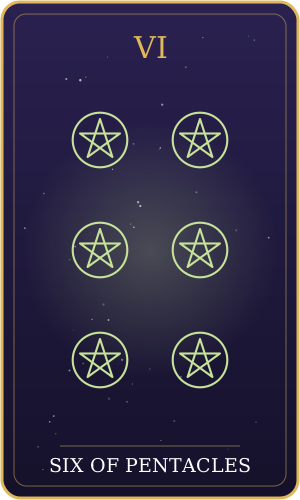
The Six of Pentacles at a glance
The Five of Pentacles shows people in the cold, and the Six follows with a hand held out. The sequence is deliberate. After hardship comes support, and the card asks what support looks like when it is done thoughtfully. Fairness matters as much as kindness here.
In the traditional Rider-Waite-Smith picture, a well-dressed merchant stands in the middle of the scene. One hand holds a balanced set of scales, and the other drops coins into the palm of a kneeling figure. A second kneeling person waits beside the first. Above the group, six coins hover in the air.
On our site the card appears in original artwork instead of the classic picture, with the traditional symbols described here. The tone is calm, civic and a little formal. Nothing about it is secret; the giving happens in the open.
The card's main idea is that exchange can be generous without being careless. The best giving takes needs into account, keeps a sense of proportion and leaves everyone's dignity intact.
The symbols, one at a time
The scales are the most important detail. They stand for measure and judgment: how much, to whom, and on what terms. Held level, they suggest that the giver has thought about the balance and is not acting on impulse or showing off.
The coins in the merchant's hand and the coins above are the resources in play. The picture shows them moving. Money, time, knowledge and attention are all forms of the same thing, and the card lets each of them stand in for the others.
The two kneeling figures show the receiving side. Their posture can be read as gratitude or as a power imbalance, and good readers hold both ideas at once. The card asks whether giving can be done in a way that respects the person receiving.
The merchant's rich clothing suggests that the giver has plenty. Some readers notice that the giver stands above the others, which raises the question of who has the power and how it is used. Generosity at its best is a relationship, not a performance.
The Six of Pentacles upright
Upright, the card describes generosity in a balanced form. It may appear when a person is offering help, receiving help or taking part in an exchange that feels fair to everyone. Typical keywords include charity, sharing, mentoring, reciprocity and gratitude.
It can apply to either side of the exchange. A reader might be the one giving, such as time, advice or a gift, or the one receiving, such as a favor or a mentor's attention. The card encourages doing both with grace, and reminds people that accepting help is as much a skill as offering it.
There is also a note about community. Sharing what you have tends to build trust, and networks of mutual support are one of the most reliable sources of resilience. The Six is a reminder that few good things are built alone.
As a reflective prompt, the upright Six asks: where in my life is giving and receiving in balance, and where does it lean too far to one side? The answer can point to a friendship, a workplace or a family habit worth adjusting.
The Six of Pentacles reversed
Reversed, the scales tip. The card often describes an exchange that is uneven, where one person gives much more than the other or where help comes with conditions attached. It may also describe generosity that is used to gain influence.
Another reading concerns debt in a wider sense: a sense of owing something, or a person who keeps count and expects return. The reversed card can invite a look at whether the terms of an arrangement are clear and fair to both sides.
A third reading concerns withholding. A person may have resources, time or kindness to share and hold back out of worry or habit, or may find it hard to accept help for fear of obligation. Either way, the flow is blocked.
A reversed card does not condemn anyone. It is a mirror for a moment, and a practical response is usually clarity: say what you can offer, say what you need and agree on what is fair. For serious questions about debt or finances, qualified advice matters far more than any card.
The Six of Pentacles in love and relationships
In love readings, the Six is about reciprocity. In a relationship, it often describes a healthy give-and-take, in which both people contribute attention, effort and care, and neither feels they are keeping score. It can also describe a period of one partner supporting the other through a busy or difficult time.
For single readers, the card may suggest that connection grows through generosity of attention, such as listening well, showing up and offering help without strings. It also asks that a person look for someone who gives in return, so that the exchange feels balanced.
As feelings, the Six can describe someone who is caring, attentive and keen to be useful. They may show love through thoughtful gestures, help with practical tasks or small gifts. Their warmth may be quite sincere, and it is worth noticing whether it is mutual.
Reversed in love, the card can describe unequal effort, resentment about who does more, or acts of kindness that carry an unspoken expectation. A calm conversation about what each person needs and offers tends to ease the strain.
The Six of Pentacles in career and work
At work, the Six speaks of fair exchange. It can show up around mentoring, teaching, sharing credit, giving feedback or taking part in a team that distributes tasks fairly. It is also associated with workplaces that have a generous culture, where people help one another.
The card may also relate to recognition and reward in a general sense. A reader could use it to ask whether effort and acknowledgment are balanced in their current role. This site treats money and pay as themes only and gives no financial or career advice.
For people who lead, the Six is a prompt about how power is used. Generous leaders tend to give clear guidance, credit and opportunities, and they check that their support is useful to the person receiving it.
Reversed, it can point to unfair division of work, favors with strings attached or a feeling of being undervalued. Real decisions about pay, contracts or employment need real information and qualified advice, and a card is not a substitute for either.
Is the Six of Pentacles a yes or no card?
In the convention used by this site, the Six of Pentacles is a yes. Most readers treat it as a card of generosity and goodwill, so it leans toward an affirmative. The rating is a matter of convention, not tradition set in stone, and opinions differ among readers. Our yes-or-no tool applies this reading.
If the Six lands reversed, our rule softens the yes into a maybe, because an imbalance or hidden condition may need to be sorted out first. Reversed draws are switched off by default; tick "Include reversed cards" to allow them.
A yes from the Six is best heard as encouragement to proceed in a fair, open-handed way. It is not a promise about the result. The format is meant for fun and reflection, and no card can say how a situation will unfold.
Questions about health, money, law or safety are not suited to a draw. Those call for qualified advice and reliable information.
The Six of Pentacles and astrology
The Golden Dawn system links the cards two to ten with decans, each a planet in a particular sign. The Six of Pentacles carries the Moon in Taurus. That is the traditional correspondence, which this site follows even though others exist.
Taurus belongs to the earth element, holds the fixed quality and has Venus as its ruler. It is connected with comfort, abundance, the senses and a steady appreciation of what is good. In the traditional scheme the Moon is said to be exalted in Taurus, a way of describing a placement where the Moon's nurturing qualities are at ease.
That pairing suits the card well. The Moon governs care, feeling and the rhythm of giving and receiving, while Taurus supplies the stable, material abundance that can be shared. Generosity from a secure place is the heart of the picture.
To bring it into your own chart, look at where the Moon sits by sign and house, and where Taurus falls among your houses. Those spots may hint at how you give care and what makes you feel nourished. Both appear in the results of our free birth chart calculator. It is a lens for reflection and not a forecast.
The Six of Pentacles as advice
As advice, the Six suggests giving in a way that is considered. Ask what the other person actually needs, and offer that, instead of what is most convenient for you. A smaller, well-aimed gift often means more than a large, vague one.
It also invites receiving. If someone offers help, practice saying thank you without apologizing. Accepting generosity completes the circle, and it lets others feel useful.
Try a quick exercise. List the last three times you gave something and the last three times you received something. Notice which list came more easily. The pattern may show where your habits lean.
If the card comes up reversed, the advice is to clarify terms. Say what you are offering, say what you hope for, and check that it fits. Fair exchange is a skill, and honest conversation is its main tool.
Six of Pentacles belongs to the decan of Moon in Taurus: in the Golden Dawn tradition each minor card from two to ten rules ten degrees of the zodiac. Find Moon in your chart or read about Taurus rising.
Frequently asked questions
Is the Six of Pentacles a good card?
Most readers see the Six of Pentacles as a positive card. It stands for generosity, fair exchange and mutual support. Reversed, it points to imbalance or hidden conditions rather than anything harmful. As with every tarot card, it is a prompt for reflection about giving and receiving and not a forecast of what comes next.
What does the Six of Pentacles mean in a relationship?
In a relationship, the Six often describes healthy give-and-take, with both people contributing care and effort without keeping score. It can also mean one partner supporting the other for a while. Reversed, it may show unequal effort or kindness with strings attached, where a calm talk about needs helps. Calm, specific talk helps.
What does the Six of Pentacles reversed mean?
Reversed, the Six of Pentacles usually points to an uneven exchange, help that comes with conditions, difficulty accepting support or generosity held back. It is no cause for alarm. It suggests clarifying terms, naming expectations openly and checking that the arrangement feels fair to everyone involved. It also helps to avoid taking the picture too literally.
What does the Six of Pentacles mean as feelings?
As feelings, the Six can describe someone who is caring and eager to help, showing affection through thoughtful gestures and practical support. Their warmth may be sincere. A card cannot read another person's mind, so treat this as a thoughtful guess and notice whether the care goes both ways. Kindness is worth noticing.
Is the Six of Pentacles a yes or no card?
On this site the Six of Pentacles is a yes, because it describes generosity and goodwill. When reversed, the result becomes a maybe, which requires ticking "Include reversed cards". The mapping is editorial, and it exists for fun and reflection. Use this as a light, editorial setting for fun and reflection; it makes no claim of accuracy about real events or decisions, and a different reader may well file the card elsewhere.
Which planet and sign go with the Six of Pentacles?
In the Golden Dawn tradition the Six of Pentacles corresponds to the Moon in Taurus, a decan pairing of nurturing with abundance and comfort. It is a traditional correspondence, not a universal one. Checking where your Moon and Taurus fall in your birth chart may make the card feel more personal.
 Five of Pentacles
 Seven of Pentacles
 The Star
 The Moon