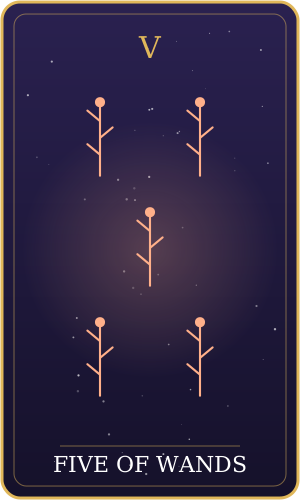
What the Five of Wands means
Anyone who has sat in a meeting where four people talk at once knows the energy of this card. Nobody is exactly wrong, nobody is really listening, and the room hums with competing ideas. The Five of Wands does not claim to solve the noise. It simply names it.
In the traditional Rider-Waite-Smith picture, five youths in everyday clothes stand on open ground, each swinging or holding a long wooden staff. Their poses cross and clash, as though they were mid-game or mid-argument. No one has fallen, nobody is bleeding, and no leader is visible. Above them is a clear sky.
Our site uses its own artwork for the card, but these are the traditional details. The lack of a winner or a clear conflict is part of the point. Many readers see the scene as rough play or a rehearsal, a kind of sparring where energy is high and the stakes are modest.
In the number sequence, five is often the number of disruption after the stability of four. In this suit, it shows what happens when a settled structure meets people who all want to have a say. The result is lively, uncomfortable and, in the right hands, productive.
The symbols, one at a time
The five staves are all different in how they are held. Some point up, some sideways, some cross another's. That mismatch is a visual shorthand for talking past each other. Everyone has energy; nobody has agreed on a direction.
The figures' clothes are ordinary and mismatched, with no uniforms, ranks or sides. This suggests a conflict among equals or near-equals, such as colleagues, siblings, friends or teammates, rather than a struggle between authority and subordinate.
The bare ground is easy to overlook. There is no fortress, no road and no destination, which implies that the clash is about itself and not about a prize. Readers sometimes read this as a warning about arguing for the sake of arguing, and sometimes as a reminder that practice and play can look like conflict.
The clear sky above matters, too. It gives the card a lighter tone than the Swords suit would. Disagreement here is physical, loud and messy, but there are no storm clouds. Many readers see the scuffle as survivable and even useful.
The Five of Wands upright
Upright, the Five of Wands describes competition, friction and a crowd of opinions. A person drawing it may be in a situation where several people want different things, or where they themselves feel pulled in several directions. The mood is restless, spirited and sometimes irritating.
Typical keywords include rivalry, debate, tension and scattered effort. The card does not say that conflict is a disaster. It points out that when a lot of strong personalities share a space, there will be bumps, and that some of those bumps clarify what everyone actually wants.
The card also relates to personal restlessness. One person can feel like all five figures at once, with several competing goals, none winning. In that sense, the card is as much about an overcrowded mind as an overcrowded room.
For reflection, the upright card can prompt questions such as: where in my life is there more noise than direction, which disagreement is productive and which is only habit, and what would one clear shared goal change? Naming a common aim often calms a scuffle faster than winning it.
The Five of Wands reversed
Reversed, the Five of Wands can point in two opposite directions. One reading is resolution. The sticks are lowered, the argument has run out of fuel, and a truce or compromise becomes possible. In this sense, the card describes tension easing and people finding a workable way to share the space.
The other reading is avoidance. The conflict has not ended; it has gone underground. People smile, stay quiet and avoid the hard topic, and the friction lingers as resentment instead of open disagreement. This version of the card suggests that a calm, honest conversation might be healthier than silence.
A third reading relates to inner conflict. When the outside noise fades, the argument may continue inside, in the form of self-doubt, mixed feelings or a stubborn tug between two wishes. The reversed card invites you to listen to that inner argument kindly.
As always, a reversed card is not a judgment. It is a way of asking which version applies: is the dust settling, or is it just being swept out of sight? Only you can tell, and a gentle check with the people involved often helps.
The Five of Wands in love and relationships
In love readings, the Five of Wands is the card of bickering, banter and friction. For a couple, it may describe a stretch of small arguments, clashing schedules or different ideas about how to spend time. It is not usually read as a sign that a relationship is doomed; it can simply show two strong personalities adjusting.
For single readers, the card often reflects competition in the dating pool, mixed signals or a flirtation that is more sparring than sweetness. It can also describe a stage where you are unsure what you want and are meeting a lot of different people.
As feelings, the Five of Wands can suggest someone who is stirred up and unsettled, possibly attracted but also irritated, or caught between several priorities. It may also point to a person who enjoys teasing and challenge. Clear, kind communication is better than reading the card as a verdict.
Reversed in love, it can mean the end of a quarrel, a truce that brings relief or a refusal to talk about something that needs attention. The gentle advice is to choose one issue, state it plainly, and listen without scoring points.
The Five of Wands in career and work
At work, the Five of Wands is the card of busy teams, competing priorities and strong egos. It often appears around brainstorming sessions, crowded projects, internal competition or any situation where the pace is quick and the roles are not yet settled. The theme is energetic friction.
It also relates to healthy competition. A reader might use the card to ask which rivalries motivate them and which only drain them. Some friction sharpens ideas, while some simply wastes time, and learning to tell the difference is useful.
In collaborative settings, the card suggests clarifying roles and agreeing on how decisions will be made. Without a shared structure, talented people can end up repeating each other or pulling in different directions.
Reversed, it may reflect resolved disputes, a negotiated compromise or a quiet standoff that no one wants to address. It is a prompt for reflection, not career advice. Decisions about jobs or income deserve solid information and trusted advisers who know your situation.
Is the Five of Wands a yes or no card?
In the convention used by this site, the Five of Wands is a no. Most readers who use tarot for quick yes-or-no questions treat it as unfavorable for a clean, smooth answer, because it pictures disagreement and scattered effort. This is an editorial convention, not an ancient rule, and different readers assign it differently. It is the one our yes-or-no tool uses.
A no from this card is best read as a sign that the matter is not straightforward right now. It suggests friction, competing interests or a lack of agreement, and that more clarity might be needed before moving ahead. It is not a prediction of failure.
Reversed cards appear only if you tick "Include reversed cards" in the yes-or-no tool; the box starts unticked. In that case the rule moves every reversed card one step toward no: yes becomes maybe, maybe becomes no, and no stays no. A reversed Five of Wands therefore stays a no, since the rule has no lower step to take.
The yes-or-no format is for fun and reflection. For questions about health, money, law or safety, a card is the wrong tool, and qualified advice is the right one.
The Five of Wands and astrology
In the Golden Dawn tradition, the Five of Wands is assigned to Saturn in Leo, the first decan of Leo. This is a correspondence from tradition, and other systems arrange the numbered cards differently, but it is the one this site follows. A decan is one of three ten-degree slices of a sign, each with its own planetary tint.
Leo is a fire sign, fixed in quality, ruled by the Sun, and it is linked with pride, creativity and a wish to be seen. Saturn is the planet of limits, discipline and testing. The pairing is not a comfortable one, and that is the idea: strong personalities meeting constraints, and the friction that follows.
To connect the card to your own chart, look at where Saturn sits by sign and house, and at where Leo falls among your houses. Those placements can hint at where you feel tested, where you hold yourself to demanding standards and where you might clash with others who want the same spotlight. Someone with Saturn in Leo, or a strong Leo emphasis, may recognize the tension.
You can find these placements with our free birth chart calculator. Astrology here is a lens for self-reflection, and a card correspondence is a thread to follow out of curiosity, not a prediction about anyone's life.
The Five of Wands as advice
As advice, the Five of Wands suggests deciding what the argument is actually about. Many disputes consume time because each side is defending a different, unspoken issue. Stating the real one aloud can shrink a loud problem to a manageable size.
It also advises choosing your battles. Not every disagreement needs a winner. Some are better settled by a coin flip, a rotation or a quick agreement to try one approach for a week and review it.
Try a short exercise. Write down the three things you would like from a current disagreement, and the one thing the other person probably wants. Look for the overlap before you open the conversation. The list often shows more common ground than the mood suggested.
If the card comes up reversed, the advice is to check whether peace is real or just quiet. If it is real, enjoy it. If not, choose a calm time to raise the issue kindly. The Five of Wands never asks you to like conflict; it only suggests that clear, honest friction beats silent resentment.
Five of Wands belongs to the decan of Saturn in Leo: in the Golden Dawn tradition each minor card from two to ten rules ten degrees of the zodiac. Find Saturn in your chart or read about Leo rising.
Frequently asked questions
What does the Five of Wands mean in tarot?
The Five of Wands stands for competition, friction and a crowd of clashing opinions. It pictures a lively scuffle with no clear winner, and readers see it as both a nuisance and a way for ideas to sharpen. It works best as a prompt for reflection about where your energy is scattered, not as a forecast of trouble.
Is the Five of Wands a yes or no card?
In the convention this site uses, the Five of Wands is a no, because its themes of friction and disagreement suggest the matter is not straightforward. That is an editorial convention and not an ancient rule, and other readers may assign it differently. A reversed no stays a no in our tool, which applies the reversed rule only when you tick the option.
What does the Five of Wands reversed mean?
Reversed, the Five of Wands can mean the conflict is easing and a truce is possible, or that people are avoiding a conversation that still needs to happen. It can also describe inner conflict between two wishes. The card is not a warning. It asks whether the quiet is peace or simply a pause.
What does the Five of Wands mean in love?
In love, the Five of Wands often describes bickering, clashing schedules or a flirtation that feels more like sparring. It does not mean a relationship is doomed; two strong personalities can simply be adjusting. Reversed, it may show a truce or avoided talks. It describes a mood to reflect on, not a prediction.
Which planet and sign go with the Five of Wands?
In the Golden Dawn tradition the Five of Wands corresponds to Saturn in Leo, the first decan of Leo. Saturn stands for limits and discipline, and Leo is the fire sign of pride and creativity. This is a traditional assignment and not the only one in use. Your own Saturn placement may make the card feel familiar.
What does the Five of Wands mean as feelings?
As feelings, the Five of Wands can describe someone who is stirred up, impatient or torn between priorities, and who may be attracted and annoyed at the same time. A card cannot read another person's mind, so treat this as a thoughtful guess and a reason to talk openly instead of assuming.
 Four of Wands
 Six of Wands
 The Star
 The Moon