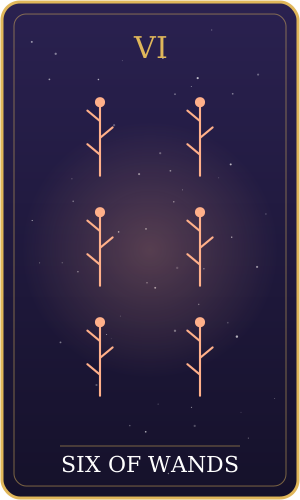
What the Six of Wands means
Victory feels different depending on who witnesses it. A private success is satisfying, but a success noticed by others carries an extra warmth, and sometimes an extra weight. The Six of Wands is about the public side of winning: being seen, congratulated and, for a moment, carried along by the goodwill of a crowd.
In the traditional Rider-Waite-Smith picture, a rider sits on a calm, decorated horse, his head crowned with a laurel wreath. In his hand is a tall staff tied with a second wreath. On both sides, people walk beside him, each carrying a wand of their own and gazing up. The ground is level and unthreatening.
Our site uses its own artwork for the card, but these are the traditional details. The scene is a procession, and what stands out is the mix of honor and togetherness. The rider is elevated, yet he is not alone; the people at his side help make the moment, and they hold wands too.
In the sequence of the suit, the Six follows the quarrel of the Five. After scuffles and competition, someone comes through, and the card shows what that looks like. It suggests effort recognized, tension resolved by results and a hard-won confidence.
The symbols, one at a time
The laurel wreath is among the oldest symbols of honor in Western culture, long associated with athletic and poetic triumph. It tells us that the win is real and has been acknowledged by others. The wreath on the staff repeats the message: the achievement has been planted where everyone can see it.
The horse adds a note of ease. The animal is steady, well-dressed and in no hurry. Many readers see it as a picture of confidence carried gracefully, as opposed to arrogantly. A rider who is calm in front of an audience is more persuasive than one who pushes for attention.
The crowd of walkers is a detail that is easy to skip. They keep their wands upright, which can be read as support. They are not rivals anymore, and some may have contributed to the win. That reading brings in a quiet reminder that most successes rest on many hands.
The cloudless backdrop keeps the mood bright and uncomplicated. Unlike some cards that carry shadows alongside their promise, this one lets itself be happy. It gives readers permission to enjoy the moment before returning to the next task.
The Six of Wands upright
Upright, the Six of Wands is a card of recognition. A person drawing it may have completed something that earned praise, such as a finished project, a successful presentation, a personal milestone or an overdue acknowledgment. The mood is proud, buoyant and sociable.
Typical keywords include victory, confidence, progress and public regard. The card suggests that the effort you have put in is visible, and that you can allow yourself to accept the compliments instead of deflecting them. Many people find that harder than winning.
There is also a point about momentum. A win tends to make the next goal feel more reachable, and the Six of Wands recognizes that boost. It does not say that success is permanent. It says that, for now, you have earned a moment of standing a little taller.
For reflection, the upright card can prompt questions such as: what have I accomplished that I have not fully acknowledged, who supported me along the way and how do I want to carry this confidence? A short list of recent wins is surprisingly effective on a gray day.
The Six of Wands reversed
Reversed, the Six of Wands often describes recognition that is late, missing or hollow. The effort was real, but the applause never came, or it came for someone else. That can sting, and the card acknowledges it. It may also show a victory that feels flat because it did not match expectations.
Another reading is a tangle with ego. Pride can swell when praise is plentiful and shrink when it is not, and the reversed card may point to a self-image that depends too heavily on outside approval. It does not accuse; it asks how steady your confidence is when nobody is watching.
A third reading is self-doubt after a setback. A reader may feel they have fallen from favor, or may fear that a recent success was luck. The reversed card suggests looking at the actual facts of what you did, instead of the story your mood is telling.
None of this is a verdict. A reversed Six is a prompt to find satisfaction in the work itself and to seek feedback from people who are honest and kind. Recognition is pleasant, but it is rarely the only measure of whether something mattered.
The Six of Wands in love and relationships
In love readings, the Six of Wands reflects pride in a partner or in a relationship that others admire. For couples, it can describe a period of shared achievement, mutual encouragement and the pleasure of being seen as a team. The mood is confident and affectionate.
For single readers, the card often points to a boost in self-esteem that makes dating feel less daunting. Feeling good about your own progress, such as a new job, a fitness goal or a creative win, can change how you show up. The card does not name a particular person arriving.
As feelings, the Six of Wands can suggest someone who admires you, is proud of you or wants to impress you. It can also describe a person who enjoys the attention of a social setting and likes to be recognized. Asking how they feel is wiser than treating the card as a certainty.
Reversed in love, the card may describe a lack of appreciation, an imbalance of praise or a partner whose pride gets in the way. The gentle suggestion is to say thank you out loud, and to ask for acknowledgment plainly when you need it.
The Six of Wands in career and work
At work, the Six of Wands is the card of earned recognition. It often appears around promotions, awards, successful launches, positive reviews or the quiet pleasure of a manager saying a job was well done. The theme is visibility after sustained effort.
It also speaks to leadership. A reader might use the card to ask how they handle credit: whether they share it generously, accept it gracefully and make room for those who did the harder-to-see tasks. The figures walking beside the rider are a useful image here.
For people who work alone, the card can relate to building a reputation or a portfolio that other people notice. It may suggest it is a good time to share your work more openly, update a profile or say yes to an invitation to present.
Reversed, it may reflect overlooked contributions, a result that fell short of hopes or concerns about status. It is a prompt for reflection, not career advice. Decisions about jobs or income deserve solid information and the counsel of people who know your circumstances.
Is the Six of Wands a yes or no card?
In the convention used by this site, the Six of Wands is a yes. Most readers who use tarot for quick yes-or-no questions treat it as a clear sign of success, since it pictures victory, recognition and confidence. This is an editorial convention, not an ancient rule, and different readers assign it differently. It is the one our yes-or-no tool uses.
A yes from this card is best read as encouragement. It suggests that the question leans toward a good result, or that you are well placed to go forward. It is not a guarantee, and a winning card cannot replace preparation or common sense.
Reversed cards appear only if you tick "Include reversed cards" in the yes-or-no tool; the box starts unticked. In that case the rule moves every reversed card one step toward no: yes becomes maybe, maybe becomes no, and no stays no. A reversed Six of Wands reads as a maybe, matching its theme of credit that is delayed or uncertain.
The yes-or-no format is for fun and reflection. For questions about health, money, law or safety, a card is the wrong tool, and qualified advice is the right one.
The Six of Wands and astrology
In the Golden Dawn tradition, the Six of Wands is assigned to Jupiter in Leo, the second decan of Leo. This is a correspondence from tradition, and other systems arrange the numbered cards differently, but it is the one this site follows. A decan is a ten-degree slice of a sign, and each has its own planetary flavor.
Leo is a fire sign, fixed in quality, ruled by the Sun, and it is linked with warmth, pride and the wish to shine. Jupiter is the planet of growth, generosity and optimism, and it tends to expand whatever it touches. The combination points toward big-hearted confidence, which is exactly the mood of the parade.
To connect the card with your own chart, look at where Jupiter sits by sign and house, and at where Leo falls among your houses. Those placements can hint at where you feel lucky, where you grow most easily and what kind of recognition feels meaningful to you. Someone with Jupiter in Leo, or a strong Leo emphasis, may find the card especially familiar.
You can find these placements with our free birth chart calculator. Astrology here is a lens for self-reflection, and a card correspondence is a thread to follow out of curiosity, not a prediction about anyone's life.
The Six of Wands as advice
As advice, the Six of Wands suggests letting a good result land. Say thank you, accept a compliment without a joke or a disclaimer, and take a few minutes to enjoy having done something well.
It also suggests sharing the credit honestly. Name the people who helped, in public if possible. Gratitude spoken aloud strengthens the team and keeps pride from curdling into a lonely thing.
Try a simple exercise. At the end of the week, write down three things you handled well, however small, and one thing you would like to be recognized for next. Keep the list somewhere you can find it on a harder day.
If the card arrives reversed, the advice is to build a source of confidence that does not depend on applause. Track your own standards, ask for specific feedback and celebrate privately if the world is quiet. The Six of Wands never insists on a parade; it only reminds you that your effort counts, noticed or not.
Six of Wands belongs to the decan of Jupiter in Leo: in the Golden Dawn tradition each minor card from two to ten rules ten degrees of the zodiac. Find Jupiter in your chart or read about Leo rising.
Frequently asked questions
What does the Six of Wands mean in tarot?
The Six of Wands stands for victory, recognition and the confidence that comes from being seen for your efforts. It pictures a procession with a crowned rider, and readers link it with public praise, pride and progress. It works best as a prompt for reflection about what you have achieved, not as a forecast of success.
Is the Six of Wands a yes or no card?
In the convention this site uses, the Six of Wands is a yes, because its themes of victory and recognition lean toward encouragement. That is an editorial convention and not an ancient rule, and other readers may assign it differently. Reversed, our tool turns it into a maybe, and only when you tick the reversed option.
What does the Six of Wands reversed mean?
Reversed, the Six of Wands usually points to recognition that is late or hollow, an ego tangle or self-doubt after a setback. The card is not a warning. It invites you to value the work itself, seek honest feedback and build confidence that does not rest entirely on applause, which is a steadier kind to have.
What does the Six of Wands mean in love?
In love, the Six of Wands often describes pride in a partner, shared achievements or a boost in self-esteem that makes dating easier. It does not name a specific person arriving. Reversed, it may suggest a lack of appreciation or pride getting in the way. It describes a mood to reflect on, not a promise.
Which planet and sign go with the Six of Wands?
In the Golden Dawn tradition the Six of Wands corresponds to Jupiter in Leo, the second decan of Leo. Jupiter stands for growth and generosity, and Leo is the fire sign of warmth and pride. This is a traditional assignment and not the only one in use. Your own Jupiter placement may make the card feel familiar.
What does the Six of Wands mean as feelings?
As feelings, the Six of Wands can describe someone who admires you, feels proud of you or wants to impress you. It can also point to a person who enjoys being recognized. A card cannot read another person's mind, so treat this as a thoughtful guess and a reason to ask them how they feel. Reversed, it may suggest someone who feels overlooked or unsure of their own standing.
 Five of Wands
 Seven of Wands
 The Star
 The Moon