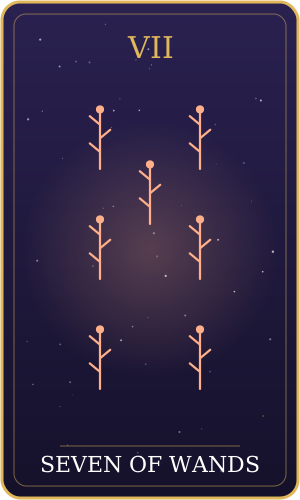
What the Seven of Wands means
Most people have had a moment when they were sure of a decision and everyone else seemed to disagree. A boundary at work, a choice about family plans, a creative idea that others kept trying to reshape. The Seven of Wands is the picture of that moment and of the nerve it takes to stay put.
In the traditional Rider-Waite-Smith image, a single figure stands at the top of a green hill, gripping a staff with both hands. Below, six other staves rise from the lower edge of the scene, as though pushed up by unseen people. The figure looks down at them, braced and a little tense, in a pose between fighting and listening.
Our site uses its own artwork for the card, but these are the traditional details. One feature often noted by readers is that the figure wears two shoes that do not match. It is a small oddity that suggests he was caught off guard, grabbing whatever he could to take up a position quickly.
That detail gives the card its human warmth. The Seven of Wands is not a tale of a flawless warrior. It is a picture of someone who is a bit disheveled and out of breath, yet still standing on the higher ground and still holding their view.
The symbols, one at a time
The hilltop is the central symbol. Height gives the figure an advantage, since those below must climb to reach him. Readers often take it as a picture of an earned position, such as experience, a track record or an honest conviction that makes a stand easier to hold.
The six staves below are shown only as wood, without faces. That choice makes them easy to read in different ways. They could stand for critics, competitors, advice that is not welcome or simply the pile of demands that arrives all at once. The card does not say they are enemies.
The single staff in the figure's hands is an important contrast. One tool, held steadily, outweighs six pushed up in a jumble. Some readers find comfort in this: you need not answer every voice, only protect the one thing you care most about.
The mismatched shoes, as mentioned, hint at being unprepared yet resolute. They bring humor and humility to the scene. Standing your ground does not require being perfectly ready. Willingness is often enough to begin.
The Seven of Wands upright
Upright, the Seven of Wands describes defending a position under pressure. A person drawing it may be dealing with criticism, competition or strong opinions about a choice they have already made. The mood is alert, determined and slightly tiring, with a core of self-respect.
Typical keywords include perseverance, courage, boundaries and standing firm. The card suggests that the position is worth the effort, and that you have some advantage, such as experience, clarity or the plain fact that you got there first. It does not say that the pressure will vanish soon.
There is a point about discernment, too. Not every challenge deserves a fight. Holding your ground is different from refusing to listen, and the upright card works best when you can tell useful feedback from simple noise. Part of the courage is deciding which voices matter.
For reflection, the upright card can prompt questions such as: what am I defending, why does it matter to me, and what would be a reasonable amount of effort to give it? Writing down the answer in one sentence often shows whether the stand is about principle or about pride.
The Seven of Wands reversed
Reversed, the Seven of Wands often points to exhaustion. The figure has been on the hill too long, and the staves keep coming. This reading describes overwhelm, a feeling of being outnumbered, or the sense that there is no end to the pushback. It is a very human state, and the card does not judge it.
A second reading is giving way. The reversed card can show someone who yields too quickly, drops a position they actually believe in or accepts a compromise they resent. Sometimes that is wise, and sometimes it is a habit of avoiding discomfort. Only you can tell which.
A third reading is defensiveness. When a person feels permanently under attack, every comment can seem like a threat, and the grip on the staff tightens past what the situation demands. The reversed card may be a gentle sign to check whether the battle is as large as it feels.
None of this is a verdict. A useful response is to ask for help, shorten the list of fights you are carrying and rest before deciding what to defend. If the strain feels heavy or constant, it is a good idea to talk with people you trust or with a qualified professional, since a card is not a substitute for that kind of support.
The Seven of Wands in love and relationships
In love readings, the Seven of Wands often points to boundaries and self-respect. For couples, it can describe a period in which one or both people stand firm on something important, such as how to spend time, how to handle family involvement or what each person needs. The tone is assertive, not hostile.
For single readers, the card may reflect protecting your standards in dating. It might mean walking away from situations that do not meet your needs, or sticking with your choice to take things slowly despite pressure from friends or relatives. It does not name a particular person arriving.
As feelings, the Seven of Wands can suggest someone who feels defensive, cautious or protective, perhaps because they feel challenged. It may also describe a person who admires your confidence. A card cannot read minds, so asking directly will tell you far more.
Reversed in love, the card may describe exhaustion from constant disagreement, dropping boundaries to keep the peace or feeling attacked when a partner raises a concern. The gentle suggestion is to separate what is truly important from what is only habit, and to say the first plainly.
The Seven of Wands in career and work
At work, the Seven of Wands is the card of the contested position. It often appears around competition for a role, pushback on an idea, a difficult stakeholder or the need to defend a decision made in good faith. The theme is composure under challenge.
It also relates to professional boundaries. A reader might use the card to ask where they have been saying yes too easily, and where a firm, polite no would protect their time and quality of work. Knowing your priorities makes it easier to keep them.
In competitive settings, the card suggests that experience is an asset. The figure holds higher ground because of where he has been. Preparation, a clear explanation of your reasoning and a calm tone often carry more weight than volume.
Reversed, it may reflect burnout from constant defending, a retreat from a position that deserved more backing or a cycle of reactive arguments. It is a prompt for reflection, not career advice. Decisions about jobs or income deserve solid information and trusted advisers who know your situation.
Is the Seven of Wands a yes or no card?
In the convention used by this site, the Seven of Wands is a maybe. Most readers who use tarot for quick yes-or-no questions see this card as conditional: the position is defensible, but it will take effort and resilience. This is an editorial convention, not an ancient rule, and different readers assign it differently. It is the one our yes-or-no tool uses.
A maybe from this card reads as a sign that the answer depends on your willingness to stand firm and deal with pushback. It suggests that the matter is possible but not effortless, and that clarifying your priorities may help more than a quick verdict.
Reversed cards appear only if you tick "Include reversed cards" in the yes-or-no tool; the box starts unticked. In that case the rule moves every reversed card one step toward no: yes becomes maybe, maybe becomes no, and no stays no. A reversed Seven of Wands reads as a no, in the sense that exhaustion or yielding makes the path harder right now.
The yes-or-no format is for fun and reflection. For questions about health, money, law or safety, a card is the wrong tool, and qualified advice is the right one.
The Seven of Wands and astrology
In the Golden Dawn tradition, the Seven of Wands is assigned to Mars in Leo, the third and final decan of Leo. This is a correspondence from tradition, and other systems arrange the numbered cards differently, but it is the one this site follows. A decan is a ten-degree slice of a sign, and each carries its own planetary tint.
Leo is a fire sign, fixed in quality, ruled by the Sun, and it is linked with loyalty, pride and the courage to stand in front of others. Mars is the planet of drive, assertion and defense. Together they form a picture of strong will and a readiness to protect what you value, which is the spirit of the figure on the hill.
To connect the card with your own chart, look at where Mars sits by sign and house, and at where Leo falls among your houses. Those placements can hint at how you respond to challenge, what you are willing to defend and where your temper or stamina tends to show. Someone with Mars in Leo, or a prominent Leo emphasis, may find the card especially familiar.
You can find these placements with our free birth chart calculator. Astrology here is a lens for self-reflection, and a card correspondence is a thread to follow out of curiosity, not a prediction about anyone's life.
The Seven of Wands as advice
As advice, the Seven of Wands suggests deciding what is truly worth defending. Write it in one sentence. If it is long or vague, the stand is probably too wide, and narrowing it may save energy.
It also suggests choosing your tone. Firm does not have to mean loud. A steady voice, a clear reason and a willingness to listen without folding often hold a position better than a sharp reply.
Try a short exercise. List the pushback you are currently facing, then sort each item into useful feedback, noise or a real threat. Respond to the first, ignore the second and ask for backup on the third. The sorting alone often lightens the load.
If the card arrives reversed, the advice is to rest and to ask for help. Share the weight with a colleague, friend or mentor, and step back long enough to see which fights you still want. The Seven of Wands never asks for endless battle; it only suggests that a considered stand beats a reflexive one.
Seven of Wands belongs to the decan of Mars in Leo: in the Golden Dawn tradition each minor card from two to ten rules ten degrees of the zodiac. Find Mars in your chart or read about Leo rising.
Frequently asked questions
What does the Seven of Wands mean in tarot?
The Seven of Wands stands for defending a position under pressure, with courage, perseverance and clear boundaries. It pictures one figure on high ground facing staves pushing up from below. Readers use it as a prompt to ask what is worth protecting and how much effort it deserves, not as a forecast of conflict.
Is the Seven of Wands a yes or no card?
In the convention this site uses, the Seven of Wands is a maybe, because it describes a position that can be held but takes effort. That is an editorial convention and not an ancient rule, and other readers may assign it differently. Reversed, our tool turns it into a no, and only when you tick the reversed option.
What does the Seven of Wands reversed mean?
Reversed, the Seven of Wands usually points to exhaustion, yielding too soon or defensiveness. The card is not a warning. It suggests resting, asking for help and deciding which fights still matter. If the strain feels heavy or constant, talking with trusted people or a qualified professional is wiser than relying on a card.
What does the Seven of Wands mean in love?
In love, the Seven of Wands often relates to boundaries, self-respect and standing firm on something important to you or your partner. It does not name a particular person arriving. Reversed, it may suggest exhaustion from constant disagreement or dropping needs to keep the peace. It describes a mood to reflect on, not a prediction.
Which planet and sign go with the Seven of Wands?
In the Golden Dawn tradition the Seven of Wands corresponds to Mars in Leo, the third decan of Leo. Mars stands for drive and defense, and Leo is the fire sign of loyalty and pride. This is a traditional assignment and not the only one in use. Your own Mars placement may make the card feel familiar.
What does the Seven of Wands mean as feelings?
As feelings, the Seven of Wands can describe someone who feels defensive, protective or challenged, or who admires your confidence. A card cannot read another person's mind, so treat this as a thoughtful guess and a reason to ask them how they feel and what they need. Reversed, it may suggest someone worn down by pressure who is close to giving up the argument.
 Six of Wands
 Eight of Wands
 The Star
 The Moon