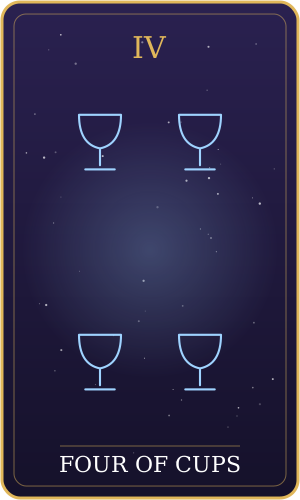
Understanding the Four of Cups
Four is the number of stability in tarot, a square, a table with four legs. In the suit of Cups, stability can feel two ways. It can be comforting, or it can be stagnant. The Four of Cups lives in the second of those moods, where nothing is wrong and yet nothing quite stirs.
In the traditional Rider-Waite-Smith picture, a young man sits on the ground under a tree with his legs crossed and his arms folded. In front of him, three cups stand in a row on the grass. From a cloud at the side, a hand reaches out to offer a fourth cup, but his gaze is fixed on the ground and he does not appear to see it.
Our site uses its own artwork instead of the classic illustration, but the symbols below are the ones tradition attaches to the card. Notice the closed posture. Folded arms and a downturned face are the body language of someone who has withdrawn to think, or to avoid thinking.
The scene does not say whether this is a healthy rest or a rut. That ambiguity is the card's honest message. Withdrawal can be wise, and it can be a way of missing what is right beside you. Only the person sitting there can tell which it is.
Details in the scene
The three cups in front of him represent what is already in hand. Readers often interpret them as past gifts, existing relationships or experiences that have lost their shine. They are not bad things. They are things he has stopped looking at with fresh eyes.
The hand offering a fourth cup from the cloud is the unexpected opportunity. It might be an invitation, a new idea, an apology, or simply a chance to feel something again. The key point is that it arrives quietly, and nobody forces it on him.
The tree behind him is steady and rooted, suggesting patience and a place where it is allowed to sit still. Many readers see the tree as permission: there is no need to jump up at once. Reflection has its place.
The empty landscape around the figure is also worth noticing. There is no crowd, no clock, no pressure. The card places the question of attention in a quiet field, where the only thing standing between him and the next step is his own focus.
Four of Cups upright
Upright, the Four of Cups describes apathy, boredom or a pause for contemplation. A person may be dissatisfied without knowing why, or may be tired of options that all look the same. The mood is neither dramatic nor despairing. It is gray and quiet.
A central theme is the missed offer. When we are absorbed in our own mood, we can overlook kindness or opportunity in plain sight. The card does not scold; it simply points out that the hand is there and asks whether anyone is looking.
The other face of the card is deliberate reflection. A sabbatical, a quiet month, a decision to say no to new commitments so you can think: these are healthy forms of the Four. What matters is whether the withdrawal serves you or only postpones a feeling.
A useful reflection prompt is to ask what you are really waiting for, and whether the things you already have deserve a second look. Gratitude is not a cure, but it sometimes restores the sense of color.
Four of Cups reversed
Reversed, the card is generally read as an awakening. The head lifts, the cup in the cloud finally comes into view, and interest returns. After a stretch of numbness, even a small flicker of curiosity can feel like a big change.
It can also mean re-engagement: answering the message you left on read, going back to a hobby you dropped, joining a plan you almost declined. The shift is gradual, and the reversed Four tends to describe the first steps rather than a finished return.
Another reading is restlessness. Boredom turns into a need to do something, anything, and the risk is grabbing the first offer simply to escape the quiet. The card suggests pausing long enough to tell the difference between real interest and relief from stillness.
If flatness lingers and begins to color everything, a card is no substitute for support from people you trust or a qualified professional. Low mood is common, and talking to someone about it is a sensible step rather than a failure.
Four of Cups in love and relationships
In love readings, the Four of Cups often describes emotional distance or dissatisfaction. Someone in a long relationship may feel that the spark has dimmed, or someone dating may feel unmoved by perfectly nice people. The card names the feeling without blaming anyone.
It may also suggest that a gesture of care is being overlooked. A partner's small effort, a friend's invitation or a thoughtful message might be sitting unnoticed. The card can prompt a reader to look again with fresh attention before deciding that nothing is on offer.
As feelings, the Four of Cups can describe someone who is withdrawn, uncertain or tired of the dating routine. They may not be uninterested in you personally. They may simply be absorbed in their own thoughts. Asking gently and giving space is usually better than guessing.
Reversed in love, the card suggests reopening. A person who has been closed off may begin to show warmth, or a couple may rediscover curiosity about each other. It does not predict any reunion or commitment. It marks a small, real turn of attention.
Four of Cups in career and work
At work, the Four of Cups is the card of disengagement. It can describe a role that has become routine, a project that no longer excites you, or a quiet stretch where promotions and praise feel hollow. It is a theme worth listening to rather than ignoring.
The card also asks whether an opportunity has been overlooked. Perhaps a colleague proposed a collaboration, or a new task appeared that you dismissed in advance. Reconsidering it costs little and might reveal something unexpected.
In a positive light, it favors reflection time. A pause between projects, a deliberate review of what you want from your work, or a day to think without meetings can all be the Four at its best. Nothing here is a call to quit or stay.
Reversed, the card may describe renewed motivation and a willingness to try something fresh. As always, it offers themes for reflection and not career guidance. Real decisions about jobs and income belong with real information and trusted advisors.
Is the Four of Cups a yes or no card?
In the convention used by this site, the Four of Cups is a maybe. Most readers treat a card of pause and hesitation as undecided: the answer is not refused, but the person asking is not yet fully engaged. That is an editorial convention and not an old rule, and it is the one our yes-or-no tool uses.
If the Four of Cups appears reversed, our rule moves it one step toward no. The same rule applies to every card: yes turns into maybe, maybe turns into no, and no stays no. For this card, a reversed draw reads as a no, with the thought that the moment for this particular question has not arrived yet.
Reversed draws appear only if you tick "Include reversed cards" in the yes-or-no tool. Because the box starts unticked, the Four of Cups normally reads as a maybe.
Treat a maybe as an invitation to reflect, not as a verdict. The format is for fun, and any question about health, money, law or safety belongs with qualified professionals and real information.
Four of Cups and astrology
In the Golden Dawn tradition, the cards from two to ten each belong to a decan, a ten-degree third of a zodiac sign, along with a ruling planet. The Four of Cups is assigned to the Moon in Cancer. This is a correspondence from tradition, and other systems differ.
The Moon governs moods, habits and the need for security, and it is the traditional ruler of Cancer, a cardinal water sign. So here the Moon sits in its own sign, which many astrologers describe as the planet being at home. A mood-heavy, introspective card fits that picture of feeling turned inward.
To link the card with your own chart, look at your Moon sign and house. That placement points to what helps you feel safe, what drains you and how you recharge after a flat patch. People with the Moon or other planets in Cancer may recognize the Four as a familiar rhythm.
Our free birth chart calculator shows these placements. Take the link as a reflective thread, because tarot and astrology are tools for self-understanding and neither predicts how a mood will end.
Four of Cups as advice
As advice, the Four of Cups suggests asking what the stillness is for. Give it a name if you can: tired, bored, grieving something small, or simply in need of space. Naming a mood often makes it lighter.
It also suggests a modest experiment in looking up. Say yes to one small invitation this week, or take a different route home, or read the message you have been avoiding. A little new input can show whether the flatness is deep or shallow.
Try a short exercise: write down three things you already have that you once wanted badly, and one sentence about how each feels now. The point is not to force gratitude but to see them clearly again.
If the card comes up reversed, move with care. Let the returning interest grow before you make big commitments, and keep some of the quiet that helped you reset. You do not need to jump up the moment the cloud hand appears.
Four of Cups belongs to the decan of Moon in Cancer: in the Golden Dawn tradition each minor card from two to ten rules ten degrees of the zodiac. Find Moon in your chart or read about Cancer rising.
Frequently asked questions
Is the Four of Cups a bad card?
Not really. The Four of Cups is a quiet, ambiguous card about boredom, withdrawal and reflection. It can describe a rut, but it can also describe a healthy pause. Reversed, it often points to interest returning. Like every tarot card, it is a prompt for reflection and not a prediction of what will happen.
What does the Four of Cups mean in love?
In love, the Four of Cups usually points to emotional distance, boredom or a possibly overlooked gesture of care. It can describe someone who feels unmoved for now. It does not say a relationship will end or begin. Reversed, it suggests reopening and renewed curiosity. A direct, kind conversation tells you more than any card.
What does the Four of Cups reversed mean?
Reversed, the Four of Cups generally describes waking up from a flat stretch: curiosity returns, a missed offer comes into view, and you start to re-engage. It can also show restlessness and a rush to fill the quiet. Lingering low mood deserves support from a trusted person or a qualified professional.
Is the Four of Cups a yes or a no?
In our yes-or-no tool, the Four of Cups is a maybe, since it describes hesitation and pause. Many readers lean the same way, though this is an editorial convention and not a rule of tarot. Reversed, our tool turns the maybe into a no, but only if you tick "Include reversed cards", which is off by default.
What does the hand holding a cup mean in the Four of Cups?
The hand from the cloud stands for an unexpected offer: an invitation, a new idea or a chance to feel something fresh. The figure under the tree has not noticed it yet. Readers often use the detail to ask what opportunity might be sitting just outside current attention, and whether a second look is worth it.
Which planet and sign go with the Four of Cups?
In the Golden Dawn tradition, the Four of Cups matches the Moon in Cancer, the last decan of that water sign. The Moon rules moods and the need for security, so the pairing suits a card about inward feeling. It is one traditional scheme among several. Your own Moon sign, shown by our free calculator, adds a personal angle.
 Three of Cups
 Five of Cups
 The Star
 The Moon