How the Five of Cups reads
Five is the number of disruption in the minor suits, the point where the tidy balance of four gets shaken. In Cups, the suit of feeling, that shake takes the form of loss. Something that mattered has changed, ended or gone differently than hoped, and the card does not pretend otherwise.
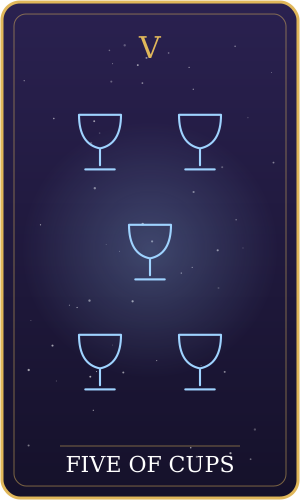
In the traditional Rider-Waite-Smith picture, a figure wrapped in a dark cloak stands with head bowed and back half-turned. In front, three cups lie on their sides with their contents spreading across the ground. Behind, two cups remain standing. Beyond them, a river flows, a bridge crosses it, and a distant building waits on the far bank.
Our site uses its own artwork instead of the classic illustration, but the symbols below are the ones tradition attaches to the card. The mood is quiet sorrow, not melodrama. The figure is not shouting or running. He is simply looking at what is gone.
That honesty is why the card is valued. Many readers appreciate a deck that admits disappointment is real, and that grief often has a shape: a long look at what spilled before the eyes move anywhere else.
What each piece of the picture suggests
The three fallen cups carry the weight of the scene. Readers often connect them with particular losses: a plan that fell through, a friendship that faded, a version of the future that did not arrive. The spilled liquid shows that the loss is not abstract but felt.
The two standing cups are the quiet counterweight. They are full, upright and out of the figure's line of sight. Many readers treat them as what remains: people, skills, memories or chances that survived. The card does not insist that the figure must look at them. It simply makes sure they are in the picture.
The dark cloak suggests mourning and privacy. When we grieve, we often wrap ourselves up and keep others at a distance. The cloak is not a flaw, only a protective layer, and the way the figure stands suggests this is a pause, not a permanent state.
The river and bridge are about passage. Water that flows, a path across, and a home on the other side gently imply that this feeling is not the end of the landscape. Whether the figure walks over soon or later is left open.
Five of Cups upright
Upright, the Five of Cups describes regret, grief and disappointment. It might refer to a recent setback, an old loss that resurfaced, or a fixation on how things could have gone differently. The core is attention stuck on what is missing.
The card does not tell the reader to cheer up. Instead, it acknowledges that sorrow deserves room. Many people find it comforting to see grief represented in a straightforward, respectful way instead of being hurried past.
Yet the second half of the picture matters too. The upright card quietly asks whether anything remains that has not been spilled, and whether some of the energy spent on what is lost could, in time, flow toward what is still standing. That is a question, not an instruction.
For hard stretches, remember that a card is not a substitute for support from people you trust or a qualified professional. Talking with someone who listens well is often more useful than any reading, and it is a sign of strength rather than weakness.
Five of Cups reversed
Reversed, the Five of Cups is generally read as a turn toward recovery. The figure lifts his head, turns around and finally sees the two cups behind. Acceptance does not erase the loss; it simply makes space for other things beside it.
Forgiveness is another reversed theme, whether of someone else or of yourself. Releasing a grudge or an old self-reproach is often gradual, and the card suggests that small softenings count. Nothing in it says the hurt was unimportant.
It can also describe a person who is moving through grief at their own pace and starting to take steps: seeing friends again, going back to a routine, trying a new place. These are tentative and uneven, and that is normal.
Another reading is a refusal to grieve at all, pushing feelings down and moving on too quickly. If that fits, the card may be asking for a bit of honest acknowledgment first. Both a lingering sorrow and a suppressed one are worth gentle attention.
Five of Cups in love and relationships
In love readings, the Five of Cups commonly points to disappointment: a breakup, a date that fell flat, a relationship that is not what it once was. It acknowledges heartache without assigning blame, and it avoids making predictions about what happens next.
It may also describe the habit of replaying old relationships, wondering about the what-ifs. The card invites a reader to notice how much time is spent looking at the spilled cups, and whether a little of that time could go toward what stands behind.
As feelings, the Five of Cups can describe someone who is sad, regretful or hurt, and perhaps withdrawn because of it. They may be mourning something that is not obvious from the outside. Gentle patience and an open door are usually more helpful than pressure, and a card cannot read anyone's mind.
Reversed in love, the card suggests healing and slow reopening. Someone may be ready to forgive, to talk, or to meet new people without comparing everyone to a past partner. It does not promise any reconciliation or new relationship.
Five of Cups in career and work
At work, the Five of Cups often describes a setback: a missed promotion, a project that was cancelled, feedback that stung. The card gives that disappointment its due and then wonders what remains standing, such as skills built, colleagues who value you, lessons learned.
It can also point to dwelling on past decisions, replaying a meeting or an email and wishing it had gone differently. A reader may use the card to notice rumination and to ask what small action would help more than another round of regret.
In a team, the Five can stand for a period of low morale after a loss, where the best thing leaders and colleagues can do is acknowledge it plainly and not rush people past it. Space to feel disappointed often leads to quicker recovery.
Reversed, it describes bouncing back, re-engaging and taking a lesson forward. The card offers themes for reflection only. Decisions about jobs, income or contracts deserve real information and trusted advisors, not tarot.
Is the Five of Cups a yes or no card?
In the convention used by this site, the Five of Cups is a no. Most readers who use tarot for quick questions treat a card about loss and disappointment as unfavorable for the thing being asked. This is an editorial convention and not an old rule, and it is the one our yes-or-no tool uses.
A no here is not a harsh word. It can be heard as the plain observation that the question is tied up with regret or sorrow, and that looking at what remains may serve you better than pressing ahead.
For reversed cards, the rule in our tool is that yes turns into maybe, maybe turns into no, and no stays no. So a reversed Five of Cups is still a no. The turn toward acceptance in the reversed meaning is worth reading in the text, even though the quick answer does not change.
Reversed draws only appear if you tick "Include reversed cards", which is off by default. Keep the whole exercise light: it is for fun and reflection, and not for decisions about health, money, law or safety.
Five of Cups and astrology
In the Golden Dawn tradition, each card from two to ten is tied to a decan, a ten-degree third of a zodiac sign, and the planet ruling that third. The Five of Cups is assigned to Mars in Scorpio. That is a correspondence from tradition, and other systems arrange the cards differently.
Mars is the planet of drive, anger and the will to act. Scorpio is a fixed water sign ruled by Mars in the traditional scheme, with Pluto as modern co-ruler, and it is linked with intensity, depth and the willingness to stay with difficult feeling. The pairing suits a card about strong emotion that does not fade quickly.
To connect the card with your chart, look at where Mars sits by sign and house, and at any planets in Scorpio. Mars shows how you respond to frustration and loss, while Scorpio placements show where feeling runs deepest. People with these placements may find the Five of Cups especially familiar.
Our free birth chart calculator will show them. Treat this as a thread for self-reflection, since tarot and astrology are interpretive tools and neither can say how a hard time will unfold.
Five of Cups as advice
As advice, the Five of Cups says to let the sadness be real. Give yourself a quiet evening, a letter you do not send, or a conversation with someone who will not try to fix you. Feeling a loss fully is often the first part of moving through it.
It also suggests, gently and without a deadline, that you glance over your shoulder at what is still standing. Write down two things that survived the disappointment, however modest, and see how they look on paper.
A small practice: set a ten-minute timer, think openly about what you miss, and when it ends, do one ordinary thing such as washing a cup or stepping outside. Giving grief a container can stop it from filling every hour.
If the card comes up reversed, the advice is to take the next step at your own pace. Reach out to one person, accept one kindness, or forgive one small thing. Recovery tends to arrive in tiny increments, and the Five accepts that.
Five of Cups belongs to the decan of Mars in Scorpio: in the Golden Dawn tradition each minor card from two to ten rules ten degrees of the zodiac. Find Mars in your chart or read about Scorpio rising.
Frequently asked questions
Is the Five of Cups a bad card?
It is a sad card, but not a harmful one. The Five of Cups speaks honestly about grief, regret and disappointment, and it reminds readers that something remains standing. Many people find it comforting to see sorrow acknowledged. Like every card, it is a prompt for reflection and not a forecast of events, and the card leaves room to rest.
What do the two upright cups mean in the Five of Cups?
The two standing cups usually represent what remains after a loss: relationships, skills, memories or chances that are still intact. The figure has not turned to see them yet. Readers often use the detail to ask what is still available, without implying that the sorrow in front of the person should be hurried.
What does the Five of Cups mean in love?
In love, the Five of Cups commonly points to disappointment, regret or mourning a past relationship. It acknowledges hurt without blame or prediction. Reversed, it suggests forgiveness and slow healing. If heartache feels heavy, a card is not a substitute for support from people you trust or a qualified professional.
What does the Five of Cups reversed mean?
Reversed, the Five of Cups usually describes turning toward acceptance and recovery: seeing what remains, forgiving, and taking small steps again. It can also suggest pushing grief aside too fast. Either way it is a mirror for a moment and not a verdict. Take recovery at your own pace, since healing rarely follows a schedule.
Is the Five of Cups a yes or no card?
In our yes-or-no tool, the Five of Cups is a no, an editorial convention based on its themes of loss and regret. Reversed draws only appear if you tick "Include reversed cards". The rule there is that yes becomes maybe, maybe becomes no, and no stays no, so this card stays a no. It is meant for fun and reflection.
Which planet and sign go with the Five of Cups?
The Golden Dawn tradition links the Five of Cups to Mars in Scorpio, the first decan of that fixed water sign. Mars brings drive and heat, and Scorpio brings depth and intensity. This is one traditional scheme among several. Your birth chart shows where Mars and Scorpio sit for you.
 Four of Cups
 Six of Cups
 The Star
 The Moon