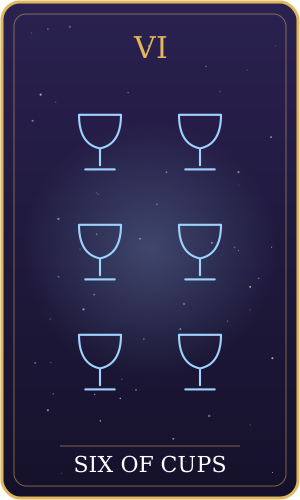
The scene on the Six of Cups
Six sits at the midpoint of the minor cards, and in many suits it signals a moment of ease after the turbulence of five. For Cups, that ease takes the form of memory and generosity: a pause where past and present quietly meet.
In the traditional Rider-Waite-Smith picture, two children stand in the courtyard of an old village. The larger child leans forward to offer the smaller one a cup filled with white flowers. Around them, five more cups, each brimming with similar flowers, are set out along the path and on a stone platform. In the background, an older figure walks past a gate.
Our site uses its own artwork instead of the classic illustration, but the symbols below are the ones tradition attaches to the card. What stands out is the scale. Everything here is small and domestic. No grand drama, no turning point. A gift, a garden, and a feeling of safety.
That ordinariness is the point. The card suggests that some of life's most meaningful moments are not events at all, but quiet exchanges that we only recognize as precious later on.
Details that add meaning
The flowers in the cups turn a vessel of feeling into something fresh and offered. Flowers are a gift that asks nothing back, and they also fade, which gives the scene a faint sweetness. Readers often take this as a reminder that the good moments are tender partly because they pass.
The two children suggest innocence and the way that younger versions of ourselves relate to the world: openly, generously, with fewer defenses. Some readers see them as a person and their childhood self, trading a gift across the years.
The village setting, with its stone walls and gate, evokes home and familiarity. It is a place where everyone knows the paths. The card therefore often pairs with ideas of belonging, hometown, family traditions and old friends.
The older figure in the background is a quiet detail. He walks on without interfering, a hint that this memory is observed from some distance in time. Nostalgia is always a view from further down the road.
Six of Cups upright
Upright, the Six of Cups speaks of nostalgia, kindness and reconnection with the past. It might show up when a person finds an old photo album, hears from a friend they have not seen in years, or visits the town where they grew up and finds it both smaller and warmer than remembered.
The card also carries a sharing quality. Offering something simple to someone, such as a homemade meal, a handwritten note or a long conversation, fits its spirit. The gift is small and sincere, with no scorekeeping.
For many readers, the Six is a reminder to consult the child-self for pleasure. What did you love to do before you worried about doing it well? Reviving a small version of that activity, like drawing, climbing a hill or baking from scratch, can be quietly restorative.
As a reflection prompt, the card asks what from the past is worth carrying forward and what can be left where it is. Memory is more useful when it is a resource and not a hiding place.
Six of Cups reversed
Reversed, the Six of Cups tends to describe a past that has too strong a grip. A person may keep comparing the present with a polished version of earlier years, so nothing in the here and now measures up. Nostalgia then becomes a way of not looking forward.
It can also describe unresolved history. An old conflict, a family pattern or a memory with sharp edges may be resurfacing, and the card asks the reader to see it as it was and not as a flattering picture.
A more positive reading is growing up. The reversed Six can mark the point where someone puts down an old role, such as the one who always had to be the responsible child, and begins forming a more adult relationship with their own past.
If old memories bring up pain that feels heavy or persistent, a card is not a substitute for support from people you trust or a qualified professional. Working through the past is easier with a good listener.
Six of Cups in love and relationships
In love, the Six of Cups has a tender, familiar tone. It can describe a relationship rooted in long friendship, someone who knew you before you were who you are now, or a couple whose bond is full of shared jokes and private history. The ease of old knowledge is its charm.
It sometimes points to the return of someone from the past, such as an old friend or former partner getting in touch. The card does not predict that anyone will return or that a reunion would be wise. It only describes the emotional flavor of old ties stirring again, and each reader decides what to do with it.
As feelings, the card can describe someone who feels sentimental, caring and protective. They may show affection through small remembered details or acts of comfort. Reversed, it may describe a person who is stuck comparing the present with the past, or who needs to resolve something old before they can fully commit to something new.
For single readers, the card often reads as a call to be gentle with the heart, perhaps by spending time with people who make you feel at home. Warm company is a good ground for any future connection.
Six of Cups in career and work
At work, the Six of Cups is about mentoring, tradition and the pleasure of passing on knowledge. It fits teachers, caregivers, family businesses and any role in which old hands show newer people the ropes. Generosity is its working style.
It can also suggest reconnecting with a former colleague, returning to a field you once enjoyed, or drawing on an early interest that was set aside. What did you want to be at ten years old, and is any small part of that still alive in what you do now?
In a team, the card encourages simple gestures of kindness, such as welcoming a new person, sharing a useful shortcut, or remembering what it felt like to be new yourself. These acts build a workplace people want to belong to.
Reversed, it can describe clinging to how things used to be done, or missing an earlier phase of a career. The card offers themes only, and real decisions about work and income call for real information and trusted advisors.
Is the Six of Cups a yes or no card?
In the convention used by this site, the Six of Cups is a yes. Most readers treat this gentle, generous card as favorable, since its themes of kindness and familiar comfort lean toward welcome. That is an editorial convention and not an ancient rule. It is the reading our yes-or-no tool uses.
Reversed cards follow a single rule in our tool: yes becomes maybe, maybe becomes no, and no stays no. A reversed Six of Cups is accordingly a maybe, with the thought that the past may be getting in the way and the question deserves a clearer look.
The reversed rule applies only when you tick "Include reversed cards" in the yes-or-no tool. The option starts off, so by default the Six of Cups is an upright yes.
Hear the yes as a friendly nudge and not a promise of how things turn out. The format is for fun and reflection, and anything involving health, money, law or safety should go to qualified people.
Six of Cups and astrology
In the Golden Dawn tradition, cards from two to ten each belong to a decan, a ten-degree third of a zodiac sign with its own ruling planet. The Six of Cups is assigned to the Sun in Scorpio. This is a correspondence from tradition, and other systems vary.
The Sun represents identity and vitality, and Scorpio is a fixed water sign ruled by Mars in the traditional scheme, with Pluto as modern co-ruler. Scorpio is linked with depth, memory and loyalty. A Sun-in-Scorpio card suggests identity shaped by what we have lived through, and the warmth that comes from holding on to what matters.
To connect the card with your chart, look at your Sun sign and house, and at any Scorpio placements. Those can hint at which memories and loyalties feel central to who you are. People with the Sun or Moon in Scorpio may find the Six particularly resonant.
Our free birth chart calculator shows the placements. Treat the link as a prompt for self-reflection, because tarot and astrology are interpretive tools and neither claims to know what lies ahead.
Six of Cups as advice
As advice, the Six of Cups suggests honoring what was good. Write the message to the old friend, play the album that was your soundtrack at sixteen, cook the meal your grandparent made. Small acts of remembering can steady a busy week.
It also suggests giving without ceremony. A cup of flowers needs no occasion. Offer a compliment, a spare hour or a favorite book to someone who might enjoy it, and let it be unremarkable.
A short exercise: write down one happy memory in detail, including where you were, who was there and what the air felt like. Then ask what quality in that memory, such as ease, play or belonging, you could invite into this month.
If the card comes up reversed, the advice is to look at the past with clear eyes and then turn toward the present. Nostalgia is a lovely visitor but a poor landlord. Keep what warms you, and leave the rest where it is.
Six of Cups belongs to the decan of Sun in Scorpio: in the Golden Dawn tradition each minor card from two to ten rules ten degrees of the zodiac. Find Sun in your chart or read about Scorpio rising.
Frequently asked questions
Is the Six of Cups a good card?
Most readers consider the Six of Cups gentle and positive. It stands for kindness, memory and the comfort of familiar people and places. Reversed, it points to being stuck in the past rather than anything harmful. As with all tarot cards, it is a prompt for reflection and not a forecast of what will happen.
Does the Six of Cups mean an ex is coming back?
Not as a prediction. The Six of Cups is about the emotional flavor of the past stirring: memories, old friends, former ties. If someone from earlier years is on your mind, the card may reflect that. It cannot say whether anyone will return, or whether a reunion would be good for you.
What does the Six of Cups mean in love?
In love, the Six of Cups describes tenderness, shared history and the ease of knowing someone well. It can point to a friendship deepening or a couple's shared memories. It makes no promises about outcomes. Reversed, it may show comparing the present with an idealized past or unresolved old feelings.
What does the Six of Cups reversed mean?
Reversed, the Six of Cups usually describes being held back by the past: over-polished nostalgia, unresolved history, or an old role that no longer fits. It can also mark a step into adulthood. If memories bring up lasting pain, support from trusted people or a qualified professional is more useful than a card.
How does the yes or no tool treat the Six of Cups?
In our yes-or-no tool the upright Six of Cups is a yes. If "Include reversed cards" is ticked and it lands reversed, the answer slides one step: yes becomes maybe. A maybe would then become a no, and a no stays no. The option is off by default, and the whole scheme is our own convention for fun and reflection.
Which planet and sign go with the Six of Cups?
In the Golden Dawn tradition, the Six of Cups corresponds to the Sun in Scorpio, a decan of that fixed water sign. The Sun stands for identity and warmth, and Scorpio for depth and loyalty. It is one traditional scheme among several. Your own chart shows where your Sun sits.
 Five of Cups
 Seven of Cups
 The Star
 The Moon