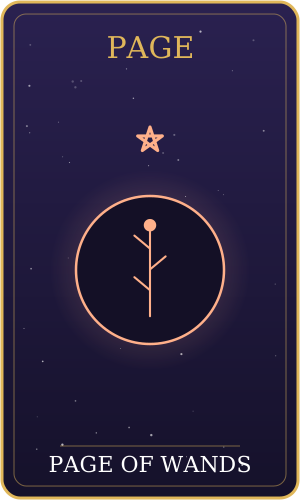
What the Page of Wands means
Every suit in the tarot has four court cards, and the Page is the youngest. In the Wands, which belong to fire, the Page is the stage where interest has just been lit. There is no plan yet and no track record, only a pleasure in the possibilities.
In the traditional Rider-Waite-Smith picture, a young figure in a tunic patterned with small salamander shapes stands on sandy ground with a few pyramids on the horizon. A feathered cap tops the head, and both hands hold a tall staff that the figure gazes at with real attention.
Our site uses its own artwork rather than the classic illustration, but tradition reads the scene the same way. Court cards in this guide are treated as personality styles or stages of an element, not as specific people you are about to meet. The Page of Wands is the curious, eager, slightly untested stage of fire.
Read this way, the card can describe a part of yourself as readily as a situation: the part that wants to try the new class, send the message or open the strange-looking book.
Symbols: salamanders, sand and a staff
The salamanders on the tunic are an old emblem of fire. In folklore, the creature was said to live in flames without being burned. Here it suggests ease with enthusiasm, a person who is not frightened by their own heat.
The sandy ground and far-off pyramids give the card its sense of open space. Nothing has been built here yet, but the horizon holds some very old structures. Readers sometimes take this as a reminder that new interests rest on a long human tradition of curiosity.
The staff is held upright and studied. It is neither a weapon nor a walking aid but an object of wonder. Many see that as the heart of the card: a person examining a new tool before deciding what to do with it.
The feather in the cap adds lightness and a touch of showmanship. The Page does not yet have the wisdom of the King or the polish of the Queen, and that freshness is part of the charm.
The Page of Wands upright
Upright, the Page of Wands speaks of curiosity and a fresh start. It often appears when a new idea arrives, a new hobby catches hold or a message shows up that raises your interest. The mood is playful and quick.
Common themes include exploration, creative sparks and the courage to be a beginner. The card has no interest in perfection. It wants to experiment, ask naive questions and find out what happens.
Readers also link it to news, particularly of an inspiring sort, though the card does not say what the news will be. It more often marks the feeling of being around something that has not been figured out yet and is therefore exciting.
A good reflective prompt is to ask what you would try this month if nobody expected you to be good at it. The upright Page tends to reward small, low-stakes experiments.
The Page of Wands reversed
Reversed, the spark flickers. The Page of Wands can show a person who starts many things and finishes few, or an idea that was thrilling on Monday and dull by Friday. Nothing is wrong with the enthusiasm itself; the trouble is that it has no container.
It can also suggest immaturity in the plain sense of acting without thinking, speaking before considering how it will land, or leaving others to deal with the consequences of a quick decision.
Another reading is the opposite: a spark that is suppressed. A reversed Page may describe someone who wants to try something but feels foolish, or who has been told to stay serious for so long that playfulness feels risky.
The response depends on the picture. For scattered interests, choose one and give it a fixed period. For a suppressed spark, give it ten minutes a day. Either way, the reversed card is a gentle mirror, not a criticism.
The Page of Wands in love and relationships
In love readings, the Page of Wands usually reads as flirtation and fun. It can describe the first stage of attraction, when conversation is lively, texts are playful and nobody is sure what this is yet. The mood is light and exploratory.
In an established relationship, the card can encourage novelty: a new restaurant, an unplanned weekend, a shared hobby that neither partner has tried. It reminds couples that curiosity about each other does not have to expire.
As feelings, the Page can describe someone who is excited, a bit impulsive and eager to show it. They may send an enthusiastic message, make a spontaneous plan or tease with a grin. A card cannot read another person's mind, so treat this as a thoughtful guess and a reason to ask.
Reversed in love, it may point to mixed interest, flakiness or a flirtation that fades once the novelty wears off. If that sounds familiar, honest conversation about what each person wants is more useful than guessing. The card does not predict how any relationship will unfold.
The Page of Wands in career and work
At work, the Page of Wands is the new-idea card. It suits brainstorming sessions, trial projects, internships, side ventures and the early phase of learning a skill. Readers use it for the feeling of being a beginner with energy.
It also describes a person on a team who asks the question nobody else thought to ask. Their enthusiasm can be contagious, and it often pushes a stale process to look fresh.
For reflection, the card asks what you are curious about at work that you have not yet mentioned to anyone. A small proposal, a quick prototype or a conversation with someone in a different department may be enough to test the interest.
Reversed, it can reflect distraction, procrastination or too many half-built projects. This is only a theme to consider; the card offers no advice about any specific job or financial choice, which are best weighed with real information and trusted advisers.
Is the Page of Wands a yes or no card?
In the convention used by this site, the Page of Wands is a yes. Most readers who use tarot for quick yes-or-no questions treat it as a positive card, since its energy is curious, eager and open to trying. This is an editorial convention, not an ancient rule, and different readers assign it differently. It is the one our yes-or-no tool uses.
If the Page lands reversed, the tool turns the yes into a maybe, since the interest is there but scattered or untested. Reversed cards only show up when you tick "Include reversed cards", and the box starts unticked.
A yes from the Page is best read as a green light to experiment, not a promise of results. It says the question has room for curiosity.
For anything touching health, money, law or safety, a deck is not the right tool, and qualified advice is.
The Page of Wands and astrology
In the Golden Dawn tradition, the court cards are tied to the elements, and the Wands suit belongs to Fire. The Page of Wands therefore corresponds to the element of Fire in its most youthful, earth-touching form.
Fire in astrology covers Aries, Leo and Sagittarius. Those signs share a taste for action, warmth and self-expression, though each shows it differently: Aries starts things, Leo shines, Sagittarius explores. The Page gathers that shared enthusiasm without any of the weight that comes later.
To connect the card with your chart, look at where your fire signs sit. If your Sun, Moon or Ascendant is in Aries, Leo or Sagittarius, or if several planets fall in those signs, the Page may feel like an old acquaintance. A chart with little fire may find it a useful reminder to add some spark.
Our free birth chart calculator shows the placements. Treat any correspondence as a thread worth pulling out of curiosity, not a prediction.
The Page of Wands as advice
As advice, the Page of Wands says to try the thing. Choose something small enough to start today: sign up for the class, draft the opening paragraph, ask the question.
It also suggests staying a beginner on purpose. Treat the first attempts as research. If they are awkward, that is information, not failure.
A tidy exercise is to write down three things that made you curious this week, however random, and pick one to follow for seven days. Notice whether the interest grows or fades.
Reversed, the advice is to pick one spark and shield it from the others for a while. Fire needs air, but it also needs a hearth, and the Page grows into the Knight and Queen by learning where to point the flame.
Page of Wands corresponds to the element of fire. See your element balance.
Frequently asked questions
What does the Page of Wands mean?
The Page of Wands represents the curious, eager beginner stage of fire: a fresh idea, a new interest or an inspiring message. Upright, it encourages experimenting without worrying about being good at it. Reversed, it points to scattered interest or false starts. Like every tarot card, it works as a prompt for reflection and not as a forecast.
Is the Page of Wands a person?
Not necessarily. On this site, court cards describe personality styles or stages of an element, and the Page of Wands can mirror a part of yourself, a situation or a style of someone you know. A card cannot identify a specific person, so it is safer to ask what the playful, curious energy is pointing to in your own life.
What does the Page of Wands mean in love?
In love, the Page of Wands usually suggests flirtation, excitement and a light, exploratory mood. In a long relationship it encourages trying something new together. Reversed, it may point to flaky interest or a spark that fades. The card is a mood and not a prediction about whether any relationship will begin or last.
What does the Page of Wands mean as feelings?
As feelings, the Page can describe someone who is excited, a little impulsive and keen to show it, perhaps with playful messages or spontaneous plans. A card cannot read another person's mind, so treat this as a thoughtful guess and a reason to ask them directly how they feel. Persistent low motivation is worth mentioning to someone you trust.
What does the Page of Wands reversed mean?
Reversed, the Page of Wands often describes enthusiasm that scatters: many starts, few finishes, or interest that cools quickly. It can also mean a suppressed spark. The gentle suggestion is to pick one idea and give it a set period, or to give playfulness a small daily space. It is a mirror, not a criticism.
Is the Page of Wands a yes or no card?
On this site it is a yes, as an editorial convention based on its curious, open energy. Other readers may differ. If you tick "Include reversed cards" in our yes-or-no tool and the card comes up reversed, the yes becomes a maybe. The box is unticked by default, so reversed cards do not appear unless you choose.
 Ten of Wands
 Knight of Wands
 The Star
 The Moon