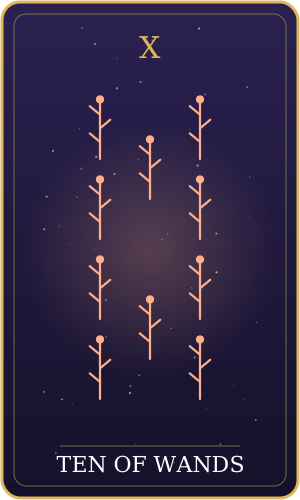
What the Ten of Wands means
Anyone who has said yes to one task too many will recognize this card at once. The Ten of Wands is not about failure; it is about the quiet accumulation of responsibilities until the load blocks the view.
In the traditional Rider-Waite-Smith picture, a figure walks along a dirt path with a thick bundle of ten staves hugged against the chest. The back is bowed and the face is hidden behind the wood. Ahead lie a few houses and a tree or two, and the path leads straight toward them.
Our site uses its own artwork instead of the classic image, but the ideas tradition attaches to the scene are unchanged. The suit of Wands is about energy and initiative. In the tenth card, that energy has piled up as duties, and the person carrying them is still moving.
As the last number in its suit, the Ten also marks a stage of completion that does not feel triumphant. What began as a spark in the Ace has become a full weight, and the card asks who decided to carry it all.
The bundle, the bend and the village
The bundle is the center of the picture. Ten staves is the largest number the suit offers, and they are held together awkwardly, with no cart or strap. Readers take this as a sign that the load grew a piece at a time, each addition seeming reasonable alone.
The bowed posture speaks of effort. It also explains something subtle: because the staves block the face, the walker cannot see where the path bends. Taking on too much narrows vision, and that is a theme the card returns to often.
The village in the distance gives the scene its hope. The destination is close. The card is not a picture of an endless trudge but of a final stretch, which is why many readers add that the strain, though real, may not last.
There is no companion in the picture, and nothing in the scene shows anyone refusing help. That absence leaves the question open for the viewer: could someone else carry a few of those staves?
The Ten of Wands upright
Upright, the card describes burden. A person might be juggling work, family tasks, a move or a long list of promises, and feeling every one of them at once. The tone is effortful and, often, a little lonely.
Common themes are responsibility, duty and overextension. Some readers also see it as the cost of success: a project went well, so more was added to the pile. Others read it as a sense of obligation that was never really chosen.
The practical suggestion is to look at the load as separate pieces. Which ones belong to you, which could be shared and which could simply be put down? Even setting down one stave changes how the bundle feels.
The upright Ten also carries a flicker of encouragement. The destination is visible, and finishing a heavy task has its own satisfaction. The point is not to quit but to carry what is truly yours.
The Ten of Wands reversed
Reversed, the Ten of Wands often describes release. The bundle is set down, handed over or dropped. Readers use this to speak of delegating, saying no, or finally admitting that a plan cannot be done single-handedly.
It can also show the moment before that release, when the weight is so great that things start to slip. A reversed Ten may mirror a person near the edge of what they can manage, and the useful response is to act early and ask for help.
Another reading is the habit of carrying burdens that belong to someone else. When the card is reversed, it can invite a reader to ask whether certain responsibilities were taken on to avoid conflict or to be seen as reliable.
If the load involves heavy stress or anxiety, a card cannot replace support from people you trust or a professional. The reversed Ten is best seen as permission to ask for a hand.
The Ten of Wands in love and relationships
In love readings, the Ten of Wands tends to be about imbalance. One partner may be handling most of the planning, the chores or the emotional upkeep, and feeling tired of it. The card gives that feeling a name without assigning blame.
For couples, it can describe a season of shared strain, such as heavy schedules or family obligations, in which affection gets less room. A simple remedy suggested by the picture is to share the staves: divide the list and check in about it.
As feelings, the Ten can describe someone who cares but is stretched thin. They may seem distracted, short on time or quiet because every spare ounce goes to duty. A card cannot read another person's mind, so treat this as a reason for a gentle conversation.
For single readers, the card can be about the pressure of caring for others while neglecting your own wishes. Reversed, it points toward relief: sharing the load, setting a limit, or reopening space for connection. It does not predict whether any relationship will start or end.
The Ten of Wands in career and work
At work, the Ten of Wands is the overloaded desk. It may describe taking on projects beyond one's role, covering for a colleague or accepting every request because refusing felt uncomfortable.
It also describes the late stages of a big effort, when the end is in sight but the work seems to multiply. Readers use the card as a nudge to rank tasks and to be honest about capacity.
A reflective exercise is to write every commitment on a separate slip and sort them into three piles: keep, share and drop. The act of sorting often shrinks the bundle before any real change happens.
Reversed, the card can show delegation, a restructured workload or the choice to step back from an unsustainable pace. It gives no advice about particular jobs or finances, and decisions about work are best made with real information and trusted people.
Is the Ten of Wands a yes or no card?
In the convention used by this site, the Ten of Wands is a no. Most readers who use tarot for quick yes-or-no questions treat it as a poor fit for fresh plans, since the picture is of someone who already has too much. This is an editorial convention, not an ancient rule, and other readers assign it differently. It is the one our yes-or-no tool uses.
A reversed card in our tool moves yes to maybe and maybe to no, while a no stays a no. So a reversed Ten of Wands is still a no. Reversed cards only appear if you tick "Include reversed cards", and that box starts unticked.
Hearing a no from this card does not close any door. It is better heard as a prompt: is there room for this right now, or would it be one more stave on the pile? That question is the useful part.
Questions about health, money, law or safety belong with qualified people, not with a deck.
The Ten of Wands and astrology
In Golden Dawn tradition, every numbered minor card from two to ten is tied to a decan, a ten-degree third of a sign with a ruling planet. The Ten of Wands is the final decan of Sagittarius, paired with Saturn.
Saturn is the planet of structure, limits, duty and time. It rewards patience and asks for responsibility, and it is often credited with the weight of obligation. Sagittarius is a mutable fire sign ruled by Jupiter, tied to freedom, belief and wide horizons. The combination reads as an expansive spirit boxed in by obligations, which is a fair description of the picture.
To bring the card into your chart, find the sign and house of Saturn, and look for anything in Sagittarius. Saturn's house often hints at where you take duty most seriously, and where you may be tempted to carry too much.
Our free birth chart calculator shows both. As elsewhere, treat this as a lens for self-reflection and not a prediction.
The Ten of Wands as advice
As advice, the Ten of Wands says to count what you are carrying. Write it out. A load that is named is easier to divide than a load that is only felt.
Next, choose one item to hand over, postpone or drop this week. It does not need to be dramatic. A smaller bundle still moves you toward the village.
Also ask whether the burden was chosen. Some duties are real and worth keeping; others were absorbed out of habit. Telling the difference is the card's quiet work.
If it arrives reversed, treat it as permission. You may set the staves down, ask someone to take two, or admit that the plan needs a different shape. Needing help is part of how big things actually get finished.
Ten of Wands belongs to the decan of Saturn in Sagittarius: in the Golden Dawn tradition each minor card from two to ten rules ten degrees of the zodiac. Find Saturn in your chart or read about Sagittarius rising.
Frequently asked questions
Is the Ten of Wands a bad card?
It is a heavy card, but not a doom card. The Ten of Wands shows overload and responsibility, often with the destination nearby. Many readers treat it as a nudge to share or trim a load. Reversed, it points toward release. Like every tarot card, it is a prompt for reflection, not a forecast of what will happen.
What does the Ten of Wands mean in a relationship?
In a relationship, the Ten of Wands usually points to imbalance or strain: one partner carrying most of the planning or upkeep, or both stretched by obligations. It suggests dividing the list and checking in. Reversed, it describes relief through sharing the load or setting a limit. It does not predict any outcome for a relationship.
What does the Ten of Wands mean as feelings?
As feelings, the Ten of Wands can describe someone who cares but is stretched thin by duties. They may seem distracted or short on time. A card cannot read a particular person's mind, so use this as a thoughtful guess and a reason for a kind, direct conversation about what they are carrying.
What does the Ten of Wands reversed mean?
Reversed, the Ten of Wands usually means releasing a burden: delegating, saying no or finally putting something down. It can also mirror a person close to their limit. The suggestion is to ask for help early. If the strain involves ongoing stress or anxiety, support from trusted people or a professional matters more than any card.
Is the Ten of Wands a yes or no card?
On this site it is a no, because the card shows someone already carrying too much. That is our editorial convention, and other readers may differ. Our yes-or-no tool moves reversed cards one step toward no, and a no stays a no. Reversed cards appear only when you tick "Include reversed cards", which is off by default.
Which zodiac sign goes with the Ten of Wands?
In the Golden Dawn tradition, the Ten of Wands corresponds to Saturn in Sagittarius, the last decan of that sign. Saturn stands for duty and limits, and Sagittarius is a mutable fire sign ruled by Jupiter. It is a traditional assignment, not the only one. Checking Saturn in your own chart is the natural next step.
 Nine of Wands
 Page of Wands
 The Star
 The Moon